
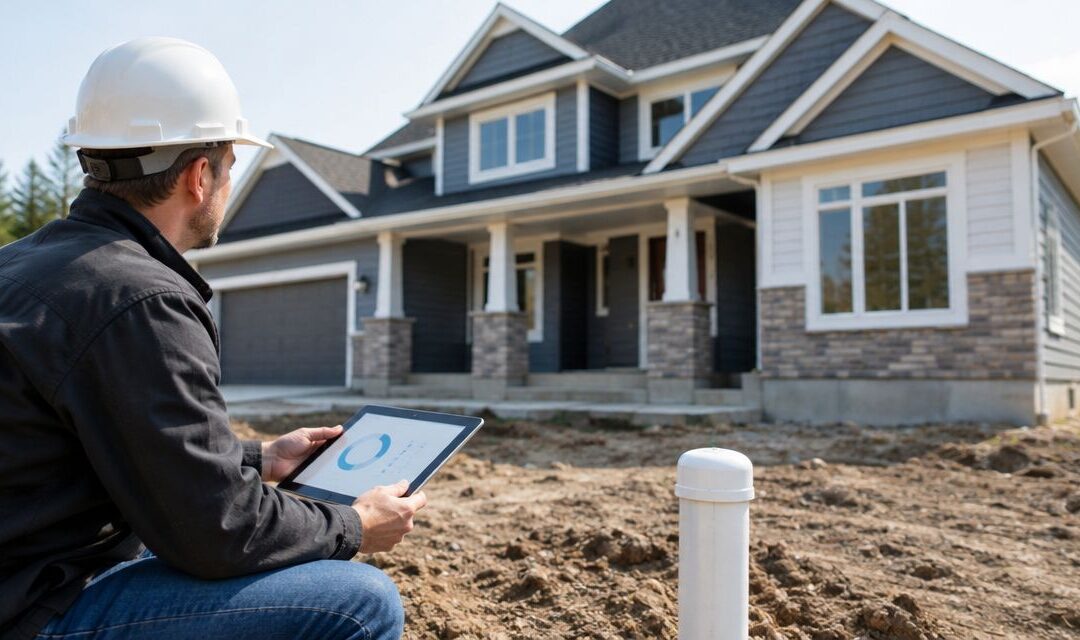
New construction in Michigan does not automatically mean radon mitigation is included. For a 2026 purchase, confirm whether your builder provides a passive system, an active fan-powered system, or no radon system; even an installed system needs testing to show how well it controls indoor radon.
- Do new Michigan homes include radon mitigation? Verify the builder’s written specifications; new construction alone does not confirm protection.
- EPA guidance calls for testing new homes, including homes built with radon-resistant features.
- A passive radon system has no powered fan; testing determines whether it needs activation.
- Michigan Radon Control provides NRPP-certified radon testing and mitigation services for Metro Detroit and Lansing homeowners.
Do new construction homes in Michigan include radon mitigation?
Check the construction specifications, not just the home's age. A builder's reference to radon-resistant construction does not tell you whether a powered fan is installed or whether anyone has measured the finished home's radon level. Ask for both the system description and the test report.
The distinction matters when reviewing radon mitigation systems for new construction homes: preparation for a future fan is different from a complete operating system.
| What the builder includes | What it does | Main benefit | Limitation | Best for |
|---|---|---|---|---|
| No documented radon system | Provides no documented dedicated radon-control pathway | You can plan a system around the finished home's needs | Installation requires work in an existing structure | Buyers arranging testing and a follow-up plan |
| Passive radon system | Uses a vent pathway without a powered fan | Incorporates radon-resistant features during construction | Natural airflow does not establish an acceptable indoor reading | New builds with testing and an activation plan |
| Active radon system | Uses a dedicated fan to draw soil gas into a vent pathway | Provides powered soil-gas removal | Requires electricity, maintenance, and verification testing | Homes where testing supports active mitigation |
These are construction conditions, not safety ratings. A test result—not a pipe, fan, or sales description—shows the indoor radon concentration during the measurement period.
Why this matters
It is completely natural to worry about another issue when you are already managing inspections, financing, and a move. You do not need to identify every pipe yourself. You need clear documentation and a properly conducted test.
Radon comes from the natural breakdown of uranium in soil and rock. It can enter through foundation openings, including joints and gaps around penetrations. A new foundation does not remove that source, and a neighboring home's result does not establish yours.
For your 2026 purchase, separate three questions: what was promised, what was installed, and what the indoor test measured. A construction specification answers the first question. Installation records address the second. Neither replaces the third.
What does a passive radon system include?
A passive radon system typically combines a gas-permeable layer beneath the slab, a soil-gas barrier, sealing at relevant openings, and a vent pipe routed outdoors above the roof. It relies on natural air movement rather than a dedicated powered fan.
The EPA's radon-resistant new construction guidance also describes preparing for future fan installation. That preparation matters because a passive system can need activation if testing shows elevated indoor radon.
Ask your builder to identify these features in the plans and explain what was actually installed. A visible pipe alone does not establish that the under-slab collection pathway, barrier, sealing, and vent routing form a complete system.
Best for: a new build where radon-resistant features are documented and the owner has a testing plan. The benefit is advance preparation; the limitation is that passive airflow does not guarantee a particular radon result.
Do not confuse an electrical outlet near a vent pipe with an installed fan. An outlet can be preparation for activation rather than evidence that activation has happened.
What does an active radon system include?
An active soil-depressurization system adds a dedicated radon fan to draw soil gas from beneath the foundation and discharge it outdoors. The collection design depends on the foundation, including whether the house has a basement, slab, crawl space, or a combination.
An operating fan is only part of the evidence you need. Ask for installation documentation, operating instructions, and a radon test performed with the system running normally.
Best for: a home where testing supports active mitigation. Powered extraction provides controlled airflow, but the system needs ongoing operation and maintenance. Its presence does not eliminate the need for future testing.
A pressure gauge indicates a pressure difference in the system; it does not measure radon in the living space. A normal-looking gauge is useful operating information, not a substitute for a radon report.
What if the builder did not install a radon system?
Test the home rather than assuming it needs mitigation—or assuming it does not. Missing radon-resistant features do not tell you the indoor concentration. They tell you that a dedicated system is not documented.
If construction is still underway, ask whether the design can include a soil-gas collection pathway and an appropriate vent route before those areas become inaccessible. Coordinate that discussion with the builder and a qualified radon professional.
If the house is complete, a mitigation contractor can assess an installation approach if testing shows it is needed. Do not let the absence of a construction-stage system turn into a reason to skip testing.
For a 2026 closing, put any agreed testing, installation, or follow-up responsibilities into the purchase documents. Have your real estate professional address the contract language rather than relying on a verbal assurance.
Why radon provisions vary between new homes
The answer for your property depends on its documents and installed features. Review these factors with the builder instead of treating every new subdivision home as identical:
- Written scope: The construction agreement establishes what the builder has promised to include. Ask whether radon work is explicitly listed.
- System status: A passive vent, fan-ready preparation, and a running active system are different deliverables. Have the builder name the actual configuration.
- Foundation layout: Basements, slabs, crawl spaces, and combined foundations require different collection approaches. Ask how each foundation area is addressed.
- Construction stage: Access beneath a slab and inside unfinished walls changes as work progresses. Resolve routing questions before those areas are closed.
- Testing responsibility: The project documents should identify who arranges testing, receives the report, and handles any necessary follow-up.
For a code question, ask the local building department which requirements apply to the property's permit. Do not treat a builder's standard package as a statement of Michigan law, or a code inspection as an indoor radon test.
How do I verify what my builder included?
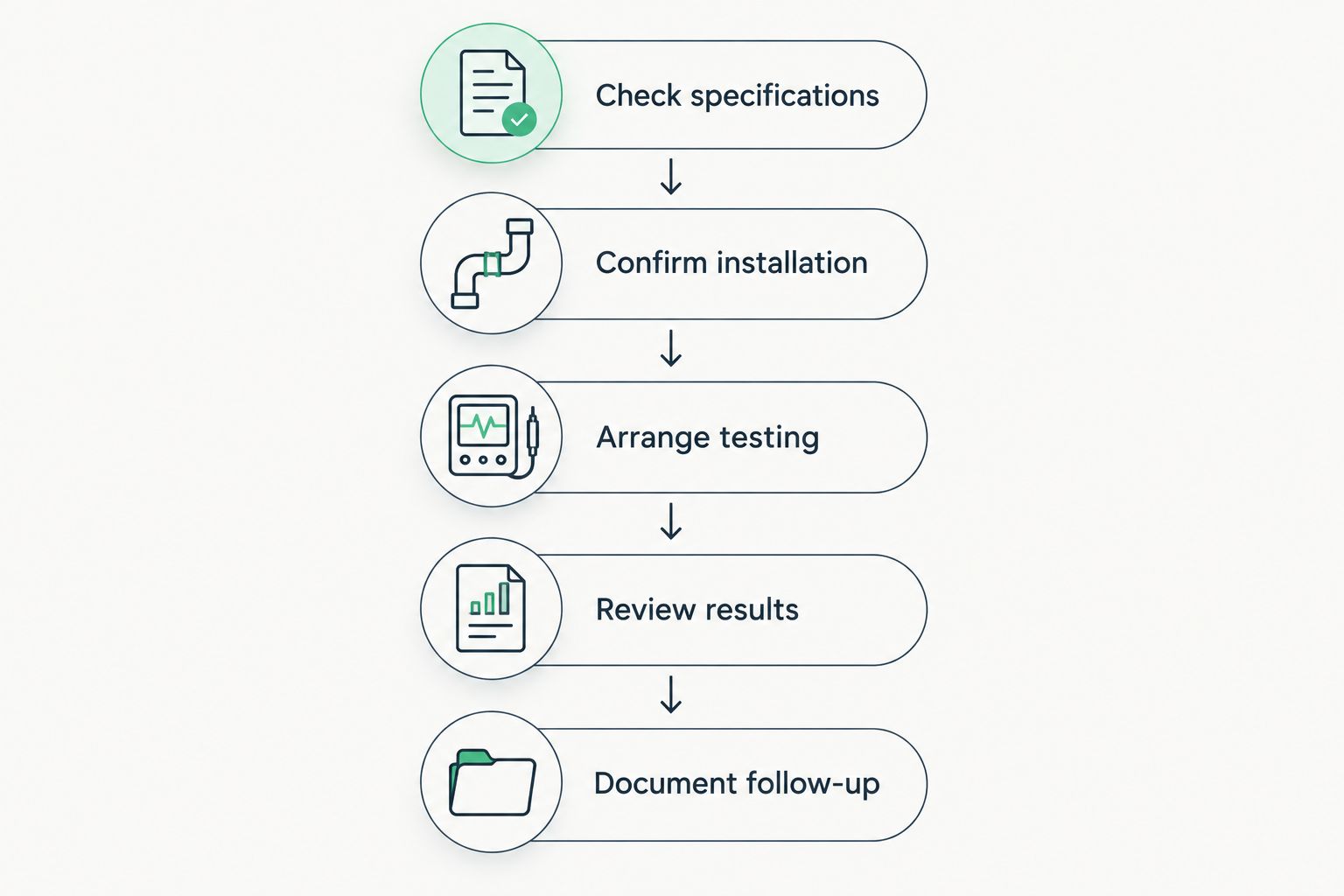
Use this sequence before your 2026 final walkthrough. It separates paperwork, physical installation, measurement, and corrective work so that an unanswered question does not disappear at closing.
- Check specifications. Find the radon language in the signed agreement, plans, and change orders. If the language only says radon-ready or radon-resistant, request a description of the included components.
- Confirm installation. Ask the builder to show the vent route, identify whether a fan exists, and provide installation records. Do not enter an unsafe attic or disturb equipment to investigate.
- Arrange testing. Agree on who will conduct the test and when the completed home will be ready for the required testing conditions. Use the device instructions and applicable testing protocol.
- Review results. Obtain the full report for your property, including the measurement location, dates, duration, and concentration. A verbal summary leaves out information you need.
- Document follow-up. Record any activation, installation, or corrective work and arrange verification testing. Keep those records with the home's maintenance documents.
Your guide to testing your home for radon explains the measurement step separately from the construction work.
What radon result means my new home needs attention?
The EPA recommends fixing homes at 4 pCi/L or higher. Its residential guidance also recommends considering a reduction between 2 pCi/L and 4 pCi/L. The action level is not a boundary between risk and no risk.
A single short-term reading is not the same as an annual average. Follow the EPA's testing and follow-up guidance, including the appropriate confirmation process, rather than making a decision from an unexplained number.
EPA guidance describes short-term tests as lasting 2 to 90 days, depending on the device, and long-term tests as lasting more than 90 days. A longer measurement better reflects a home's average exposure over time, while transaction deadlines require careful advance planning.
Ask the tester to explain the result and next step in plain language. If a passive system needs activation, the contractor should assess the existing system rather than assuming that adding any fan will solve the problem.
Does radon-resistant construction mean I can skip testing?
No. Radon-resistant construction does not establish an indoor radon concentration. The EPA recommends testing new homes even when they include radon-resistant features because testing determines whether those features are sufficient.
For a home completed in 2026, ask for a report that reflects the finished building and its documented system configuration. A test from another house, a neighboring lot, or a different system condition does not answer that question.
Who can help me check a new home's radon system?
Michigan Radon Control is best for Metro Detroit and Lansing homeowners seeking NRPP-certified radon testing and mitigation services. Michigan Radon Control also provides system maintenance, making the service relevant when a new home's installation needs follow-up after occupancy.
Professional testing gives you a documented measurement, but it does not replace a written agreement with your builder. Keep the builder's obligations, the contractor's work scope, and the test report separate and clear.
Michigan Radon Control's stated service area covers Metro Detroit and Lansing; homeowners elsewhere should confirm service coverage before arranging work. Certification and local service fit matter more than a general promise that a new house is protected.
Arrange your new home’s radon test
Request radon testing for a home in Metro Detroit or Lansing.
FAQ
Do new Michigan homes include radon mitigation automatically?
No—new construction alone does not confirm that radon mitigation is included. Check the builder’s written specifications, identify whether the system is passive or active, and obtain a radon test report for the completed home.
Is a passive radon system the same as an active system?
No. A passive radon system relies on natural airflow, while an active system uses a dedicated powered fan. Both need testing to establish the home’s indoor radon concentration.
Should I test a new house that already has a radon fan?
Yes. A running radon fan does not establish the indoor radon level. Obtain a test with the system operating normally and retain the report with the installation records.
What radon level calls for mitigation in a new home?
The EPA recommends fixing homes at 4 pCi/L or higher and considering reduction between 2 pCi/L and 4 pCi/L. Follow its testing and confirmation guidance when deciding the next step.
Does a certificate of occupancy prove my house has low radon?
No. A certificate of occupancy is not a radon measurement report. Ask separately for the radon system documentation and the results of a properly conducted indoor test.
Can a passive radon system be upgraded after I move in?
A properly designed passive system can be activated with a suitable fan when testing shows that additional control is needed. A qualified contractor should assess the existing installation and arrange verification testing after the work.
Can Michigan Radon Control test a newly built home?
Michigan Radon Control provides NRPP-certified radon testing for homeowners and realtors in Metro Detroit and Lansing. Confirm the property’s location and testing readiness when arranging the appointment.
One last thing
The most useful handover document is a complete test report, not a photograph of a radon pipe. Before accepting a summary that the home passed, ask what the measured concentration was, where the device sat, and whether the system was operating during the test.
Keep that report alongside the plans and operating instructions. When you change the basement layout or have system work performed, those records give your tester and contractor a clear starting point instead of a guess.
Related guides
- How to request radon-resistant features from a Michigan home builder
- Is a passive radon system enough for Michigan homes?
- How to schedule radon testing after mitigation installation