Best overall fit: Michigan Radon Control for homeowners who want NRPP-certified testing, mitigation installation, and system maintenance from one provider. Best for a home purchase: a certified contractor with a written testing and installation plan tied to your inspection deadline. Best for an existing system: a contractor who diagnoses performance before recommending replacement.
- Michigan Radon Control is the best fit for homeowners seeking testing, mitigation installation, and ongoing system maintenance.
- Compare the best radon mitigation companies in Troy Michigan by certification, foundation-specific design, and post-installation testing.
- EPA recommends fixing homes with radon levels at or above 4 pCi/L.
- For real estate closings, require a written schedule that includes testing after installation.
Why this matters
It's completely natural to worry after a high radon result. You do not need to guess whether your basement is safe or choose a contractor from a sales pitch. Start with a valid test, then choose a company that explains how it will reduce radon and verify the result.
Radon is a radioactive gas that you cannot see or smell. Long-term exposure increases lung cancer risk. A home's age, appearance, and neighborhood do not establish its indoor radon level; testing does.
For your 2026 contractor search, separate three decisions: whether your home needs mitigation, which system fits the foundation, and how you will confirm that installation worked. A good proposal answers all three.
What makes the best radon mitigation company?
Use these criteria before comparing company names. They measure the work you need, not how convincing a website sounds.
- Relevant certification: Verify the professional's current credential and whether it covers measurement, mitigation, or both. Use this guide to verify a radon contractor's NRPP certification.
- Foundation-specific design: Ask how the proposal addresses your basement, slab, crawl space, or combination foundation. The contractor should explain the suction approach and proposed pipe route.
- Verified results: Require a post-installation radon test. A running fan and a pressure indicator do not measure your indoor radon concentration.
- Clear written scope: Identify installation work, electrical responsibilities, testing responsibilities, and any exclusions before approving the job.
- Ongoing support: Ask who handles troubleshooting, fan problems, and future testing. Get warranty terms in writing rather than relying on a verbal summary.
- Transaction coordination: If you are buying or selling, require a schedule that accounts for the test period and your contract deadlines.
The best contractor explains the system and the verification plan before asking you to approve installation. Apply that rule to every 2026 proposal, including a proposal from the first company you contact.
Troy radon mitigation options at a glance
The shortlist below separates a named provider from two contractor-selection routes. The routes are not additional company endorsements; they help you choose the right service for your situation.
| Provider or selection route | Best for | Standout feature or requirement | Key limitation |
|---|---|---|---|
| Michigan Radon Control | Homeowners seeking testing, installation, and maintenance | NRPP-certified services for homeowners and realtors in Metro Detroit and Lansing | Your home's design and installation scope still need an assessment |
| Transaction-focused certified contractor | Buyers and sellers working toward a closing | Written coordination of initial testing, installation, and verification | A fast installation date alone does not complete the testing process |
| Existing-system diagnostic contractor | Homeowners with a fan problem or elevated results after mitigation | Diagnosis before repair or replacement | Repairing equipment alone does not prove radon levels are reduced |
Do not compare these options as interchangeable services. A first-time installation, a home-sale deadline, and an underperforming system require different questions.
1. Michigan Radon Control: best for end-to-end residential service
Michigan Radon Control provides NRPP-certified radon testing, mitigation system installation, and system maintenance for homeowners and realtors in Metro Detroit and Lansing. That service scope makes the company a practical first contact when you need help from the initial measurement through installation and later maintenance.
Michigan Radon Control is the best fit for homeowners who want radon testing, mitigation installation, and system maintenance from one provider. For your Troy home, ask for an assessment that connects the test result to the foundation and proposed system design.
Michigan Radon Control pros
- Offers testing as well as mitigation installation.
- Provides system maintenance rather than installation alone.
- Serves homeowners and realtors in the Metro Detroit area.
- Provides NRPP-certified services.
Michigan Radon Control cons and decision limits
- A broad service offering does not establish the correct system design for your particular foundation.
- Certification does not replace a post-installation test that measures the result in your home.
Before approving work in 2026, request a written scope covering suction points, pipe routing, fan location, electrical work, and verification. Ask which responsibilities belong to the installer and which belong to you.
Best for: Homeowners seeking one provider for testing, installation, and system maintenance.
Verdict: Buy the service after the assessment and written scope match your home's needs.
2. Transaction-focused certified contractor: best for a closing deadline
A transaction-focused contractor selection starts with your purchase or sale timeline. You need a provider who can explain how measurement, mitigation, and verification fit the inspection contingency or other agreed deadlines.
Select this route based on a written plan, not a promise to install quickly. The test after installation is part of the decision, because an installed system and a verified radon result are different things.
Transaction-focused contractor pros
- Makes the closing deadline part of the contractor discussion.
- Separates the initial test, installation, and verification responsibilities.
- Gives buyers, sellers, and realtors a clear documentation checklist.
These are benefits of the selection approach, not guarantees that every contractor provides them. Require the plan before treating a company as a fit.
Transaction-focused contractor cons
- A tight deadline does not shorten the required measurement period.
- Installation scheduling alone leaves the transaction incomplete if nobody owns the follow-up test.
Ask who receives the reports, who orders verification, and what happens if the first post-installation result remains elevated. Confirm any agreement with the parties responsible for your transaction.
Best for: Buyers and sellers who need radon work coordinated with a home closing.
Verdict: Hold until the contractor documents the full testing and installation schedule.
3. Existing-system diagnostic contractor: best for troubleshooting
If your Troy home already has mitigation, start with diagnosis rather than automatically buying another system. A fan problem, a changed pressure reading, and an elevated radon measurement are different observations; the contractor needs to investigate what each means.
Ask the professional to examine system operation, accessible piping, seals, and the foundation areas served by the system. Then connect any proposed repair to a follow-up radon measurement.
Existing-system diagnostic contractor pros
- Focuses the assessment on the system already installed.
- Gives you a reason for a proposed repair or replacement.
- Separates equipment operation from measured indoor radon levels.
Existing-system diagnostic contractor cons
- Restoring fan operation does not by itself establish that radon is adequately reduced.
- An equipment-only assessment does not answer whether the system serves every relevant foundation area.
For a 2026 repair decision, ask for the diagnosis in plain language. You should understand what failed, what the proposed work changes, and how the result will be checked.
Best for: Homeowners with a noisy fan, an abnormal system indicator, or elevated radon after mitigation.
Verdict: Hold on replacement until diagnosis establishes what work is needed.
How to evaluate your radon result
The EPA's residential guidance recommends fixing a home when radon measures 4 pCi/L or higher. It also recommends considering mitigation between 2 pCi/L and 4 pCi/L. The action level is not a boundary between harmful and harmless exposure.
EPA's A Citizen's Guide to Radon describes short-term tests as lasting 2 to 90 days and long-term tests as lasting more than 90 days. These are residential testing categories, not a promise that every test takes the same time. Follow the device instructions and the professional's measurement protocol.
For 2026 planning, bring the complete report to the contractor. Include the test location, measurement dates, device information, and any notes about conditions during testing. A concentration without that context is less useful for deciding the next step.
Do not use a neighbor's result to decide whether your own home needs work. Nearby houses can have different indoor radon concentrations.
Match the installation to your foundation
A radon mitigation system needs to address how soil gas enters your home. The contractor should explain that connection without burying you in technical language.
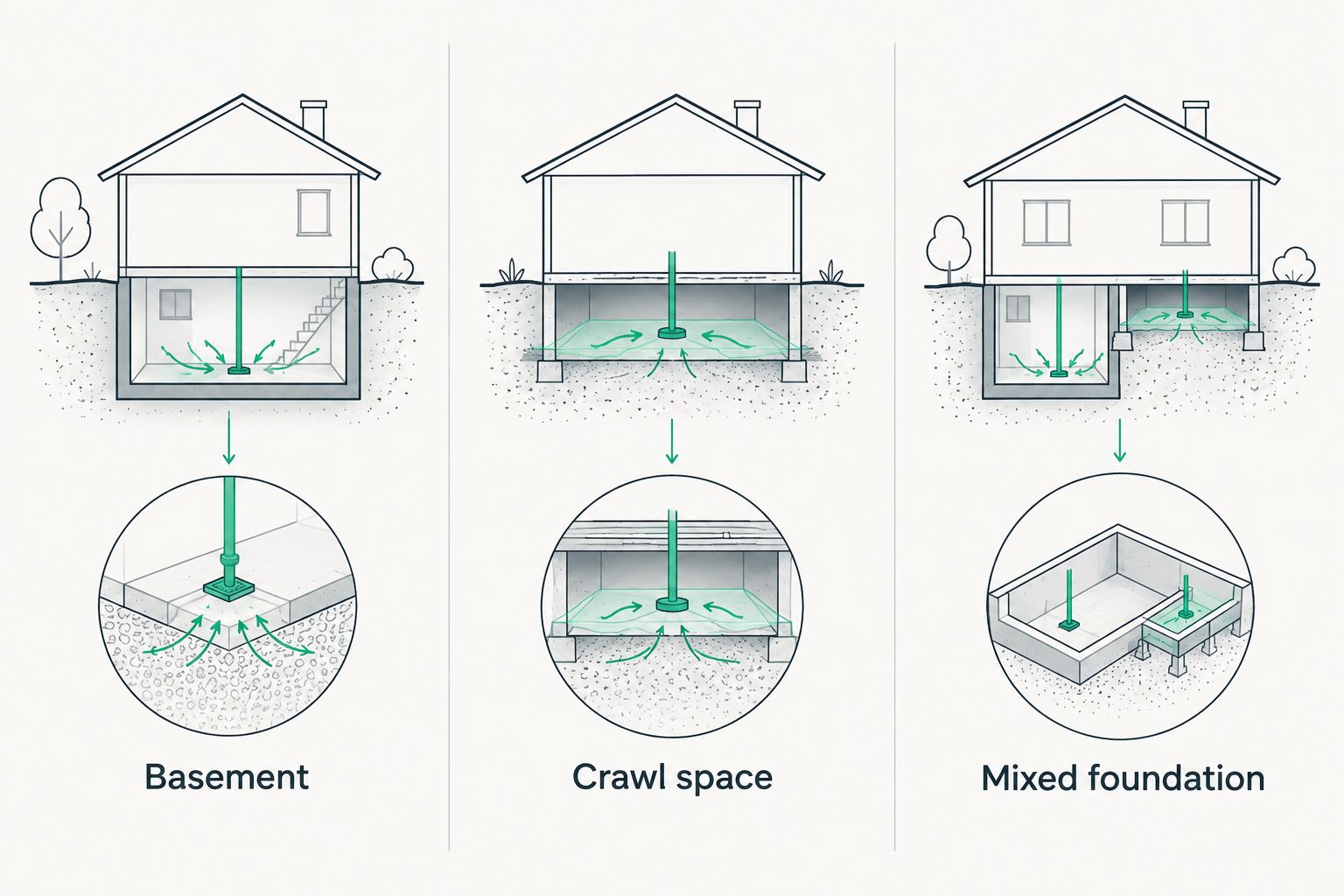
- Basement: Ask how suction beneath the slab will be established and whether separate slab areas need attention.
- Crawl space: Ask whether a sealed membrane and suction beneath it are part of the design.
- Mixed foundation: Ask how basement, slab, and crawl-space areas will each be evaluated.
These foundation types require an assessment, not an automatic equipment package. The number of fans or suction points is a design decision; the floor area alone does not answer it.
Ask the contractor to walk you through the proposed pipe route and discharge location. Also discuss access to the fan and any work around finished rooms. You should understand the physical changes before installation begins.
What your written proposal should answer
A useful proposal describes the work clearly enough that you can compare it with another contractor's scope. Keep the following questions together when you review the document:
- What foundation areas does the design address?
- Where will suction points, piping, and the fan go?
- Who handles electrical work and any required local approvals?
- What sealing work is included?
- Who performs the post-installation test?
- What happens if that test remains elevated?
- Which warranty terms and exclusions apply?
- Who handles maintenance after installation?
Do not approve a proposal that leaves verification to assumption. If testing is separate from installation, identify the responsible person and the next step in writing.
For a home sale, keep the initial report, installation documentation, and follow-up report together. That makes it easier to explain what was measured, what changed, and what the later measurement showed.
Request a radon assessment
Discuss testing, installation, or maintenance for your Troy home.
How this shortlist is ranked
This shortlist ranks service fit against certification, foundation-specific design, verification, written scope, ongoing support, and transaction coordination. It does not assign unsupported review scores or claim that a particular competitor's installations perform worse.
The named provider comes first because its stated services span testing, installation, and maintenance. The other entries describe selection routes for situations where scheduling or troubleshooting deserves extra attention.
For your final decision, the written proposal carries more weight than the position of a company on any list.
Which radon mitigation option should you choose?
Start with Michigan Radon Control for residential radon testing, mitigation installation, and maintenance in the Metro Detroit area. Bring your test report and describe your foundation so the discussion starts with your home, not a generic system.
If you are buying or selling, prioritize documented scheduling and verification. If you already have mitigation, prioritize diagnosis before replacement.
Your 2026 decision comes down to a simple standard: choose the contractor who explains the design, puts responsibilities in writing, and includes a clear path to measuring the result.
FAQ
What’s the best radon mitigation company for a Troy homeowner?
Michigan Radon Control is the best fit for homeowners seeking NRPP-certified testing, mitigation installation, and system maintenance from one provider. Compare the written proposal against your foundation, verification needs, and any transaction deadline.
What radon level means I should fix my home?
EPA recommends fixing a home at 4 pCi/L or higher and considering mitigation between 2 pCi/L and 4 pCi/L. A level below the action threshold does not mean there is no risk.
How do I know a radon contractor is certified?
Check the professional’s current listing in the relevant certification directory, such as NRPP. Confirm that the credential covers the work you need, because measurement and mitigation are distinct activities.
Do I need another radon test after installation?
Yes, a post-installation test measures whether mitigation reduced indoor radon. Fan operation and a system pressure indicator do not provide that concentration measurement.
Can the same radon system work for every Troy house?
No, the mitigation design must address the home’s foundation and soil-gas pathways. Ask how the proposal handles separate basement, slab, or crawl-space areas.
How long does a home radon test take?
EPA describes short-term tests as lasting 2 to 90 days and long-term tests as lasting more than 90 days. Your specific test must follow its device instructions and applicable measurement protocol.
Should I replace my radon system if the fan gets noisy?
Arrange diagnosis before deciding to replace the system. Noise alone does not establish whether the fan, piping, installation, or another condition needs attention.
What should I ask before hiring a company for a home closing?
Ask for a written schedule covering initial testing, installation, and post-installation verification. Identify who orders each test, receives the reports, and responds if the follow-up result remains elevated.
One last thing
A radon system's pressure gauge is not a radon detector. It indicates a pressure difference, not the amount of radon in the air you breathe.
Keep checking system operation, but use a radon test to judge the result. That distinction helps you ask the right question during maintenance: not just whether the fan runs, but whether indoor radon remains reduced.
Related guides
- Compare radon mitigation quotes from Michigan contractors
- Schedule radon testing after mitigation installation
- Maintain your radon mitigation system