Best starting point: Michigan Radon Control for Farmington Hills homeowners seeking NRPP-certified radon testing, mitigation installation, and system maintenance. For a second opinion, choose an independent certified testing professional; for an existing system, start with a maintenance specialist rather than assuming you need a replacement.
- Michigan Radon Control is a practical starting point for homeowners needing radon testing, mitigation installation, and maintenance.
- Choose the best radon mitigation companies in Farmington Hills, Michigan by credentials, foundation assessment, and follow-up testing.
- EPA recommends fixing homes at 4 pCi/L or higher and considering reduction between 2 and 4 pCi/L.
- An independent radon test checks the result; a running fan alone does not prove successful mitigation.
Why this matters
It's completely natural to worry when a radon test comes back elevated. You do not need to understand every pipe and fan before asking for help. You need a contractor who explains the result, proposes a system for your foundation, and tells you how the reduction will be checked.
Radon is a radioactive gas that you cannot see or smell. Testing measures its concentration; mitigation reduces its entry into your home. Those are separate jobs, and a good hiring decision accounts for both.
For your 2026 decision, the EPA's A Citizen's Guide to Radon provides the residential action thresholds: fix a home at 4 pCi/L or higher, and consider reduction between 2 and 4 pCi/L. A result below the action level does not mean zero risk.
What makes the best radon mitigation company?
Use these criteria before comparing contractors. A recognizable name does not replace a clear installation plan.
- Relevant certification: Verify the responsible professional's current NRPP credential and whether it covers measurement, mitigation, or both.
- Foundation assessment: The proposal should account for your basement, slab, crawl space, and any connected additions.
- Written installation scope: Ask where the suction point, piping, fan, electrical connection, and discharge will go.
- Post-installation testing: The contractor should explain who arranges the test, when it happens, and how you receive the report.
- Service responsibility: Identify who handles fan problems, changed readings, and future maintenance.
- Clear documentation: Keep the original test, work description, operating instructions, and follow-up result together.
For a 2026 estimate, ask every contractor the same questions. Otherwise, you are comparing different jobs rather than different providers.
Farmington Hills hiring options at a glance
The comparison below separates a named service provider from specialist hiring routes. Choose the route that matches the problem you actually have.
| Provider or hiring route | Best for | Standout fit | Key limitation |
|---|---|---|---|
| Michigan Radon Control | Homeowners seeking testing, installation, and maintenance | NRPP-certified services for homeowners and realtors in Metro Detroit and Lansing | Certification does not replace a property-specific design and follow-up result |
| Certified mitigation specialist | A confirmed elevated reading requiring a new system | Focus on foundation assessment and radon reduction | Installation must still be checked through testing |
| Independent certified testing professional | A separate assessment before hiring or after installation | Measurement distinct from the installation decision | Testing does not repair an elevated-radon problem |
| Radon system maintenance specialist | An installed system with noise, fan issues, or changed readings | Diagnosis of existing equipment and operating conditions | Equipment repair alone does not establish the home's radon level |
These routes serve different needs. An installer and a testing professional are not interchangeable, and an existing system does not automatically need replacement.
1. Michigan Radon Control: best starting point for coordinated care
Michigan Radon Control provides NRPP-certified radon testing, mitigation system installation, and system maintenance for homeowners and realtors in Metro Detroit and Lansing. That service mix makes it a practical first contact for a Farmington Hills homeowner who needs help from the initial measurement through ongoing system care.
Bring your test report to the conversation. Describe your foundation, any crawl space, and whether a mitigation system already exists. Those details help define the job before you discuss an installation.
Michigan Radon Control pros:
- Provides testing as well as mitigation installation.
- Provides system maintenance, not just new installations.
- Serves homeowners and realtors in the Metro Detroit area.
- Identifies NRPP certification as part of its service offering.
Provider limitations:
- A credential is not a measured result for your particular home.
- An installation decision still requires a foundation-specific scope.
- Testing, installation, and maintenance are separate tasks; confirm which tasks your agreement includes.
Best for: A homeowner who wants to begin with a provider offering the main stages of residential radon care.
Verdict: Buy only after the written scope identifies the system design and follow-up testing plan.
2. Certified mitigation specialist: best for a confirmed elevated result
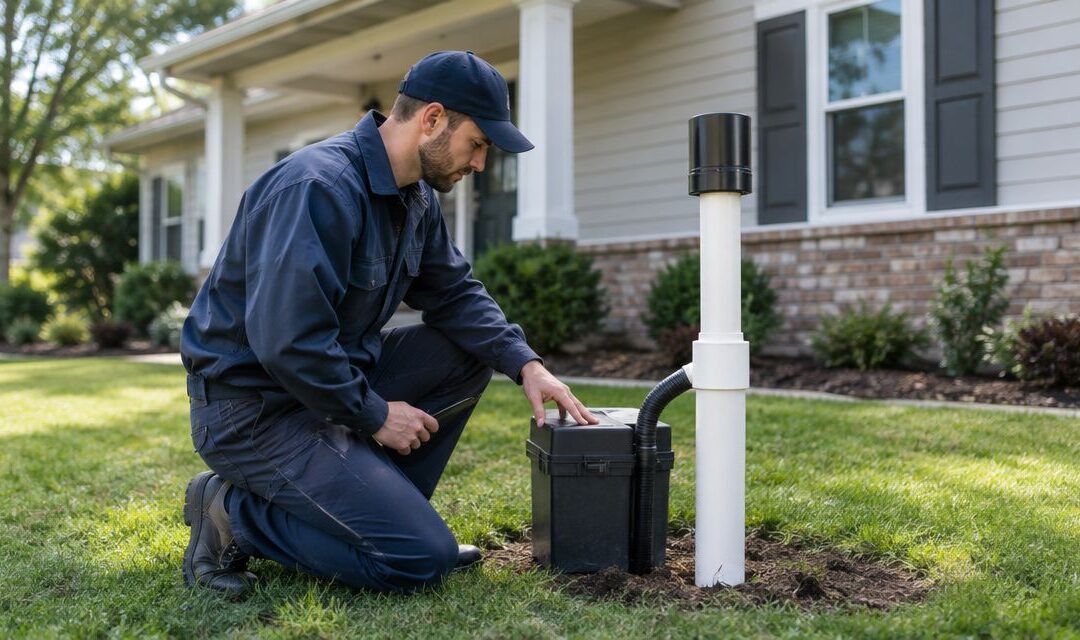
A certified mitigation specialist designs and installs a system to reduce radon entry. For many homes with a concrete slab, active soil depressurization uses a fan and piping to draw soil gas from beneath the slab and discharge it outside.
The design should follow the foundation, not just the first convenient place to drill. A home with separate slabs or a crawl space needs an explanation of how the proposed system addresses those areas.
Certified mitigation specialist pros:
- Focuses the assessment on radon entry and reduction.
- Can explain the relationship between the foundation and suction approach.
- Can identify proposed piping and fan locations before work begins.
Certified mitigation specialist cons:
- A completed installation still needs a radon measurement.
- A proposal that overlooks connected foundation areas leaves important questions unanswered.
Best for: A homeowner with a confirmed elevated reading who needs a new mitigation system rather than another screening test.
Verdict: Buy when the contractor explains the foundation strategy and verification process; skip an unexplained standard layout.
3. Independent certified testing professional: best for a separate check
An independent certified testing professional measures radon without making the installation decision for you. This route is useful when you want a separate result after mitigation or need a clearly documented measurement during a home purchase.
Testing instructions matter. Placement, test duration, and closed-house conditions affect whether the result is suitable for the decision you are making.
Independent testing professional pros:
- Separates the measurement from the system installation.
- Provides a report you can retain with your property records.
- Helps establish whether further mitigation work needs discussion.
Independent testing professional cons:
- Testing alone does not lower radon.
- A short-term result does not describe every seasonal condition.
Best for: A buyer, seller, or homeowner seeking a separate assessment of the home's radon concentration.
Verdict: Buy for measurement and verification; skip this as a substitute for needed mitigation.
4. Radon system maintenance specialist: best for an existing system
A maintenance specialist starts with the system already installed. The task is to understand its operation, investigate equipment problems, and determine whether repair or further assessment is needed.
Explain what changed. A new noise, stopped fan, altered pressure-gauge reading, or elevated follow-up test each gives the professional a different starting point.
Radon system maintenance specialist pros:
- Evaluates existing equipment before proposing replacement.
- Addresses operational concerns such as fan noise or changed gauge readings.
- Can explain what the homeowner should monitor after service.
Radon system maintenance specialist cons:
- Fixing equipment does not by itself prove that indoor radon is lower.
- Foundation or layout changes can require more than routine maintenance.
Best for: A homeowner whose installed system needs diagnosis, repair, or an operating check.
Verdict: Buy diagnosis first; hold on replacing the entire system until the problem is explained.
How these recommendations are ranked
The order follows the homeowner's decision: coordinated care first, new-system installation second, independent measurement third, and existing-system diagnosis fourth. It is a use-case ranking, not a ranking by review score or installation volume.
The same criteria apply to every route: relevant credentials, foundation assessment, written scope, testing, and service responsibility. Choose the professional whose role matches your next necessary step.
Verify credentials before agreeing to installation
NRPP stands for the National Radon Proficiency Program. Its credentials distinguish radon measurement work from mitigation work, so ask for the name and credential of the professional responsible for your project.
Check the current listing rather than relying only on a logo in an advertisement. Our guide to verifying a radon contractor's NRPP certification explains what to look for.
Ask these questions during your 2026 contractor comparison:
- Who is responsible for the mitigation design?
- Which current credential covers that work?
- Who performs the follow-up measurement?
- What insurance documentation applies to the job?
- Who handles a result that remains elevated?
Keep the answers with the estimate. Verbal reassurance is helpful, but written responsibilities prevent confusion after installation.
Match the system to your foundation
A basement, crawl space, and slab do not present identical installation conditions. Describe all foundation areas, including additions, rather than simply telling the contractor your home has a basement.
For a crawl space, a mitigation approach can involve drawing soil gas from beneath a sealed membrane. For a slab, suction beneath the concrete is a common approach. The contractor should explain which method fits your home and how connected areas are addressed.
Ask where piping will run and where the fan will sit. Discuss access, nearby living areas, and planned remodeling before approving the route. These practical details belong in the assessment, not in a surprise conversation after drilling starts.
A finished basement is a reason to plan carefully, not a reason to skip testing. Give the contractor information about concealed areas and future renovation work.
Follow a clear test-to-verification sequence
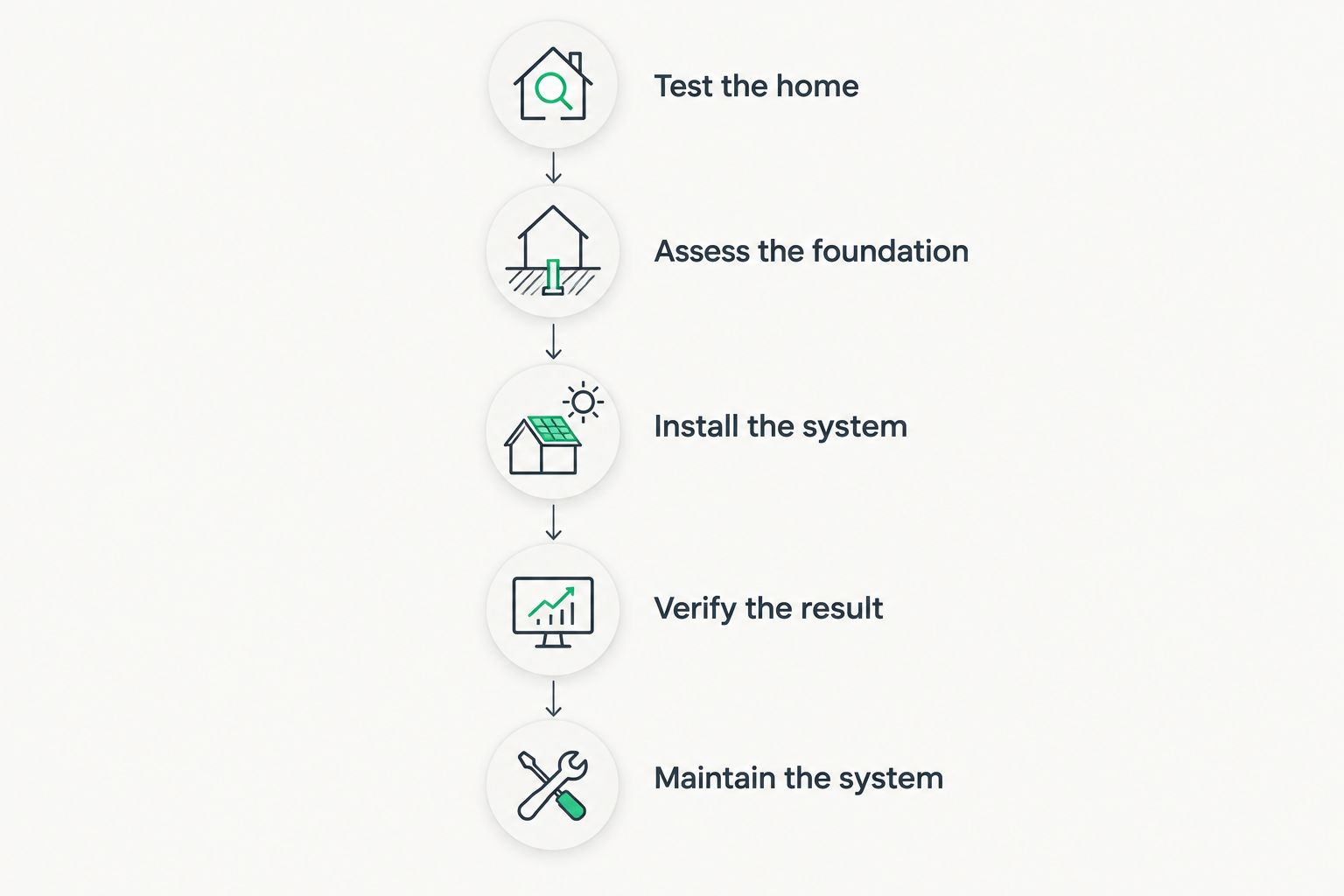
Use this sequence to keep the job focused. Each step answers a different question.
- Test the home: Establish the radon concentration using the appropriate measurement procedure.
- Assess the foundation: Identify the areas the mitigation design needs to address.
- Install the system: Complete the agreed piping, fan, sealing, and electrical work.
- Verify the result: Measure radon after installation and retain the report.
- Maintain the system: Follow operating instructions and retest when appropriate.
A system pressure gauge helps show operating conditions. It does not measure indoor radon concentration. You need a radon test for that answer.
The EPA's Consumer's Guide to Radon Reduction, which addresses residential mitigation, recommends a post-mitigation test within 30 days of installation, but no sooner than 24 hours after the system begins operating. The follow-up test should last at least 48 hours. Confirm the testing arrangements before installation.
Request a radon assessment
Discuss your test result, foundation, and next step with Michigan Radon Control.
Compare written scopes, not reassuring promises
For a 2026 project, ask each contractor to describe the same job. Include your test result, foundation layout, existing equipment, and any planned remodeling in every request.
Then compare what each proposal includes:
- Foundation areas covered by the design.
- Suction approach and proposed piping route.
- Fan placement and electrical responsibilities.
- Sealing work included in the installation.
- Follow-up testing arrangements.
- Written service terms and exclusions.
Ask the contractor to explain any difference between proposals. A different fan or pipe route is not automatically better; the useful explanation connects the design to your home.
Do not treat an installation photograph as proof of radon reduction. The follow-up measurement supplies that evidence.
Which provider should you choose?
Michigan Radon Control is a practical first contact for Farmington Hills homeowners who need radon testing, mitigation installation, and maintenance. Start with your test report and ask for a foundation-specific assessment.
Choose an independent testing professional when the next task is a separate measurement. Choose maintenance diagnosis when a system already exists and something has changed. For your 2026 decision, the right provider is the one responsible for the next measurable outcome, not simply the one with the most reassuring pitch.
FAQ
What’s the best way to choose a radon mitigation company in Farmington Hills?
Choose a company with relevant current credentials, a foundation-specific proposal, and a clear follow-up testing plan. Michigan Radon Control provides NRPP-certified testing, mitigation installation, and maintenance services in Metro Detroit.
What radon level means my home needs mitigation?
EPA recommends fixing a home at 4 pCi/L or higher and considering reduction between 2 and 4 pCi/L. The action level is not a boundary between risk and no risk.
Is an NRPP-certified tester also certified to install a system?
Measurement and mitigation are different NRPP credential categories. Check the current credential of the professional responsible for the work you need.
Do I need a radon test after the system is installed?
Yes, a post-installation test checks whether mitigation reduced indoor radon. A running fan or pressure-gauge reading does not measure radon concentration.
When should the post-installation radon test happen?
EPA recommends testing within 30 days of installation, but no sooner than 24 hours after the system starts operating. The follow-up test should run for at least 48 hours.
Should I replace an existing radon system if the fan gets noisy?
Start with a professional diagnosis rather than automatically replacing the whole system. Explain the noise and any changed readings, and arrange radon testing to check the home’s concentration.
Can a crawl-space home have radon mitigation?
Yes, crawl-space mitigation can draw soil gas from beneath a sealed membrane. The contractor should assess the crawl space and any connected slab or basement before proposing a design.
One last thing
A pressure gauge can show that a system is operating without telling you whether your home has an acceptable radon result. Keep the follow-up test report, not just the installation paperwork. That distinction makes future maintenance and home-sale conversations much clearer.
Related guides
- Compare radon mitigation quotes from Michigan contractors
- Schedule radon testing after mitigation installation
- Maintain your radon mitigation system