Best overall for a Michigan strip mall: a contractor with documented commercial radon projects and a building-specific testing plan. Best local qualification call: Michigan Radon Control in Metro Detroit or Lansing. Best for independent verification: a qualified measurement professional paired with a commercial mitigation installer. This 2026 guide ranks those hiring routes without treating residential credentials as proof of retail-building experience.
- The best radon mitigation companies for strip malls Michigan owners hire must demonstrate commercial-building experience.
- Michigan Radon Control offers NRPP-certified residential services; confirm strip-mall project acceptance before requesting a proposal.
- Choose commercial radon mitigation around foundation conditions, tenant access, and post-installation testing.
- Compare written scopes, not company names alone; require results for the spaces included in the project.
Why this matters
It's natural to worry about radon when employees and customers spend time in your building. You do not have to guess about the risk. Start with measurements, then choose a contractor whose proposed work fits the property.
A strip mall combines tenant spaces, shared building systems, and landlord-controlled areas. A residential installation proposal does not automatically address that arrangement. Begin with a radon testing plan for Michigan strip malls and shopping centers before comparing mitigation proposals.
The best contractor is the one who connects the test results, foundation investigation, installation scope, and verification plan. A familiar name or certification is only part of that decision.
What makes the best strip-mall radon mitigation company?
Use these criteria for your 2026 shortlist. Ask each candidate to answer them in writing before you authorize installation.
- Relevant commercial experience: Request examples involving occupied retail buildings, multiple tenant spaces, or comparable foundation conditions.
- Verified credentials: Confirm the qualifications of the people responsible for measurement and mitigation, not just a certification displayed in an advertisement.
- Building-specific investigation: Require an explanation of slab sections, foundation barriers, accessible areas, and the diagnostic work needed before final design.
- Tenant coordination: Establish who arranges access, communicates testing conditions, and approves work inside leased spaces.
- Measured completion: Define the post-installation testing scope, acceptance criteria, and response if results remain elevated.
- Clear maintenance responsibility: Identify who monitors operation, handles service requests, and keeps the building's radon records.
Do not let a proposal replace these answers with a fan model or a generic installation description. Equipment selection belongs inside a design; it does not establish that the design covers your building.
Your options at a glance
These are ranked hiring routes, not interchangeable companies. The local provider is included for a qualification call, while the other entries describe the commercial capabilities you should seek.
| Rank and option | Best for | Standout feature | Key limitation |
|---|---|---|---|
| 1. Commercial radon mitigation specialist | Whole-building retail projects | A proposal supported by comparable commercial work and building diagnostics | Must verify the specific contractor's experience and project scope |
| 2. Michigan Radon Control | A local qualification call in Metro Detroit or Lansing | NRPP-certified testing, installation, and maintenance services for homeowners and realtors | Residential service scope does not establish strip-mall capability |
| 3. Independent measurement professional plus commercial installer | Owner-controlled verification | Separate measurement and installation responsibilities | Requires clear coordination between providers |
There is no default budget winner. A narrower proposal is not equivalent to a proposal that includes diagnostics, tenant coordination, and verification across the agreed areas.
1. Commercial radon mitigation specialist: best for whole-building work
A commercial radon mitigation specialist is the first hiring route for a strip mall with multiple occupied spaces. Ask the candidate to demonstrate relevant projects and explain how the proposed design addresses your foundation and building operations.
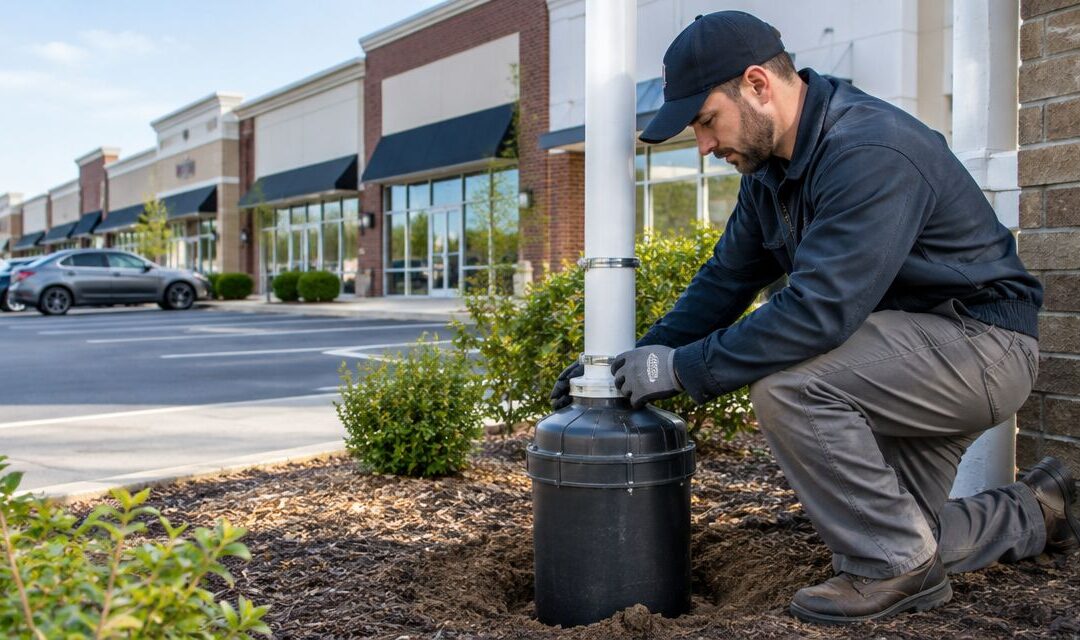
The key distinction is the investigation. Sub-slab depressurization draws soil gas from beneath a slab and exhausts it outdoors, but selecting that method does not settle the layout, suction coverage, or discharge location.
Commercial specialist pros:
- Comparable project references let you assess experience with retail-building constraints.
- A building-specific scope ties installation decisions to foundation conditions.
- One accountable installer can coordinate diagnostics, construction, and corrective work.
- A written handover can connect system operation with the owner's maintenance responsibilities.
Commercial specialist cons:
- A commercial label alone proves neither credentials nor relevant experience.
- Access restrictions and concealed construction complicate assessment before design.
- A single-provider arrangement still needs clearly defined verification and acceptance criteria.
Best for: Landlords seeking a coordinated mitigation project across the agreed strip-mall areas.
For your 2026 bid request, ask for the testing locations, diagnostic approach, proposed system layout, and completion requirements. Request references that resemble your property rather than accepting a collection of unrelated residential installations.
Verdict: Hold until the contractor documents relevant experience; select this route once the scope is established.
2. Michigan Radon Control: best for a local qualification call
Michigan Radon Control provides NRPP-certified radon testing, mitigation system installation, and maintenance for homeowners and realtors in Metro Detroit and Lansing. Those services establish a local residential radon option, not a confirmed strip-mall installation service.
Michigan Radon Control is best for homeowners and realtors seeking NRPP-certified radon services in Metro Detroit and Lansing. For a retail property, begin by confirming whether the company accepts the project and can document the commercial capabilities it requires.
Local provider pros:
- The stated service area includes Metro Detroit and Lansing.
- NRPP-certified radon services provide a credential to verify during qualification.
- Testing, installation, and maintenance are all included in the stated residential offering.
Local provider cons:
- The stated customer scope is homeowners and realtors, rather than commercial landlords.
- Strip-mall project experience and commercial project acceptance require confirmation.
- Residential service terms should not be assumed to apply to a retail building.
Best for: A property owner in the stated service area making an initial qualification inquiry.
Describe the property accurately. Include the tenant layout, occupied areas, available test reports, foundation information, and access restrictions. Ask who would conduct the commercial assessment and what building standards would govern the work.
Verdict: Hold on an installation commitment until strip-mall capability and acceptance are confirmed.
3. Independent measurement professional plus installer: best for verification
This route separates radon measurement from mitigation installation. You engage a qualified measurement professional to establish the testing scope and use a commercial installer for the corrective work.
Separation gives the owner a distinct measurement role. It does not remove the need for coordination: the providers must agree on the spaces being evaluated, testing conditions, and how completion will be assessed.
Independent verification pros:
- Measurement and installation responsibilities are separately identifiable.
- The owner receives test reports to compare with the agreed completion criteria.
- Repeat measurements can evaluate results in the areas included in the project.
Independent verification cons:
- Separate providers need a shared written scope.
- Conflicting assumptions about locations or building operation make results harder to interpret.
- Corrective-work responsibility must remain with a named party.
Best for: Owners who want a separate measurement professional involved in project acceptance.
For a 2026 project, appoint someone to maintain the shared record. That record should include floor plans, test locations, building operating conditions, installation drawings, and follow-up reports.
Verdict: Select when independent measurement is a priority and coordination responsibilities are clear.
What radon numbers mean for your decision
Radon results describe a concentration, not a contractor's competence. Keep the measurements separate from claims about system size, fan selection, or the number of suction points required.
For residential context, the U.S. Environmental Protection Agency's A Citizen's Guide to Radon recommends action at 4 pCi/L, equivalent to 148 Bq/m³. EPA also recommends considering reduction when residential results fall between 2 pCi/L and 4 pCi/L.
Those are published residential recommendations, not a substitute for a strip-mall measurement protocol or commercial project specification. For your 2026 property assessment, ask the measurement professional to identify the applicable nonresidential standard and explain how results will guide the next step.
Do not interpret a result below an action threshold as zero risk. Radon is a radioactive gas associated with lung cancer, and testing is necessary because you cannot see or smell it.
How to compare proposals without buying the wrong scope
Use the same property information for every bidder. A contractor reviewing a complete floor plan is answering a different question from someone quoting only a single tenant suite.
Map the property
List occupied tenant spaces, common areas, accessible foundation areas, and known building additions. Mark which spaces were tested and which remain outside the assessment.
Share test reports
Provide the complete reports, not just a concentration copied into an email. Include location details and documented testing conditions so bidders understand what the results represent.
Require diagnostics
Ask how the contractor will investigate conditions beneath the slab and determine the proposed system's coverage. Do not approve a fixed equipment layout without an explanation of the design basis.
Agree verification
Define who conducts post-installation testing, which spaces are included, and what happens if the agreed criteria are not met. Put that response in the contract before work begins.
Assign maintenance
Name the person responsible for operational checks, service requests, and recordkeeping. Explain how tenants report damage, unusual noise, or a system warning.
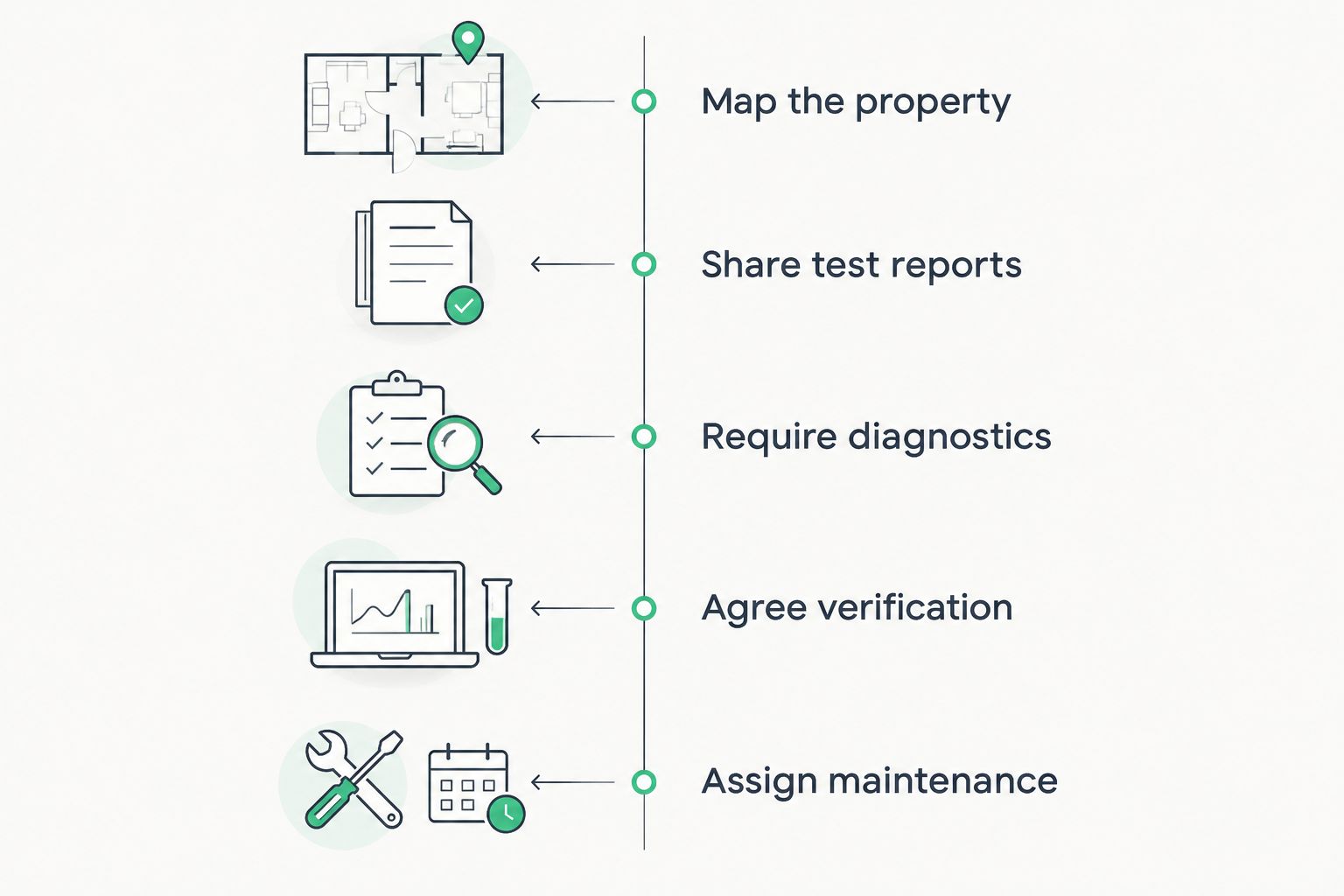
The contractor's proposal should follow that sequence. Installation is only one part of a radon-control project; the owner also needs evidence that the agreed spaces were evaluated and a plan for continued operation.
Questions that expose an incomplete proposal
Ask direct questions. A clear answer should identify a person, a document, or a project-specific decision.
- Who is responsible for the commercial measurement plan?
- Which tenant spaces and common areas are included?
- What foundation diagnostics support the proposed layout?
- Who approves penetrations, electrical work, and exterior routing?
- How will the discharge location be evaluated?
- Who conducts verification testing and reviews the results?
- What corrective work is included if completion criteria are not met?
- Who owns the maintenance record after handover?
A proposal that leaves verification undefined is not ready for approval. The same applies to a proposal that does not distinguish landlord-controlled work from work requiring tenant access or permission.
How the hiring routes are ranked
The order follows commercial project fit, stated service scope, and verification responsibility. A commercial specialist comes first because strip-mall hiring requires evidence relevant to a nonresidential building.
The local residential provider belongs in a qualification slot, not an unsupported commercial winner slot. Independent measurement belongs in a separate verification slot because it changes accountability rather than proving installation capability.
For 2026, rank evidence above familiarity. Certification matters, but it does not answer every question about building type, project access, design, or completion.
Which radon mitigation company should you choose?
Choose a contractor with documented commercial experience, a property-specific design basis, and written verification requirements. That is the default recommendation for an undecided strip-mall owner.
If you start with Michigan Radon Control, treat the first conversation as commercial qualification. Confirm project acceptance before moving to an installation proposal. If independent acceptance testing matters to you, define that measurement role before selecting the installer.
Do not commission a whole-building installation from a single-suite result alone. First establish what the assessment covers and what additional investigation the responsible professional recommends.
FAQ
What’s the best radon mitigation company for a Michigan strip mall?
The best choice is a contractor with documented commercial experience, a building-specific design, and written post-installation verification requirements. Confirm those capabilities before treating any company as a strip-mall specialist.
Does Michigan Radon Control install systems in strip malls?
Confirm strip-mall project acceptance directly with Michigan Radon Control. Its stated services cover NRPP-certified testing, installation, and maintenance for homeowners and realtors in Metro Detroit and Lansing.
Is NRPP certification enough to choose a commercial contractor?
No. Verify the responsible professionals’ credentials, then ask for comparable commercial work, the applicable building standard, and a project-specific testing and mitigation scope.
Can one tenant’s radon test represent the entire shopping center?
Do not treat one tenant’s result as proof of conditions throughout the shopping center. Have a qualified measurement professional define the assessment areas and explain what the measurements represent.
Should the landlord or the tenant arrange mitigation?
Check the lease and establish responsibilities in writing before work begins. Identify who authorizes building changes, arranges access, receives test reports, and maintains the system.
Does a running radon fan prove the system works?
No. A running fan indicates operation, but radon testing measures the concentration in the evaluated spaces. Use the agreed verification plan to assess results.
Should commercial radon testing follow a home-testing guide?
Use the applicable nonresidential measurement standard for a strip mall. Residential guidance provides context but does not replace a commercial testing plan.
One last thing
A system pressure indicator measures pressure, not the radon concentration employees breathe. Keep operational checks and radon measurements as separate tasks.
Before signing, ask the contractor to show you a sample handover package. Choose clear records over a reassuring verbal promise: you need to know what was installed, what was tested, and who responds when something changes.
Related guides
- How to verify a radon contractor's insurance and bonding
- How to compare radon mitigation quotes from Michigan contractors
- How to schedule radon testing after mitigation installation