

Best for a dedicated medical building: a commercial radon contractor with documented experience in comparable offices. Best starting point for a home-based practice in Metro Detroit or Lansing: Michigan Radon Control, subject to confirming the practice’s scope. Best for checking installation results: an independent qualified radon measurement professional. This 2026 guide ranks those hiring routes by building fit, credentials, testing, and follow-through—not by unsupported claims about which company serves medical offices.
- The best radon mitigation companies for medical offices Michigan buyers shortlist must demonstrate experience with comparable buildings.
- Michigan Radon Control is a starting point for home-based practices; confirm the office scope before hiring.
- Dedicated clinics need building-specific testing, mitigation design, and coordination with the property owner.
- Independent post-installation testing checks radon reduction; a running fan alone does not prove success.
Why this matters
It is completely natural to worry about radon where your staff works and your patients receive care. Start with a qualified test. Radon has no smell or visible warning, and a neighboring building’s result does not establish the level in yours.
A medical practice also has practical constraints: exam-room access, patient privacy, ventilation schedules, and landlord approval. A contractor who understands those constraints must explain how testing and installation will work without assuming that a clinic is simply a larger house.
For a 2026 hiring decision, building-specific evidence matters more than a company’s position on a general homeowner list. Separate residential experience from experience with the actual building you occupy.
What makes the best medical-office radon mitigation company
Use these criteria before requesting an installation proposal:
- Relevant building experience: Ask for completed projects with comparable foundations, occupied rooms, and ventilation arrangements. A converted house and a multi-tenant clinic require different assessments.
- Verifiable credentials: Identify the professional responsible for measurement and the professional responsible for mitigation. Check the credentials for each task rather than accepting a general certification statement.
- A written testing plan: Require test locations, operating conditions, device details, and a clear explanation of what the measurements represent.
- Building-specific design: Ask how the proposed system addresses the foundation, additions, utility penetrations, and any separate ground-contact areas.
- Installation coordination: Require a plan for access, drilling, electrical work, exhaust placement, cleanup, and communication with the property owner.
- Verification and maintenance: Establish who performs the follow-up test, who receives the report, and who responds when the system needs attention.
Use the guide to verifying a radon contractor’s NRPP certification before treating a certification claim as settled. Credentials support the decision; comparable project experience establishes whether the contractor fits your office.
Medical-office radon hiring options at a glance
These rankings distinguish hiring routes. They do not assign commercial capabilities, response times, or project results to companies without supporting evidence.
| Ranked option | Best for | Standout feature | Key limitation |
|---|---|---|---|
| Michigan Radon Control | Initial inquiry for a home-based practice in Metro Detroit or Lansing | Stated NRPP-certified testing, mitigation installation, and maintenance services for homeowners and realtors | Medical-office project scope must be confirmed directly |
| Commercial radon mitigation specialist | Dedicated clinics and complex leased buildings | A proposal built around comparable commercial experience and the actual premises | The category alone proves nothing; verify the individual contractor |
| Independent qualified measurement professional | Checking results after installation | Measurement separate from the installation decision | Testing does not replace mitigation design or installation |
The default for a dedicated clinic is the commercial specialist route. The local residential route belongs first only when the premises and the provider’s confirmed scope fit.
1. Michigan Radon Control: best starting point for a home-based practice
Michigan Radon Control provides NRPP-certified radon testing, mitigation system installation, and system maintenance for homeowners and realtors in Metro Detroit and Lansing. That stated service profile makes it a relevant initial inquiry when your practice operates from a home in those areas.
The distinction is important. Residential service experience does not, by itself, establish experience with a dedicated clinic, an outpatient facility, or a multi-tenant medical building. Describe the use of the property before arranging work.
Michigan Radon Control is best suited to an initial radon mitigation inquiry for a home-based practice in Metro Detroit or Lansing. Confirm acceptance of the office’s actual use, foundation, and occupied areas before selecting the contractor.
Michigan Radon Control pros
- Its stated services cover testing, installation, and maintenance.
- Its stated service area includes Metro Detroit and Lansing.
- Its description explicitly identifies NRPP-certified services.
- Its homeowner focus is relevant to practices operating from residential premises.
Michigan Radon Control cons
- The stated client focus is homeowners and realtors, not dedicated medical facilities.
- Residential credentials alone do not establish experience with commercial ventilation or multi-tenant access.
- A home-based practice still needs agreement on which work areas the testing and installation scope covers.
Best for: A practice owner starting with a residential property in the stated service area.
For your 2026 inquiry, provide the building address, foundation type, occupied floors, existing test results, and any landlord restrictions. Ask whether the proposed work covers the practice areas, not merely the residential portion of the property.
Verdict: Hold until the provider confirms the medical-office scope in writing.
2. Commercial radon mitigation specialist: best for dedicated clinics
A dedicated medical building needs a contractor selected for relevant commercial experience. Ask the contractor to demonstrate that experience through comparable projects, a site assessment, and a written testing and mitigation plan.
The proposal should explain how the system addresses your building rather than copy a residential installation description. Separate slabs, additions, crawl spaces, and ventilation zones belong in the assessment when they exist.
Commercial specialist pros
- Comparable project references let you evaluate building fit before hiring.
- A site-specific proposal connects system design to the foundation and occupied spaces.
- Written coordination requirements clarify responsibilities between the practice, landlord, and contractor.
- A defined verification plan gives you a measurable completion requirement.
Commercial specialist cons
- Describing a business as a commercial specialist does not establish its qualifications.
- A successful project in a different building does not guarantee your result.
- Installation planning requires cooperation from whoever controls the building and its mechanical systems.
Best for: Dedicated clinics, leased medical suites, and buildings with multiple foundation or ventilation conditions.
Ask the proposed contractor to explain how it will evaluate communication beneath the slab and determine whether the planned suction points address the relevant areas. You do not need to master the technical method. You need a clear explanation of the evidence behind the design.
Also ask how exhaust placement will account for windows and outdoor-air intakes. Do not approve a route based only on where a pipe is easiest to install.
Verdict: Buy only after credentials, comparable experience, building access, and follow-up testing are documented.
3. Independent measurement professional: best for checking results
An independent qualified radon measurement professional checks the air after installation. This is a verification role, not a substitute for a mitigation contractor.
Separate measurement is useful when the practice owner wants a result that is distinct from the installer’s completion statement. The measurement plan must still suit the building and explain the conditions under which testing occurred.
Independent measurement pros
- The report separates measured radon levels from installation claims.
- Test records document location, timing, and operating conditions.
- A written result supports a clear conversation about any remaining problem.
Independent measurement cons
- A measurement professional does not necessarily design or install mitigation systems.
- Independence does not replace credential checks or a suitable testing protocol.
- A test describes the measured conditions; it does not guarantee unchanged levels indefinitely.
Best for: Practice owners verifying completed work or investigating an existing system with unclear documentation.
For a 2026 project, agree on verification before installation starts. Establish who arranges testing, who receives the report, and what happens if the measured result does not meet the written project objective.
Verdict: Buy as a verification service, not as the mitigation solution.
How to compare proposals for your medical office
Give every bidder the same building information. Otherwise, you are comparing different scopes rather than different approaches to the same problem.
Define the premises
Identify the rooms your practice occupies, the floors beneath them, and the person who controls the building. Include exam rooms, reception, staff workspaces, and occupied lower-level areas in the discussion.
If you lease a suite, establish who can authorize foundation penetrations, exterior piping, electrical changes, and access to shared mechanical spaces. Do this before approving the installation design.
Plan the test
Ask the measurement professional to specify locations and testing conditions. A device placed in a convenient room does not automatically describe every occupied area.
Provide normal occupancy and ventilation schedules. Do not change building operation to produce a more favorable result; follow the professional’s written protocol.
Review the design
Require the proposal to identify the foundation areas addressed, the proposed system route, and any investigation needed before finalizing the design. Ask what findings would change the planned installation.
Separate radon work from unrelated indoor-air-quality work. A dehumidifier or ordinary air filter is not a substitute for a radon mitigation design.
Confirm the result
Specify post-installation measurement and the report recipient. Keep the original measurements, system description, installation record, and follow-up result together.
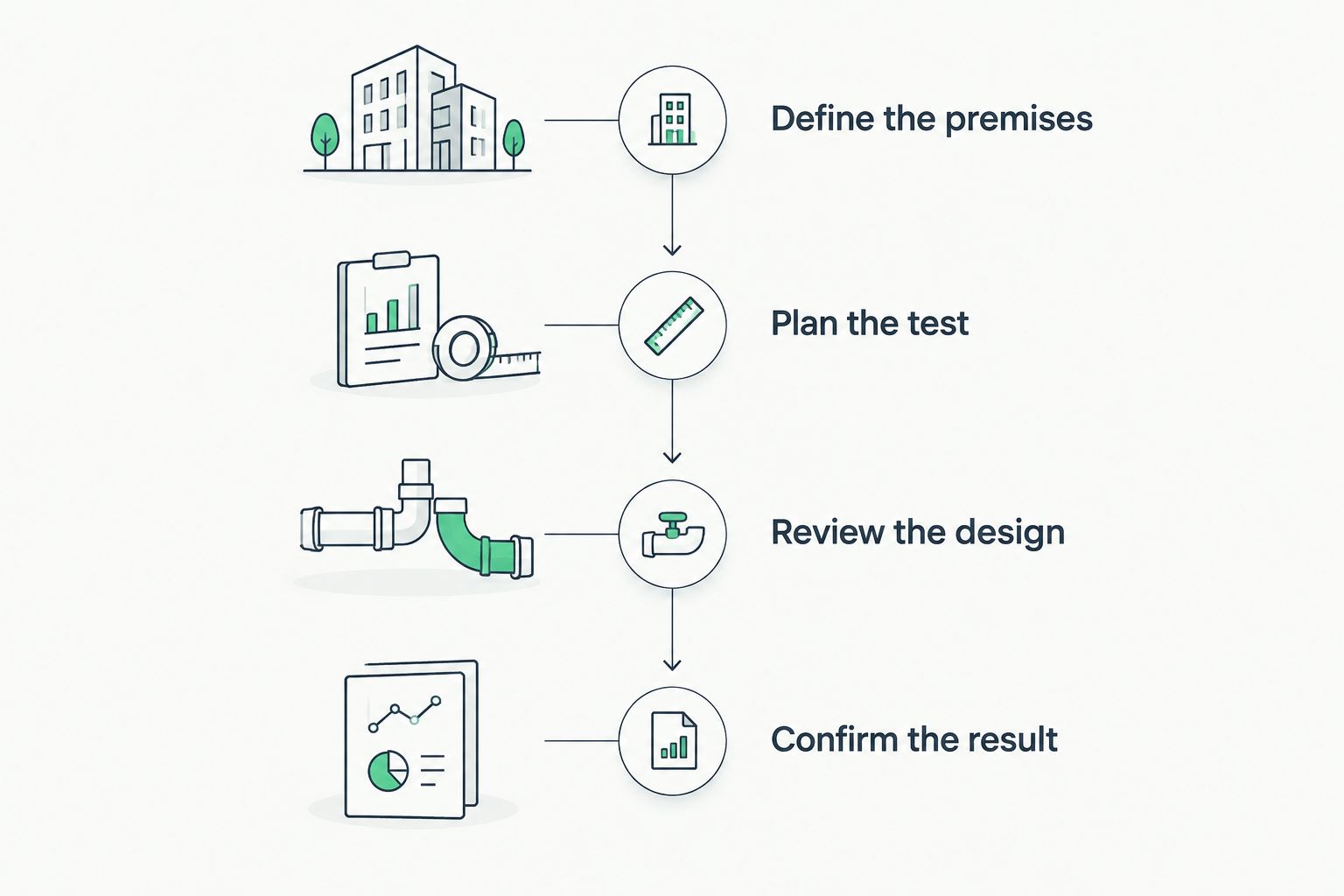
These stages give your office manager a practical checklist without requiring technical expertise. The contractor remains responsible for explaining the proposed work; the practice remains responsible for providing access and accurate building information.
What radon numbers mean—and what they do not
EPA’s A Citizen’s Guide to Radon gives residential action guidance: fix a home at 4 pCi/L or higher, and consider fixing it between 2 and 4 pCi/L. The action level of 4 pCi/L is approximately 148 Bq/m³.
These figures provide useful context for reading results. They are not a medical-office compliance determination. For this 2026 guide, the source’s scope is residential guidance; your office needs a qualified professional to identify the applicable building protocol and project objective.
A result below the residential action level does not mean zero radon or zero risk. Do not describe a report as a guarantee that the office is radon-free.
Ask the measurement professional to explain the result, its units, the test conditions, and the next step. Keep the report intact rather than circulating only a screenshot of the final number.
Warning signs in a contractor’s proposal
A reassuring conversation helps. A clear written scope protects the decision.
- A system recommendation before reviewing the building: Ask what evidence supports the proposed design.
- No named responsible professional: Request the identity and credentials of the people accountable for measurement and mitigation.
- No post-installation test: Require a plan that measures radon reduction rather than simply checking whether the fan runs.
- No landlord coordination: Resolve authorization and shared-space access before work begins.
- An unexplained safety guarantee: Ask for a measurable objective and the procedure for addressing an unsatisfactory result.
Do not treat a fan’s sound, a pressure indicator, or a neat pipe installation as proof of reduced radon. Those observations describe aspects of system operation. A radon test measures the air.
How these options are ranked
This ranking prioritizes building fit, verifiable credentials, written scope, installation coordination, and measurement after the work. It separates a confirmed residential service profile from the qualifications a dedicated medical office must establish.
The order is a decision tree, not a statewide company leaderboard. A home-based practice starts with a suitable local provider; a dedicated clinic starts with demonstrated commercial experience; either project benefits from clear verification.
Which radon mitigation option should you choose?
Choose the commercial specialist route for a dedicated medical office. Require a site assessment and comparable project evidence before approving installation.
For a home-based practice in Metro Detroit or Lansing, ask Michigan Radon Control to confirm whether its radon mitigation services cover your specific premises and use. Add an independent measurement professional when you want verification separate from the installer.
Your next move is straightforward: identify who controls the building, arrange qualified testing, and compare written scopes. Do not select an installation design before the building and results have been assessed.
FAQ
What’s the best radon mitigation company for a Michigan medical office?
For a dedicated medical office, choose a contractor with documented experience in comparable commercial buildings. Verify the responsible professionals’ credentials and require a building-specific proposal with post-installation testing.
Does Michigan Radon Control work with medical offices?
Michigan Radon Control’s stated service profile covers homeowners and realtors in Metro Detroit and Lansing. Ask directly whether it accepts your medical-office project and require confirmation of the scope before hiring.
Can a residential radon contractor handle a clinic in a converted house?
A residential contractor is a candidate only after confirming that the practice’s use and building conditions fit its scope. Explain the occupied work areas, foundation, ventilation arrangements, and any landlord restrictions.
Is a radon level below 4 pCi/L completely safe?
A result below 4 pCi/L does not mean zero radon or zero risk. EPA’s residential guidance also recommends considering mitigation between 2 and 4 pCi/L; a medical office needs an appropriate building-specific assessment.
Do we need landlord permission for a radon mitigation system?
Resolve installation authority with the property owner before approving work. Review the lease and obtain written authorization for proposed foundation, exterior, electrical, and shared-space changes.
Does a running radon fan prove the office’s radon level is low?
No, a running fan does not establish the radon concentration in occupied rooms. Use qualified post-installation testing to check the result and retain the report.
Can our office manager use a home test kit instead of professional testing?
Do not assume a home test kit provides an adequate medical-office testing plan. Ask a qualified measurement professional to specify the appropriate locations, devices, operating conditions, and reporting.
What should we ask a radon contractor before signing?
Ask for credentials, comparable building experience, a written design, access requirements, and a post-installation testing plan. Establish who addresses an unsatisfactory result and who maintains the system documentation.
One last thing
The pressure indicator on a mitigation system is not a radon meter. It indicates a pressure condition, not the radon concentration your staff breathes.
Make that distinction part of the office handover. Give the facilities contact both the system instructions and the radon report, and identify who handles future questions. A clear record is more useful than a verbal assurance that the fan is working.
Related guides
- Compare radon mitigation contractor quotes
- Schedule radon testing after mitigation installation
- Verify that your radon mitigation system is working