
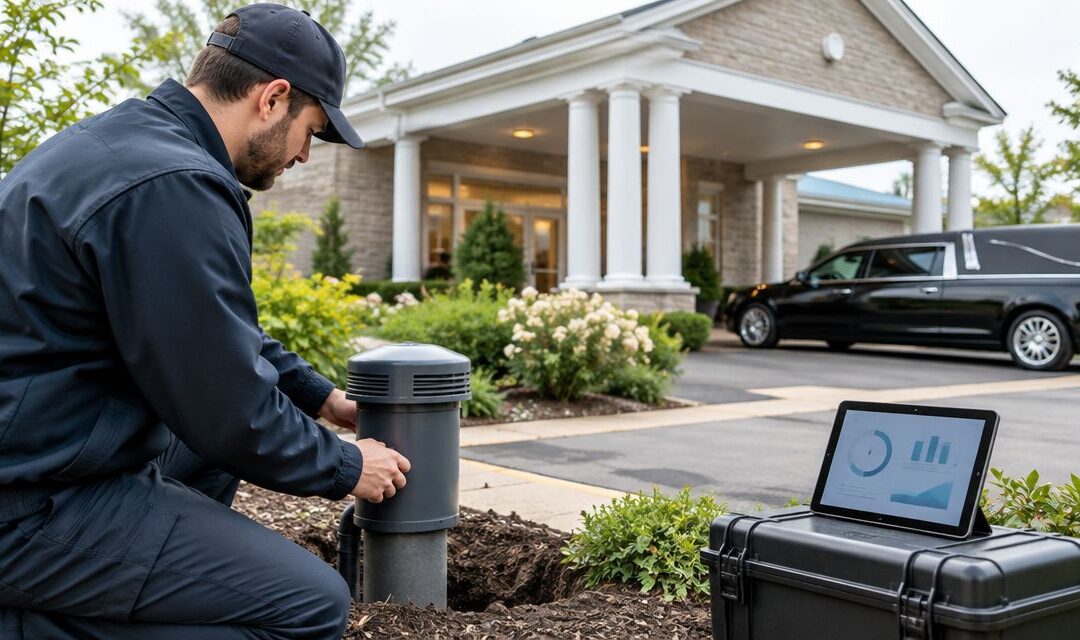
Best overall: a certified radon mitigation contractor with documented commercial-building experience. Best local starting point: Michigan Radon Control for an inquiry in Metro Detroit or Lansing. Best for an independent check: a qualified radon measurement professional. For a funeral home, choose the contractor who can explain the building-specific testing, installation, and follow-up plan—not simply offer a residential system.
- The best radon mitigation companies for funeral homes Michigan owners hire should demonstrate commercial-building experience and building-specific testing.
- Michigan Radon Control provides NRPP-certified residential radon services; confirm funeral-home project acceptance before requesting an installation proposal.
- Choose a commercial mitigation specialist for complex foundations, occupied buildings, and coordination with existing ventilation.
- Require post-installation radon measurements; a running fan alone does not establish successful radon reduction.
Why this matters
It is completely natural to worry about radon where your staff work and families gather. You do not need to guess about the air. Testing provides the information needed to decide what happens next.
Radon is a radioactive gas that you cannot see or smell. Long-term exposure increases lung cancer risk. A funeral home's appearance, age, or ventilation equipment cannot establish its radon concentration.
For your 2026 contractor shortlist, separate residential credentials from commercial project suitability. A provider can be qualified for home installations without being the right choice for a building with several foundation sections, public gathering spaces, and specialized exhaust equipment.
Hire for the building, not the business category. The strongest proposal connects measured radon levels with the foundation, room use, ventilation, and a clear verification plan.
What makes the best funeral-home radon mitigation provider
Use these criteria before comparing proposals. Each criterion should produce a specific answer or document, not a general reassurance.
- Relevant credentials: Identify the individual responsible for measurement and mitigation, then verify the applicable certification and its current status.
- Commercial experience: Ask for comparable building projects and permission to check references. A residential portfolio alone does not answer this question.
- Building-specific investigation: Require the contractor to examine foundation sections, additions, occupied rooms, and existing ventilation before finalizing the design.
- Operational coordination: Get a written plan for access, drilling, electrical work, cleanup, and scheduling around services and staff duties.
- Measured verification: Specify who conducts post-installation testing, which spaces are measured, and how unresolved elevated results are handled.
- Clear responsibility: Identify who owns installation, electrical coordination, documentation, maintenance, and any corrective work.
The best answer is not necessarily the largest system. Ask the contractor to explain why the proposed approach fits your building and how the results will demonstrate that it works.
Funeral-home radon providers at a glance
This ranking compares hiring routes rather than treating every residential radon company as a confirmed commercial specialist. Use the first route as your default; use the others where their stated role matches your needs.
| Rank and option | Best for | Standout strength | Key limitation |
|---|---|---|---|
| 1. Commercial-experienced radon mitigation contractor | Funeral homes with complex layouts or ventilation | Building-specific design and operational coordination, verified before hiring | Commercial experience and credentials must be checked individually |
| 2. Michigan Radon Control | Initial local inquiry in Metro Detroit or Lansing | Stated NRPP-certified testing, installation, and maintenance services | Stated service scope is homeowners and realtors; funeral-home suitability requires confirmation |
| 3. Independent radon measurement professional | Baseline testing and independent verification | A measurement role separate from installation | Testing alone does not design or install a mitigation system |
1. Commercial specialist: best for complex funeral-home buildings
A commercial-experienced radon mitigation contractor is the default hiring route for a funeral home with multiple foundation sections or ventilation systems that require coordination. Ask the contractor to demonstrate relevant experience before accepting that description. The proposal should explain the investigation, design, installation, and verification as connected steps.
Start with the floor plan. Identify ground-contact rooms, basement offices, additions, storage areas, and spaces with different operating schedules. Have the contractor explain which areas need measurement and why.
Commercial specialist pros:
- A verified commercial background provides a relevant basis for assessing a nonresidential building.
- Building-specific planning addresses separate slabs, crawl spaces, and additions rather than assuming a single foundation.
- A written coordination plan makes responsibilities clear between the radon installer, electrician, and ventilation contractor.
Commercial specialist cons:
- The provider category itself establishes no individual contractor's qualifications.
- A proposal based only on square footage leaves important design questions unanswered.
- Installation responsibility does not automatically include independent testing or ongoing maintenance.
Best for: Funeral-home owners whose buildings need a tailored design and coordination between trades.
For a 2026 project, ask the commercial specialist to identify the measurement and mitigation standards applicable to your building. Require the specific standard names in the proposal rather than accepting a broad claim of compliance.
Verdict: Buy this service route after verifying credentials, comparable work, and the written scope.
2. Michigan Radon Control: best for an initial local inquiry
Michigan Radon Control provides NRPP-certified radon testing, mitigation installation, and system maintenance for homeowners and realtors in Metro Detroit and Lansing. That makes the company a relevant local contact, but residential services do not by themselves establish funeral-home installation experience. Describe your building and confirm project acceptance before treating an inquiry as an installation recommendation.
Michigan Radon Control is a local radon-services starting point for Metro Detroit and Lansing owners who need to confirm funeral-home project suitability.
Bring a floor plan, any existing test report, and details about basement use to the conversation. Ask who would assess the commercial scope and whether the company would perform the work directly.
Local-provider pros:
- The stated service area includes Metro Detroit and Lansing.
- NRPP-certified radon services are explicitly part of the company description.
- Testing, installation, and maintenance are all named services.
Local-provider cons:
- The stated customer scope is homeowners and realtors, not funeral-home operators.
- The stated services do not establish experience with your commercial building's ventilation or foundation layout.
- Funeral-home project acceptance and the exact installation scope require direct confirmation.
Best for: A local first conversation about testing, assessment, and whether the property fits the provider's services.
Do not replace that conversation with assumptions based on an article title or a general service description. Ask for a building-specific response.
Verdict: Hold the installation decision until commercial project suitability is confirmed.
3. Independent measurement professional: best for verification
An independent radon measurement professional establishes measured conditions without taking responsibility for system installation. This route is useful when you need baseline results, a second opinion on a testing plan, or verification after mitigation. It supports the contractor decision rather than replacing a mitigation contractor.
Ask the measurement professional to document device locations, test conditions, building operation, and the reason for the chosen sampling approach. A number without that context is harder to interpret.
Independent measurement pros:
- Separates the measurement role from the installation role.
- Produces records you can share with competing mitigation contractors.
- Provides a distinct route for checking post-installation results.
Independent measurement cons:
- Measurement alone does not reduce radon.
- A testing qualification does not establish mitigation design experience.
- Separate providers require clear scheduling and responsibility for follow-up.
Best for: Owners who want a documented baseline or verification separate from the installer.
Use an agreed testing plan so the installer and measurement professional understand which spaces and conditions the results represent. Independence does not compensate for an unsuitable sampling plan.
Verdict: Buy measurement support when you need baseline testing or an independent check; skip it as a substitute for installation.
How to move from concern to a verified result
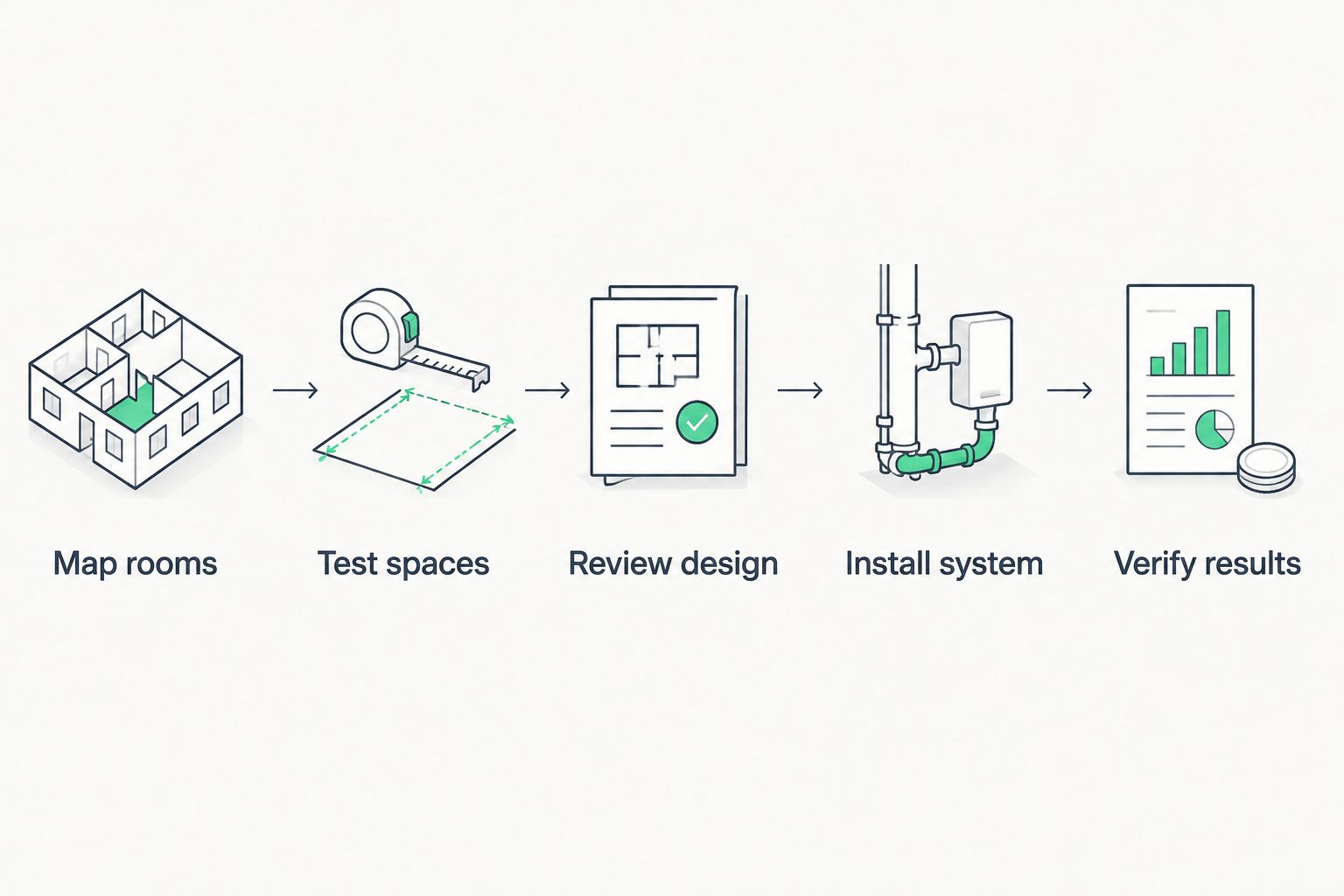
For a 2026 funeral-home project, keep the process simple: Map rooms, Test spaces, Review design, Install system, Verify results. Each stage should leave a record the next professional can use.
Map rooms and test spaces
Mark rooms that touch the ground and describe how they are used. Include additions and separate foundation areas. Give the testing professional the building's operating schedule and explain any unusual ventilation conditions.
EPA's A Citizen's Guide to Radon recommends fixing homes at 4 pCi/L or higher and considering reduction between 2 and 4 pCi/L. It also describes long-term home tests as lasting more than 90 days. These are residential guidance points—not a substitute for a commercial measurement plan or a determination of workplace requirements.
For your funeral home, require the professional to identify the applicable protocol and explain how the results support the next decision. Do not assume one residential test location represents every occupied space.
Review the design before installation
Ask for the proposed suction locations, pipe route, fan location, discharge arrangement, and electrical responsibilities. Where the building has existing exhaust equipment, ask how the radon work will be coordinated with it. Do not let a contractor alter specialized ventilation without appropriate assessment.
Protect the funeral home's operations through planning rather than promises. Identify work areas, access restrictions, noise-producing tasks, and cleanup expectations before agreeing to the schedule.
Install the system and verify results
Collect the installed-system documentation and the post-installation test report. Require the report to identify where measurements were taken and the conditions under which they were collected. Keep both records with the building's maintenance information.
A fan running or a pressure indicator showing suction does not measure indoor radon concentration. You still need radon testing. Agree in advance who responds if verification identifies an unresolved problem.
Questions that separate useful proposals from vague ones
Use the same questions for every contractor on your 2026 shortlist. Comparable answers make the decision clearer than differently worded sales proposals.
- Who is responsible? Request the names and roles of the measurement professional, designer, installer, and any subcontractors.
- What building information is needed? Ask whether the proposal follows a site assessment or still depends on one.
- What does the design cover? Require an explanation of separate foundations, occupied areas, and ventilation coordination.
- What proves success? Identify the testing protocol, responsible party, reporting requirements, and corrective-work process.
- What happens afterward? Clarify maintenance instructions, service responsibilities, and the terms of any warranty in writing.
Check insurance and any applicable licensing or permit requirements for the work involved. Ask the provider to explain these requirements for your property rather than assuming every Michigan project follows identical rules.
Avoid selecting by a promised completion date alone. A fast installation without an agreed testing plan leaves the central question unanswered: what are the radon levels after the work?
How this ranking works
The ranking prioritizes commercial project suitability, credentials, building-specific assessment, operational coordination, and measured verification. Those criteria put a verified commercial specialist first for an installation decision.
The local-provider route is an inquiry recommendation, not a claim of demonstrated funeral-home experience. The independent-measurement route addresses testing and verification, not installation. Each option has a distinct job.
Which provider should you choose?
Choose a certified contractor with verified commercial-building experience for the installation. If your property is in Metro Detroit or Lansing, Michigan Radon Control is a local inquiry option; confirm funeral-home suitability before commissioning work.
If you do not yet have meaningful test results, start with a qualified measurement professional and a building-specific testing plan. If you already have elevated results, share the complete report rather than only the highest reading.
Your 2026 decision should rest on a documented chain: measured conditions, an explained design, an installed system, and verified results. Keep that chain intact even when different providers handle different stages.
Discuss your building’s radon concerns
Explain your funeral home’s location and layout, then confirm whether the project fits the provider’s services.
FAQ
What’s the best radon mitigation company for a Michigan funeral home?
The best choice is a certified contractor with verified commercial-building experience and a building-specific testing and mitigation plan. Check comparable projects, ventilation coordination, and post-installation verification before hiring.
Does Michigan Radon Control install systems in funeral homes?
Confirm funeral-home project acceptance directly with Michigan Radon Control before commissioning work. The company’s stated scope covers NRPP-certified testing, installation, and maintenance for homeowners and realtors in Metro Detroit and Lansing.
Can a residential radon contractor handle a funeral home?
Choose a residential contractor only after verifying qualifications and experience relevant to your commercial building. Residential certification or home-installation experience alone does not establish suitability for every funeral home.
Should every room in a funeral home be tested?
A qualified measurement professional should determine the sampling locations under the applicable commercial protocol. Provide the floor plan, foundation information, room uses, and ventilation schedule so the testing plan reflects the building.
Is 4 pCi/L the legal limit for Michigan funeral homes?
EPA’s 4 pCi/L action level is residential guidance, not proof of a funeral-home legal limit. Ask the responsible professional to identify the standards and workplace requirements applicable to your property.
How do you know a radon mitigation system worked?
Post-installation radon measurements establish the concentration after mitigation. A running fan or pressure indicator shows aspects of system operation, not the indoor radon concentration.
Can we keep holding services during installation?
Agree on access and scheduling after the contractor assesses the planned work. Require a written plan for affected spaces, drilling, electrical work, noise, and cleanup rather than assuming normal use is appropriate throughout.
One last thing
A working fan is not the same as a verified result. Assign a staff member to keep the test reports, system instructions, and service records together. That simple handoff prevents future staff from mistaking equipment operation for proof of radon reduction.
Related guides
- Radon testing for Michigan funeral homes
- Verify a contractor's NRPP certification
- Compare radon mitigation quotes
- Schedule testing after mitigation installation