
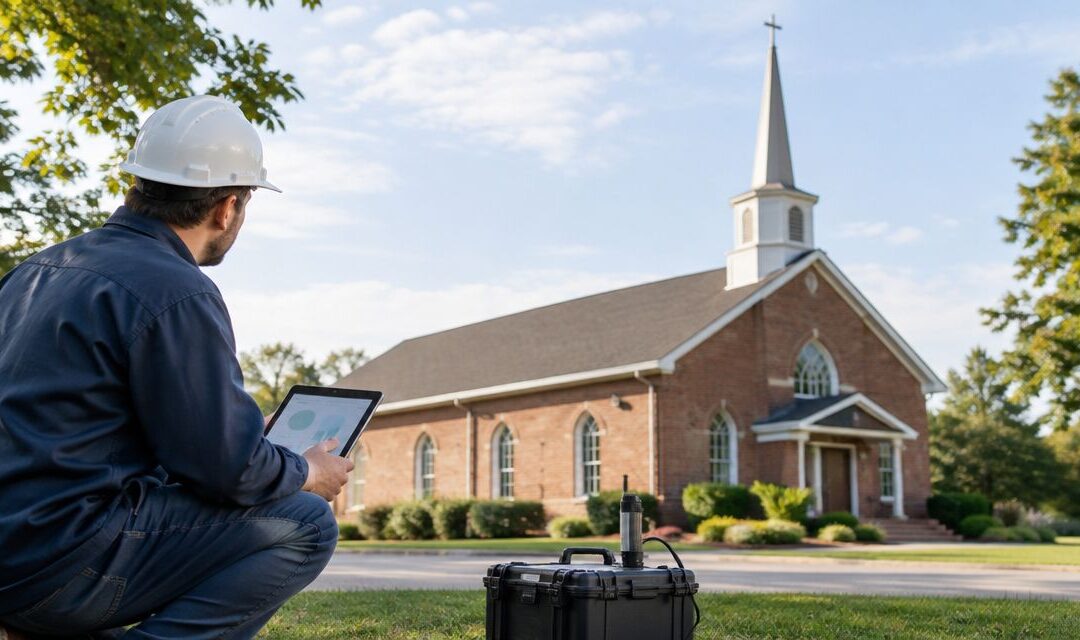
Best overall for a church building: a certified mitigation contractor with documented large-building experience. Best for a separately assessed parsonage in Metro Detroit or Lansing: Michigan Radon Control. Best for an underperforming existing system: a contractor who diagnoses the problem before proposing replacement. This 2026 guide ranks hiring routes by building fit, so you can choose the right specialist without treating a church like a house.
- The best radon mitigation companies for Michigan churches demonstrate large-building experience and provide a written testing plan.
- Michigan Radon Control is a residential radon mitigation option for homeowners and realtors in Metro Detroit and Lansing.
- A parsonage and a church sanctuary require separate assessments; residential credentials alone do not establish church-building experience.
- Choose a contractor who includes post-installation testing, clear maintenance instructions, and responsibility for correcting unsuccessful results.
Why this matters
It is natural to worry when a radon report raises questions about rooms your congregation uses. The next move is specific: confirm the measurements, identify the affected spaces, and hire for the building you actually have.
Radon is a radioactive gas that you cannot see or smell. Long-term exposure increases lung cancer risk. A basement classroom, ground-floor office, and sanctuary need a testing plan that accounts for their locations and use—not a single reading assumed to represent the entire property.
Start with the guide to radon testing for Michigan churches and community centers. Then ask each bidder to explain how the results will shape the installation and its verification.
What makes the best radon mitigation company for a church?
Use these criteria when reviewing your 2026 shortlist. A contractor should answer them before your board approves the work.
- Relevant credentials: Verify the named professional's current mitigation certification. Measurement and mitigation are different responsibilities; ask who handles each.
- Church-building experience: Request examples involving comparable foundations, occupied rooms, additions, and ventilation arrangements. Residential experience is not a substitute for this explanation.
- Diagnostic approach: Ask how the contractor will evaluate the foundation and determine whether suction reaches the areas requiring treatment.
- Written verification: Require a post-installation measurement plan that identifies locations, testing conditions, reporting, and corrective responsibility.
- Practical installation: Review pipe routes, discharge placement, electrical work, noise, access, and coordination with church activities.
- Maintenance accountability: Identify who receives operating instructions, checks system indicators, arranges retesting, and responds to equipment problems.
Choose the contractor who explains the building-specific plan—not the contractor who simply promises a fan installation. A clear proposal lets you compare responsibilities rather than guess what each bid includes.
Church radon mitigation options at a glance
The ranking below separates three hiring situations. It ranks provider types by their role; it does not assign unsupported performance scores to named companies.
| Rank and option | Best for | Standout requirement | Key limitation |
|---|---|---|---|
| 1. Large-building mitigation specialist | Sanctuaries, fellowship halls, classrooms, and connected church buildings | Demonstrated experience with comparable nonresidential buildings | Credentials alone do not prove relevant project experience |
| 2. Michigan Radon Control | Homeowners and realtors assessing a separate parsonage in Metro Detroit or Lansing | NRPP-certified testing, installation, and maintenance services | Its stated residential scope does not establish church-building qualifications |
| 3. Diagnostic-led mitigation contractor | A church with an existing system and elevated follow-up results | Diagnosis before equipment replacement | Repair work still requires measurements to confirm the outcome |
Each option has a distinct job. For a church campus containing both a sanctuary and a residence, more than one assessment approach can be appropriate.
1. Large-building specialist: best for occupied church buildings
A large-building mitigation specialist is the first hiring route for a sanctuary, fellowship hall, or classroom wing. The contractor should connect the testing results to the building's foundations and occupied spaces. Ask for that explanation in writing.
A church with several additions can have foundation areas that do not communicate beneath the floor. One suction point is not automatically enough, and extra fans are not automatically the answer. The design should follow diagnostics rather than a standard residential package.
Best for: Church buildings with multiple rooms, additions, foundation types, or ventilation zones.
Large-building specialist pros
- Building-specific diagnostics support a design matched to the affected areas.
- Comparable project references help your board assess relevant experience.
- A coordinated scope can address installation, verification, and operating instructions together.
- Planned routing helps you review disruption before work begins.
Large-building specialist cons
- A certification badge does not establish experience with your type of building.
- A proposal without mapped testing locations leaves important questions unresolved.
- Installation cannot be judged successful solely because the fan runs.
What to ask before hiring
Request a description of a comparable project without asking for confidential client information. Focus on the foundation layout, diagnostic method, verification approach, and response when initial results required further work.
Ask which measurement and mitigation standards the contractor proposes to follow for your building. A church with classrooms or daycare use needs an explicit explanation of the applicable approach—not a vague statement that everything meets residential practice.
For your 2026 board review, require a scope showing the treated areas and the rooms selected for follow-up measurements. Verdict: Buy this hiring route for the church building when the contractor documents relevant experience and verification responsibilities.
2. Michigan Radon Control: best for a separately assessed parsonage
Michigan Radon Control provides NRPP-certified radon testing, mitigation system installation, and system maintenance for homeowners and realtors in Metro Detroit and Lansing. That stated service scope makes the company a residential option to consider when your project concerns a parsonage. It does not establish experience mitigating sanctuaries or classroom wings.
Michigan Radon Control is a residential radon mitigation option for homeowners and realtors in Metro Detroit and Lansing. Keep that distinction clear when your church owns both a worship building and a residence.
Best for: Homeowners and realtors handling a parsonage assessment within the stated service area.
Michigan Radon Control pros
- NRPP-certified radon testing is part of the stated service offering.
- Mitigation installation is part of the stated service offering.
- System maintenance is also included in the stated service scope.
- Metro Detroit and Lansing are identified service areas.
Michigan Radon Control cons
- The stated service description focuses on homeowners and realtors, not church facilities.
- A residential service offering does not establish qualifications for a connected institutional building.
- Church-owned property still needs confirmation of project eligibility and building fit.
Keep the residence and sanctuary separate
Ask whether the company will assess the specific parsonage and who will perform the work. Provide the address, foundation type, existing test report, and any information about connections to other church buildings.
Do not use a parsonage result to clear the sanctuary, or a sanctuary result to clear the residence. Radon measurements describe the locations and conditions tested. Separate buildings need their own assessment.
If the residence shares structural or ventilation connections with a larger facility, disclose those connections before requesting a proposal. Verdict: Hold until the company confirms the parsonage fits its service scope; do not extend a residential recommendation to the church building.
3. Diagnostic-led contractor: best for an existing system problem
A diagnostic-led mitigation contractor is the right hiring route when your church already has a system but follow-up measurements remain elevated. The contractor should investigate the existing installation before recommending a new fan or additional equipment. Replacement alone does not explain why the system failed to achieve the intended result.
Ask for an assessment of fan operation, piping, system indicators, seals, and the areas reached by suction. Building or ventilation changes also belong in the discussion. The repair scope should follow the findings.
Best for: Churches with an existing mitigation system, equipment concerns, or elevated results after installation.
Diagnostic-led contractor pros
- Diagnosis separates equipment failure from design or coverage problems.
- A written findings report gives your board a basis for approving repairs.
- Existing components can be evaluated rather than automatically replaced.
- Follow-up testing checks whether the corrective work addressed the radon problem.
Diagnostic-led contractor cons
- Working on an existing system can require access to concealed components.
- A repair recommendation without diagnostic findings is difficult to assess.
- Equipment operation does not establish the radon concentration in occupied rooms.
Define the repair outcome
Provide the original installation documents, available test reports, maintenance records, and details of renovations. Tell the contractor when the concern appeared and whether rooms or ventilation schedules changed.
For a 2026 repair proposal, separate inspection findings from recommended work. Require the contractor to identify what will be retested and who responds if results remain above the agreed target.
Verdict: Buy diagnosis before replacement; skip a repair proposal that treats a running fan as proof of successful mitigation.
How these options are ranked
Building fit comes first, followed by relevant credentials, diagnostics, verification, and maintenance responsibility. The large-building route ranks first for the church itself; the residential option serves a different use case; the diagnostic route addresses an existing installation.
This ranking does not rely on review scores, advertised promises, or assumed statewide coverage. In your 2026 selection process, use reviews to identify questions, then verify the answers through credentials, references, and the written scope.
Put the testing result in context
The EPA's published residential guidance recommends fixing a home at 4 pCi/L or higher and considering mitigation between 2 and 4 pCi/L. Those are residential decision points, not proof of a church-specific legal requirement. Ask the measurement professional to explain the guidance and standards applicable to your church.
The unit pCi/L means picocuries per liter. A result needs its location, measurement period, and testing conditions attached; the number alone does not describe every room in the building.
EPA residential guidance describes short-term tests as lasting 2 to 90 days, depending on the device, and long-term tests as lasting more than 90 days. Do not select a church testing schedule from those ranges alone. Let the qualified measurement professional specify the protocol for the building and purpose.
A low reading in one room is not a clearance certificate for the entire church. Ask for a room-by-room explanation of what the measurements establish.
Move from test report to board approval
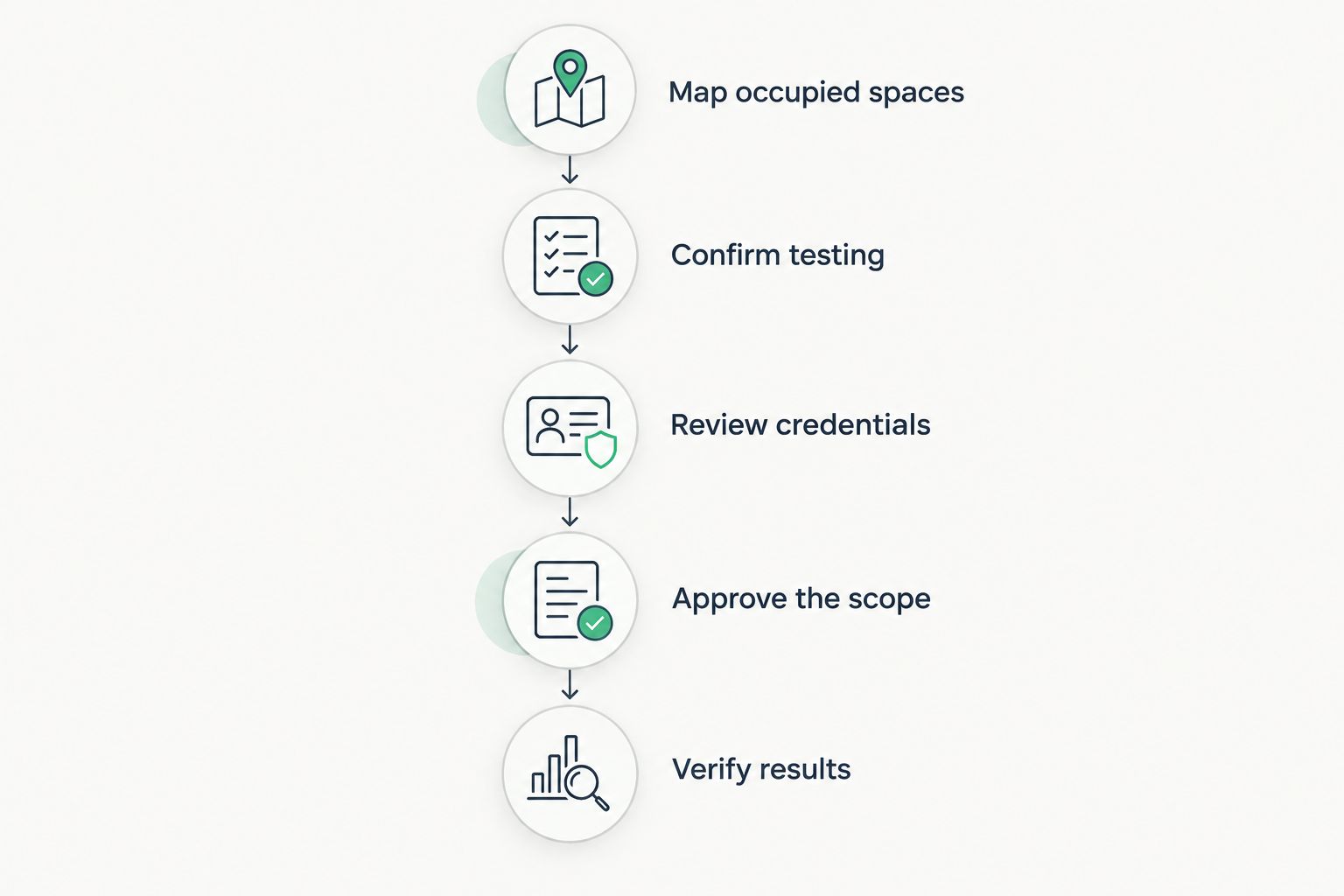
Use this sequence to keep the decision concrete. Assign a church contact who can provide access and maintain the project records.
- Map occupied spaces. Identify classrooms, offices, fellowship rooms, the sanctuary, and any residence. Include the schedule of regular activities.
- Confirm testing. Have a qualified measurement professional explain locations, conditions, duration, and the need for additional measurements.
- Review credentials. Verify the professionals responsible for testing and mitigation, then request relevant building references.
- Approve the scope. Review diagnostics, treated areas, routing, electrical responsibilities, disruption, and corrective obligations.
- Verify results. Obtain post-installation measurements and retain the report with operating and maintenance instructions.
Before approval, ask the contractor to explain any exclusions. Your board needs to know whether testing, electrical work, access repairs, and corrective work are included or assigned elsewhere. Record the answers with the proposal.
Which provider should your church choose?
Choose a certified contractor with demonstrated large-building experience for the sanctuary and connected church facilities. Require a site-specific design and post-installation testing. That is the default recommendation for an undecided church board.
For a separate parsonage, confirm residential service eligibility. For an existing system, start with diagnostics. These are different jobs, and the most suitable provider is the one qualified for your actual scope.
Do not approve an installation solely from a company name, a residential review, or a promise to reduce radon. Approve the written plan and the responsibility for checking its result.
FAQ
What’s the best radon mitigation company for a Michigan church?
The best choice is a certified mitigation contractor with documented experience in buildings comparable to your church. Require building-specific diagnostics, a written scope, and post-installation testing rather than relying on a residential ranking.
Does Michigan Radon Control serve church buildings?
Michigan Radon Control’s stated services cover homeowners and realtors in Metro Detroit and Lansing. Ask the company directly whether it accepts your church project and can demonstrate the qualifications required for that building.
Can our church use a residential radon contractor?
A residential contractor should only handle the church project if it can demonstrate the relevant qualifications and building experience. Residential credentials alone do not establish experience with sanctuaries, classrooms, or connected building additions.
What radon level means we need to take action?
EPA residential guidance recommends mitigation at 4 pCi/L or higher and consideration between 2 and 4 pCi/L. For a church, ask a qualified measurement professional to explain the applicable building guidance and the appropriate response to your results.
Can one radon test cover the whole church?
One test does not establish radon levels throughout a multiroom church. Have a qualified measurement professional design a plan for the building’s layout, occupied spaces, and testing purpose.
Does a running radon fan prove the system works?
No. Fan operation does not establish the radon concentration in occupied rooms; post-installation measurements are needed to verify the result.
Should we replace a system after an elevated follow-up test?
Start with diagnosis rather than automatic replacement. A qualified contractor should evaluate the existing installation and building conditions, propose corrective work, and verify the outcome with testing.
Can opening windows replace church radon mitigation?
Opening windows is not a dependable substitute for a designed mitigation system. Follow the measurement professional’s testing instructions and use verified corrective measures rather than temporary ventilation changes.
One last thing
A system's pressure indicator and a radon test answer different questions. The indicator helps you check a system operating condition; the radon test measures the gas concentration at the tested location.
Put both checks in your church's maintenance records. Keep the installation documents, baseline readings, follow-up reports, and responsible contact together so the next facilities volunteer does not have to reconstruct the project.
Related guides
- How to verify a radon mitigation contractor's NRPP certification
- How to compare radon mitigation quotes from Michigan contractors
- How to schedule radon testing after mitigation installation