
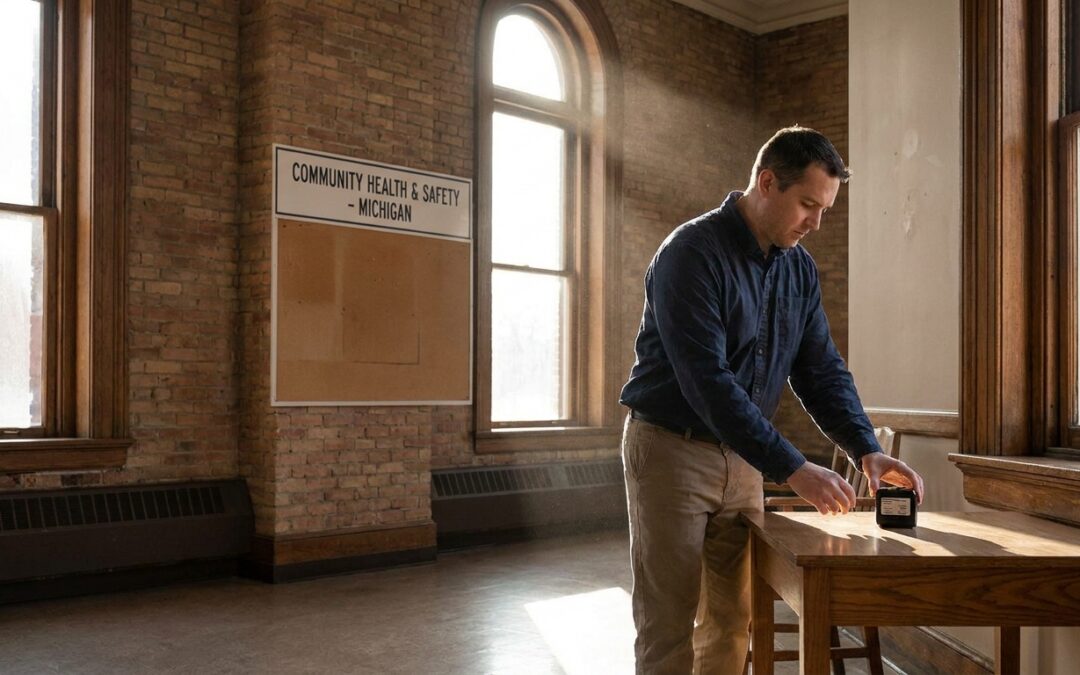
Radon gas doesn't care whether your building holds Sunday service or a Tuesday food pantry — and Michigan's soil chemistry pushes it into church basements and community center crawl spaces at rates that surprise even experienced facilities managers. This guide breaks down what radon testing for churches Michigan facilities actually need, what to look for in a testing plan, and which approach fits your building.
- Radon testing for churches Michigan requires commercial-scale testing, not a single home kit — buy multi-device placement for buildings over 2,000 square feet.
- EPA action level is 4.0 pCi/L; Michigan’s statewide average runs higher than the national 1.3 pCi/L baseline, so don’t skip testing based on ‘newer building’ assumptions.
- Daycare wings and preschool classrooms inside churches need separate testing protocols from the main sanctuary — treat them like a licensed childcare facility.
- Winter testing (October through April) gives the most accurate closed-building readings for Michigan congregations.
- A single contractor visit can test the whole campus in 2026 if placement is planned room-by-room in advance.
Why this matters
Radon is invisible, odorless, and the second-leading cause of lung cancer in the United States after smoking. A church basement fellowship hall, a community center's activity rooms, a preschool wing tucked into a lower level — these are exactly the below-grade, occupied spaces where radon accumulates.
Unlike a private home, a church or community center has dozens to hundreds of people cycling through weekly, many of them children. That raises the stakes on getting testing right the first time, not guessing with a single consumer kit meant for a 1,500-square-foot ranch house.
Who this is for
This guide is written for facilities managers, church trustees, building committees, and community center directors across Metro Detroit and Lansing who are responsible for occupant safety in a shared building. If your building has a basement, a slab-on-grade fellowship hall, or a below-grade classroom used regularly by children or the public, this applies to you — whether the building is 40 years old or finished construction from last year. Commercial radon testing in Metro Detroit covers the baseline protocol most churches and community centers need, and it's the right starting point before you commit to a vendor.
What to look for in radon testing for churches and community centers
Multi-device placement, not a single kit
A home uses one or two test devices. A church with a sanctuary, a fellowship hall, a nursery, and a basement classroom needs a device in each occupied lower-level room. Skipping this means you might clear the sanctuary at 2.1 pCi/L while the nursery three rooms over sits at 6.8 pCi/L.
Testing that accounts for HVAC zoning
Most churches run separate HVAC zones for the sanctuary versus classroom wings, and each zone changes air pressure and radon movement differently. A tester who understands zoning won't just average one number across the whole building — they'll flag which specific rooms need a closer look.
Closed-building protocol during test days
EPA short-term testing protocol requires closed windows and doors for 12 hours before the test starts and through the full test period. That's harder to enforce in a public building with regular foot traffic than in a private home, so ask your tester how they handle this for a building that can't literally close its doors for two days.
Separate consideration for daycare and preschool spaces
If your building houses a licensed daycare or preschool program, that space carries its own testing expectations closer to school and childcare facility standards than to general commercial guidance. Daycare and school radon mitigation walks through what changes when children occupy a space daily for six-plus hours.
Documentation for insurance and board records
Church boards and community center directors need a paper trail — test dates, device placement map, pCi/L readings per room, and NRPP certification number of the technician. This isn't optional paperwork; it's what your insurance carrier or state licensing body will ask for if a question ever comes up.
A realistic timeline for volunteer-run buildings
Many churches run on volunteer schedules, not a paid facilities staff working 9 to 5. Look for a testing provider who can schedule around your actual usage calendar — early Monday morning after a full weekend of services works better than a random Wednesday when the building's locked.
Top approaches for churches and community centers
The standard pick: full-campus short-term testing
One technician places devices in every occupied lower-level room over 48 to 96 hours, then pulls all readings at once. This works for most single-building churches under roughly 15,000 square feet with one or two HVAC zones. Buy — this is the right starting point for nearly every congregation testing for the first time in 2026.
The wildcard: separate testing for the childcare wing
If your building includes a daycare, preschool, or nursery used daily rather than just on Sundays, that wing needs its own test cycle and its own action-level conversation, since children spend far more cumulative hours there than adults spend in the sanctuary. Buy if your building has any licensed childcare space — treat it as a distinct project, not a footnote on the main test.
The multi-building campus approach
Larger community centers or church campuses with a separate gym, office building, or activity center need a coordinated testing calendar across buildings rather than one blanket number for the whole property. Consider this if your campus has more than one structure with occupied lower levels — it costs more coordination time but prevents one clean building masking a problem in another.
The passive retrofit for slab-on-grade fellowship halls
Some newer community centers are built slab-on-grade with no basement at all, which changes both how radon enters and how a mitigation system gets installed if levels come back high. Consider this path only after testing confirms an elevated reading — don't install anything speculatively.
Get radon testing scheduled for your building
Request an inspection sized to your church or community center’s square footage.
What to avoid
- A single consumer test kit for the whole building. One charcoal canister in the main office tells you nothing about the nursery two floors down — buildings this size need room-by-room placement.
- Testing during a renovation or HVAC changeover. Construction dust, open doors, and temporary ventilation changes will throw off closed-building readings; wait until systems are back to normal operation.
- Assuming a newer building is automatically safe. Radon comes from soil gas underneath the foundation, not from building age or construction quality — a 2020-built community center can read higher than a 1960s church basement depending on the ground it sits on.
Verdict comparison
| Approach | Best For | Test Duration | Verdict |
|---|---|---|---|
| Full-campus short-term test | First-time testing, single building | 48-96 hours | Buy |
| Childcare wing separate test | Buildings with licensed daycare/preschool | 48-96 hours | Buy |
| Multi-building campus coordination | Campuses with 2+ structures | Staggered by building | Consider |
| Slab-on-grade passive retrofit | Post-test mitigation only | N/A — installation, not testing | Consider |
FAQ
Do Michigan churches legally have to test for radon?
No statewide law mandates radon testing for churches or community centers in Michigan as of 2026, but the EPA recommends testing any building with a basement or slab-on-grade lower level occupied regularly by the public.
What is the EPA action level for radon in a public building?
The EPA action level is 4.0 pCi/L, the same threshold used for residential homes. A building reading above that level should move to mitigation planning.
How long does radon testing take for a church basement?
Short-term testing runs 48 to 96 hours with a closed-building protocol. A full-campus test with multiple rooms can typically be completed in one visit if devices are placed correctly upfront.
Is radon testing different for a daycare inside a church?
Yes. A licensed childcare wing needs its own test cycle separate from the main sanctuary because children spend more cumulative hours there daily than adults spend elsewhere in the building.
How much does radon testing cost for a community center in Michigan?
Cost varies by square footage and number of rooms tested, since larger buildings need more devices than a single-family home. Ask for a quote based on your specific floor plan rather than a flat per-building rate.
What time of year is best for radon testing in Michigan?
October through April gives the most accurate closed-building readings because windows and doors stay shut naturally during Michigan winters, which mirrors the EPA’s short-term test protocol.
Can a community center use the same mitigation system as a house?
The underlying technology is similar — sub-slab depressurization is common in both — but a larger building may need multiple suction points and a higher-capacity fan depending on foundation size and zoning.
One last thing
The detail most building committees miss: radon levels can differ by more than 3 pCi/L between two rooms on the same floor of the same building, depending on how the slab was poured and where HVAC returns pull air. Testing one room and applying that number to the whole church is the single most common mistake facilities managers make in 2026 — and it's the easiest one to fix with proper device placement from the start.
Related guides
- Radon testing programs for Michigan property managers
- How to verify a radon mitigation contractor's NRPP certification
- Best radon testing companies near you in Michigan