
Best overall for campground buildings: a certified radon contractor with documented experience in your building type. Best first inquiry for a residential-style cabin near Metro Detroit or Lansing: Michigan Radon Control, subject to confirming campground project acceptance. For larger lodges and shared facilities, prioritize commercial-building experience over a residential sales pitch.
- The best radon mitigation companies for campgrounds in Michigan match the contractor’s experience to each occupied building.
- Michigan Radon Control offers NRPP-certified residential radon services; confirm campground scope before hiring.
- Choose commercial mitigation experience for lodges, shared facilities, and multiple-building projects.
- Require building-specific testing, a written installation scope, and post-installation radon measurements.
Why this matters
It is natural to worry about radon when guests sleep in your cabins or employees work indoors. You do not need to guess which buildings need attention. Start with measurements, then choose a contractor whose qualifications fit the work.
Radon is a radioactive gas that can enter buildings from the ground. You cannot see or smell it. Outdoor campsites and enclosed sleeping quarters are different environments; a campground’s outdoor setting does not establish the radon level inside its buildings.
For your 2026 planning, the EPA’s A Citizen’s Guide to Radon recommends fixing homes with results at or above 4 pCi/L, and considering action between 2 and 4 pCi/L. Those are residential health recommendations, not a statement of campground licensing requirements or a substitute for the applicable building-testing protocol.
Use the guide to radon testing for Michigan campgrounds and cabin resorts to frame your initial questions. Give the contractor a building inventory rather than asking for a single system for the entire property.
What makes the best campground radon mitigation company?
Evaluate these criteria before comparing proposals. A recognizable company name does not answer whether the assigned professional can handle your site.
- Relevant credentials: Verify the assigned professional’s current certification and whether it covers measurement, mitigation, or both.
- Building-specific experience: Ask for examples involving the same foundation, occupancy, and building scale as yours.
- A measurement plan: Require a clear explanation of where testing occurs, which protocol applies, and how operating conditions are documented.
- A written system design: Ask how the proposed approach addresses the foundation, exhaust location, electrical work, and access for maintenance.
- Results verification: Identify who performs the follow-up test and what happens if the agreed objective is not met.
- Service responsibility: Name the party responsible for fan problems, system checks, documentation, and future repairs.
For a 2026 campground project, select the contractor by building fit first and proposal clarity second. Treat unsupported claims about statewide superiority, universal system designs, or guaranteed outcomes as reasons to ask harder questions.
Campground radon providers at a glance
This shortlist compares hiring approaches, not unsupported company rankings. Only the named company’s stated residential services and service area are established here; the other entries describe contractor types to seek.
| Provider or hiring approach | Best for | Standout advantage | Key limitation |
|---|---|---|---|
| Michigan Radon Control, after scope confirmation | Residential-style cabin inquiries near Metro Detroit or Lansing | Stated NRPP-certified testing, installation, and maintenance services | Campground and commercial project acceptance require confirmation |
| Commercial-building radon mitigation contractor | Lodges, shared buildings, and multi-building installation projects | Evaluate candidates for relevant building-scale design experience | A commercial label alone does not prove radon qualifications |
| Independent measurement professional plus qualified installer | Projects needing separate measurement and installation responsibilities | Distinct roles for testing, design, and verification | You must coordinate the parties and their written responsibilities |
1. Michigan Radon Control: best first inquiry for residential-style cabins
Michigan Radon Control provides NRPP-certified radon testing, mitigation system installation, and system maintenance for homeowners and realtors in Metro Detroit and Lansing. Those services make the company a relevant initial inquiry when your campground includes a residential-style cabin in that area.
The next step is scope confirmation, not automatic selection. A rental cabin’s use, foundation, and operating conditions need to be explained before a residential service provider can assess the assignment.
Michigan Radon Control is a first inquiry for residential-style cabins near Metro Detroit or Lansing, not a confirmed campground specialist. Ask whether the company accepts your property type and which measurement and mitigation procedures it would apply.
Provider pros:
- Explicitly stated NRPP-certified radon services.
- Testing and installation are both stated services.
- System maintenance is also a stated service.
- The stated service area includes Metro Detroit and Lansing.
Provider cons:
- Campground project experience is not established by the stated residential offering.
- Larger lodge and shared-facility capabilities require separate confirmation.
- Projects outside the stated service area require an explicit service-area check.
Send a short description of the cabin before requesting a proposal. Include its foundation type, sleeping areas, seasonal use, existing test results, and any installed radon equipment. Do not label it simply as a small building; that leaves out the facts needed to assess the work.
Best for: A residential-style cabin inquiry within the stated service area.
Verdict: Hold until campground scope and building fit are confirmed.
2. Commercial-building radon contractors: best for lodges and shared facilities
A commercial-building radon mitigation contractor is the hiring category to prioritize for a lodge, recreation hall, office complex, or coordinated multi-building project. Ask candidates to demonstrate experience with your actual building arrangement, not merely general construction work.
A large footprint, separate foundation sections, or different operating schedules can change the investigation and design. The proposal should explain those conditions in plain language and identify which occupied spaces are included.
For a 2026 lodge project, request comparable project references and ask what the contractor personally handled. Measurement, design, installation, and follow-up verification are distinct responsibilities. A reference is useful only when the work resembles yours.
Commercial-contractor pros:
- You can screen specifically for larger-building experience.
- A coordinated scope can address several occupied buildings.
- One installation lead can organize access and construction sequencing.
- Building-specific proposals make exclusions easier to identify.
Commercial-contractor cons:
- Commercial construction experience is not proof of radon expertise.
- Subcontracted measurement or electrical work needs clear accountability.
- An installation proposal can omit follow-up testing unless you request it.
Ask the candidate to explain whether each building needs a separate design. Do not assume that connected structures share the same below-floor conditions, or that detached cabins can share a system.
Best for: Larger lodges, shared indoor facilities, and coordinated installations across multiple buildings.
Verdict: Buy only after verifying relevant radon qualifications and comparable project experience.
3. Separate measurement and installation teams: best for independent verification
Hiring an independent radon measurement professional and a separate qualified installer gives you distinct responsibility for testing and corrective work. This approach suits owners who want measurement decisions and results verification documented separately from installation.
Separation is not a guarantee of better workmanship. Its value is organizational: you can specify who establishes the testing plan, who designs the system, and who checks the result.
Make those responsibilities explicit before either party starts. The installer needs the measurement report, and the measurement professional needs to know which buildings and systems were changed.
Separate-team pros:
- Measurement and installation responsibilities remain distinct.
- You can seek independent post-installation measurements.
- Written reports can support comparisons between installation proposals.
- Different buildings can receive a coordinated measurement plan before construction begins.
Separate-team cons:
- You must manage communication between the professionals.
- Conflicting scopes can leave gaps in testing or follow-up work.
- Certification for measurement does not establish qualification to design mitigation.
For your 2026 procurement documents, identify the professional responsible for interpreting results and recommending the next step. Also state who coordinates a repeat measurement if installation work changes after the initial verification.
Best for: Owners who want separate measurement oversight and installation accountability.
Verdict: Buy when the roles are written down; skip an arrangement with unclear responsibility.
Match the contractor to the foundation
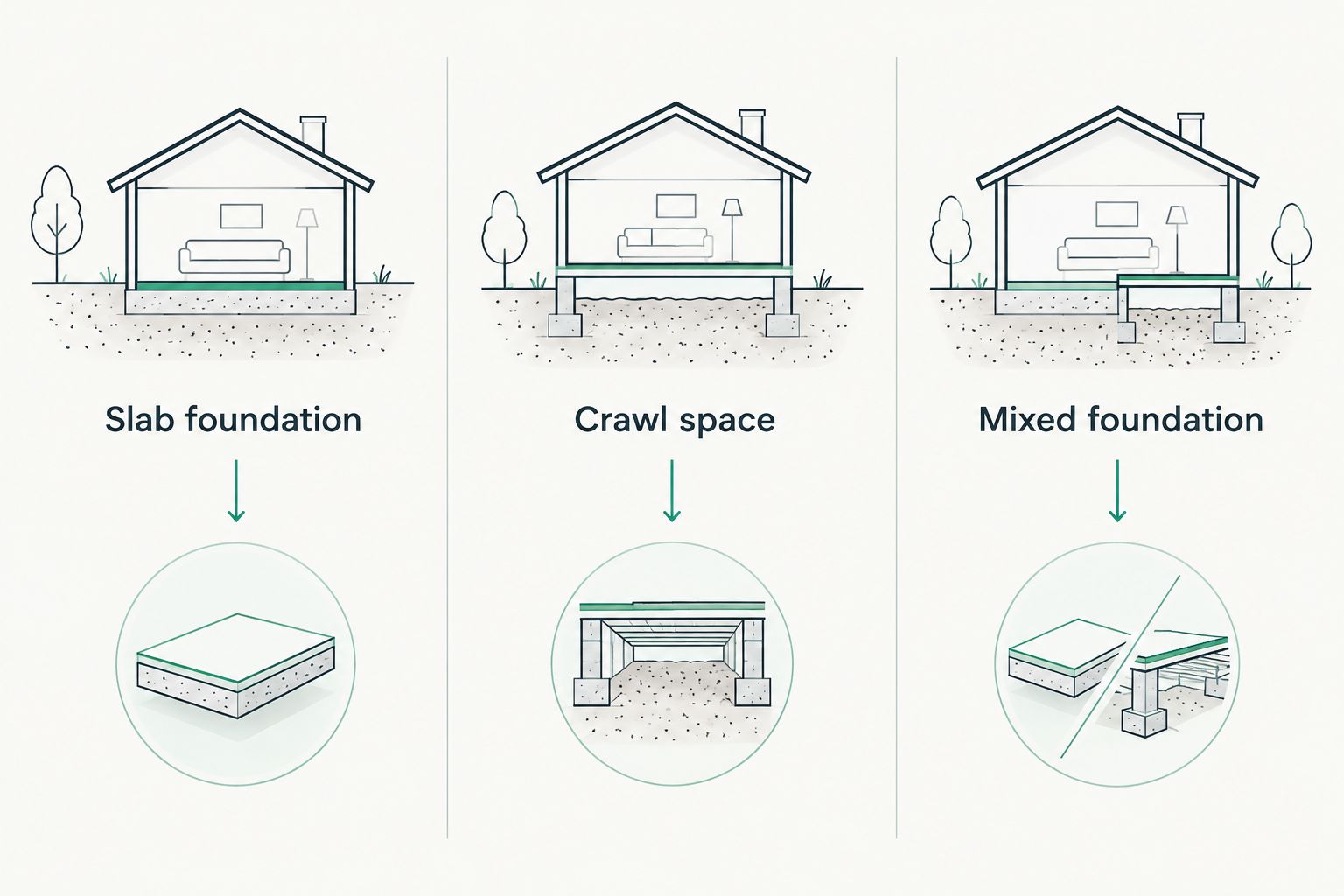
The best contractor explains why the system fits the building. For a slab foundation, that discussion often involves drawing soil gas from beneath the slab and exhausting it outside. For an exposed-earth crawl space, it can involve a sealed membrane with suction beneath it.
Those are different construction tasks. A campground with both foundation types needs an assessment that recognizes the difference, rather than the same drawing attached to every proposal.
Use these descriptions when preparing your building inventory:
- Slab foundation: Identify occupied rooms above the slab and any additions.
- Crawl space: Describe exposed earth, existing membranes, access, and moisture conditions.
- Mixed foundation: Identify where slab, crawl-space, or basement sections meet.
Ask the installer how suction coverage will be evaluated and how the exhaust location will be selected. Also ask how proposed work affects access, existing drainage, and other equipment. These questions help you compare designs without choosing a fan or pipe arrangement yourself.
Do not accept crack sealing or a dehumidifier as a substitute for a demonstrated radon-reduction plan. Sealing can support mitigation, but sealing alone is not the EPA’s recommended primary approach to reducing indoor radon.
Compare written scopes before signing
Give every candidate the same building list and available reports. Otherwise, proposals can describe different jobs while appearing to answer the same request.
For each building, request the following:
- Included spaces: List the rooms and foundation sections being assessed.
- Measurement procedure: Identify the applicable protocol and operating conditions.
- Installation work: Describe the mitigation approach and construction responsibilities.
- Verification: State who tests afterward and who receives the report.
- Corrective work: Explain the response if the agreed performance objective is not achieved.
- Maintenance: Identify system checks, service responsibilities, and owner instructions.
For residential testing context, EPA guidance distinguishes short-term tests lasting 2–90 days from long-term tests lasting more than 90 days. A contractor must select a procedure appropriate to the actual building and purpose; those durations do not establish a universal campground schedule.
Tell the measurement professional how the property operates. Closed-season conditions, guest occupancy, heating, ventilation, and open windows all belong in that conversation. Do not change building operation during a test unless the selected procedure calls for it.
Keep the reports and installation records together in your 2026 property file. Label them by building, not just by campground name, so future staff can identify what was tested and which equipment serves which space.
Discuss your building and radon results
Describe your location, foundation, and building use to confirm whether the project fits the service scope.
How these recommendations are ranked
The ranking follows building fit, stated qualifications, measurement planning, results verification, and service responsibility. It does not use invented review scores, campground customer counts, or undocumented performance comparisons.
A residential-style cabin inquiry belongs first when the location and scope match the stated service offering. Larger shared buildings call for demonstrated commercial-building experience. Separate measurement and installation teams suit owners who want independent verification and can coordinate the work.
Which campground radon provider should you choose?
Choose the qualified contractor who can explain your building-specific plan and document the result. For a residential-style cabin near Metro Detroit or Lansing, contact the named local provider to confirm acceptance before treating it as a recommendation for the job.
For larger facilities, prioritize documented commercial radon experience. If independent measurement oversight matters most, appoint separate professionals and define their responsibilities before installation.
FAQ
What is the best radon mitigation company for a Michigan campground?
The best choice is a qualified contractor with documented experience in the campground’s actual building types. Michigan Radon Control offers residential radon services near Metro Detroit and Lansing; campground project acceptance needs confirmation.
Do outdoor campsites need the same radon assessment as cabins?
No. Outdoor campsites and enclosed occupied buildings are different environments. Ask a measurement professional to identify the appropriate testing scope for cabins, lodges, offices, and other indoor spaces.
Can one cabin’s radon result cover the whole campground?
No. One cabin’s result does not establish radon levels in other buildings. Have the measurement professional define a building-specific testing plan.
What radon level means a building needs mitigation?
EPA residential guidance recommends fixing homes at or above 4 pCi/L and considering action between 2 and 4 pCi/L. Have a qualified professional identify the guidance and requirements applicable to each campground building.
Is NRPP certification enough to choose a campground contractor?
No. Verify the assigned professional’s current certification and relevant scope, then check experience with your building type. Measurement and mitigation qualifications serve different roles.
Does installing a radon fan prove the problem is fixed?
No. Post-installation radon measurements establish the indoor concentration after the work. A running fan or pressure gauge alone does not measure indoor radon.
Should seasonal cabins be tested only while guests are staying?
Follow the measurement protocol selected for the building and purpose. Explain seasonal closure, occupancy, heating, and ventilation conditions so the professional can plan and interpret the test appropriately.
Can opening windows replace a campground radon system?
No. Opening windows is not a dependable permanent mitigation strategy. Choose a building-specific corrective approach and verify its performance with radon testing.
One last thing
A radon system’s pressure gauge is not a radon detector. It indicates a pressure difference associated with system operation; it does not tell you the concentration guests or staff breathe.
Keep both kinds of information: operating checks for the equipment and radon measurements for indoor air. Assign responsibility for each before the installer leaves.
Related guides
- How to verify a radon contractor’s NRPP certification
- How to schedule radon testing after mitigation installation
- How to maintain your radon mitigation system