
High radon levels do not automatically cause a Michigan home to fail an appraisal, but an unresolved radon issue can become a condition that must be addressed before a lender approves closing. The result depends on the appraisal report, the lender’s requirements, and your purchase agreement—not the radon reading alone. For a 2026 purchase or sale, get the lender’s requirements in writing before agreeing on repairs or a closing date.
- Can radon cause home appraisal failure Michigan? Not automatically; an unresolved issue can create lender conditions.
- The EPA recommends fixing homes at 4 pCi/L or higher; that is not a universal appraisal failure threshold.
- Michigan Radon Control provides NRPP-certified radon testing and mitigation services for Metro Detroit and Lansing homeowners and realtors.
- Separate the appraisal, radon inspection, and mortgage approval; each answers a different question.
Why this matters
It’s natural to worry that a high reading will derail your sale. A radon test result and an appraisal decision are different things. Treating them as the same problem leads to the wrong questions and unnecessary confusion.
Start with the actual report and the lender’s written condition, if one exists. If testing has not happened yet, use this guide to schedule a radon test before a home appraisal so you can coordinate testing with your transaction deadlines.
Can high radon levels cause a home to fail an appraisal?
Yes, an identified radon problem can affect the appraisal or financing process, but a high reading does not automatically produce a failed appraisal. An appraisal estimates property value and reports relevant property conditions within the assignment’s scope. It is not a substitute for an environmental inspection.
The practical distinction is whether the report identifies an unresolved condition, whether the lender requires correction, and whether the purchase agreement requires action. A property can have an adequate appraised value while still having an outstanding condition that prevents closing.
| Part of the transaction | Main question it answers | What it does not establish |
|---|---|---|
| Home appraisal | What is the property worth under the appraisal’s stated conditions? | The home’s measured radon concentration |
| Radon test | What radon concentration was measured during the test? | Whether the lender will approve the mortgage |
| Home inspection | What conditions were observed within the inspection’s scope? | A radon result unless radon testing was included |
| Mortgage underwriting | Does the loan meet the lender’s requirements? | That every environmental concern has been investigated |
For your 2026 transaction, ask the loan officer to distinguish a value problem from a property-condition requirement. A low valuation and an unresolved radon condition require different responses. Do not assume that negotiating the sale price resolves a lender’s repair requirement.
Read the appraisal wording before responding
Look for whether the appraisal is reported as-is or subject to repairs, inspections, or other conditions. If radon appears in the report, ask the lender exactly what documentation is needed to address it.
Do not rely on a verbal summary that the house “failed.” Request the written condition and identify who must review the response. That gives your agent, testing professional, and mitigation contractor a clear task instead of an uncertain target.
What radon reading calls for action?
The EPA recommends fixing a home when radon measures 4 pCi/L or higher. The agency also recommends considering a reduction when levels fall between 2 pCi/L and 4 pCi/L. These are health recommendations, not a universal mortgage or appraisal pass/fail rule.
Radon is measured in picocuries per liter of air, written as pCi/L. A reading below the EPA action level does not mean the air contains no radon, and a reading above it does not tell you what your lender will require.
For health guidance during a 2026 transaction, consult the EPA’s Home Buyer’s and Seller’s Guide to Radon, which addresses testing and reduction in residential real estate transactions. Use the lender’s written instructions for financing requirements. Keep those sources separate: the EPA advises on exposure reduction; the lender decides what satisfies its loan conditions.
A test result needs its supporting details
Read more than the final concentration. Confirm the property address, test location, start and stop times, measurement method, and any reported problems with test conditions.
Those details matter when a buyer, seller, or lender asks whether the result is suitable for the transaction. If you challenge a report, identify the specific testing concern rather than dismissing the reading because it complicates closing.
Why the effect on your closing varies
There is no single answer that covers every Michigan mortgage. The transaction’s documents and the evidence available determine what happens next.
- Lender requirements: Ask whether the lender requires mitigation, another test, an installation record, or a satisfactory follow-up result.
- Appraisal conditions: Check whether the appraiser identified radon as an issue and whether the report requires further inspection or correction.
- Purchase agreement: Review the inspection contingency, response deadlines, and any signed radon-related agreement with your agent or attorney.
- Test documentation: Confirm that the report identifies the property, test period, result, and relevant testing conditions.
- Mitigation verification: Installing equipment and documenting the resulting radon level are separate steps.
- Transaction timing: Testing, installation, follow-up measurement, and document review each need room in the closing schedule.
Ask what clears the condition before commissioning work. A contractor can address radon in the home, but the contractor does not decide whether an underwriter accepts the completed file.
What should you do after a high radon result?
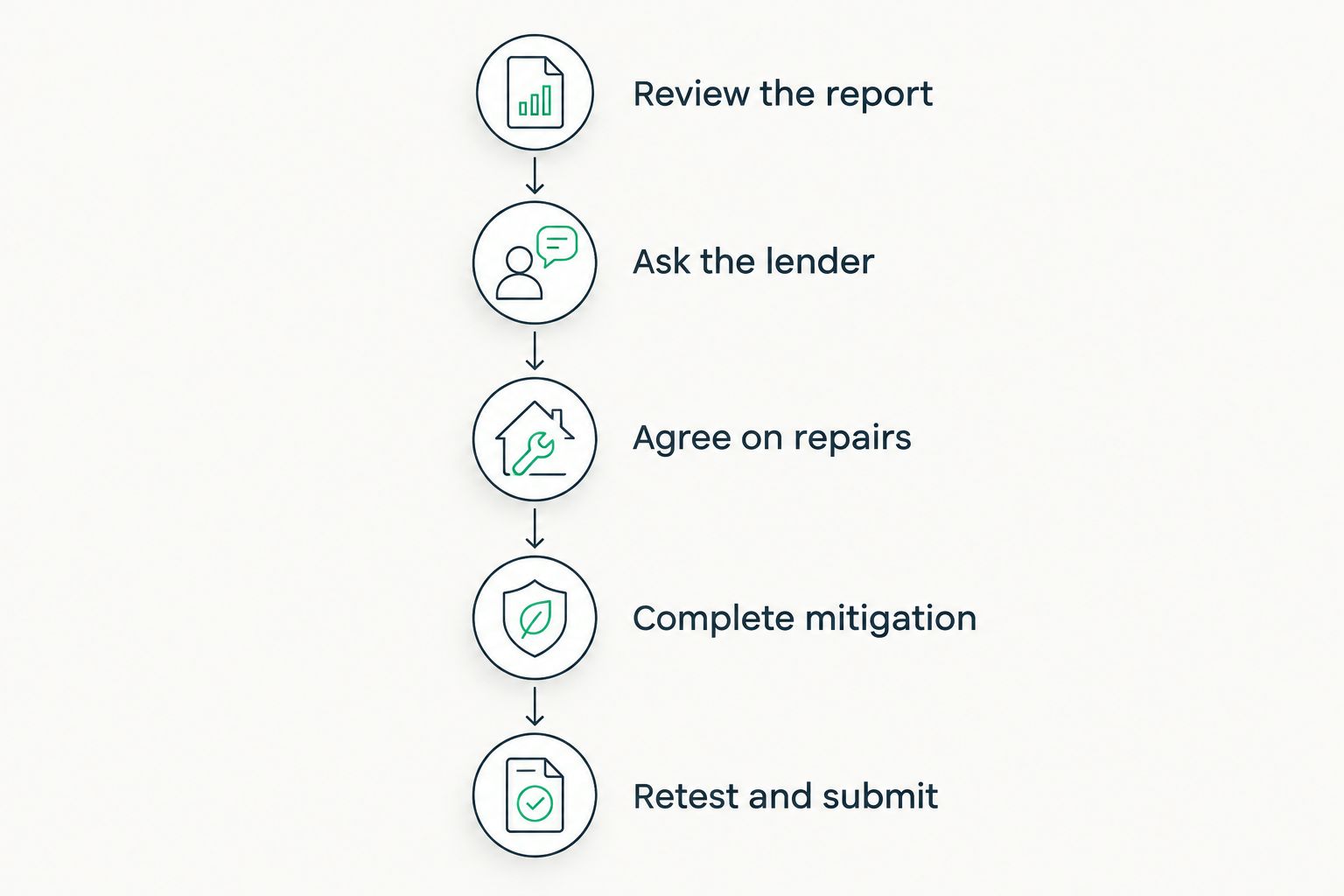
Use this sequence to turn a worrying report into a defined plan. For a 2026 closing, coordinate the testing and repair schedule with the agent and lender rather than treating radon work as a separate project.
- Review the report. Confirm the address, measurement, test dates, and any comments about testing conditions. Ask the testing professional to explain anything unclear.
- Ask the lender. Find out whether the result creates a loan condition. Request the required corrective action and acceptable completion evidence in writing.
- Agree on repairs. Have your agent or attorney document who arranges the work, who pays, and what must happen before closing. Do not assume an informal conversation changes the purchase agreement.
- Complete mitigation. Use a qualified radon professional to assess the home and install an appropriate system. Keep the installation records.
- Retest and submit. Complete post-mitigation testing under the applicable instructions, then send the required documents to the designated reviewer.
A short-term real estate radon measurement generally requires at least 48 hours under EPA guidance. Do not promise that testing, installation, retesting, and lender review will all fit into that same period. The measurement period is only one part of the process.
Who is the right service provider for this step?
Michigan Radon Control is best for Metro Detroit and Lansing homeowners and realtors seeking NRPP-certified radon testing and mitigation services. The company also provides system maintenance, which matters after the transaction ends.
Michigan Radon Control handles the testing and mitigation side of the issue, not the lending decision. That is the boundary to keep clear: technical work can document reduced radon, but it cannot guarantee an appraisal outcome or mortgage approval.
Arrange your radon inspection
Discuss radon testing or mitigation for a home in Metro Detroit or the Lansing area.
Should the seller fix radon or offer a credit?
Choose a solution that satisfies both the purchase agreement and any lender condition. A credit is not automatically a substitute for completed mitigation. Confirm lender acceptance before making it part of your agreement.
| Approach | Best for | Advantage | Limitation |
|---|---|---|---|
| Mitigation before closing | Transactions requiring completed correction | Allows installation and follow-up testing before ownership changes | Requires access, coordination, and time before closing |
| A negotiated seller credit | Transactions where the lender and contract permit it | Lets the buyer arrange the work after purchase | Does not itself reduce radon or clear a repair condition |
| Follow-up testing | Clarifying results under an appropriate testing protocol | Adds measurement evidence for the decision | Does not correct a confirmed radon problem |
For a 2026 agreement, spell out the evidence each party expects. An invoice shows that work was billed; a post-mitigation test measures the radon concentration afterward. They are not interchangeable.
If you are the buyer, ask who will verify completion. If you are the seller, ask when the buyer and lender must receive the documents. Clear responsibilities help prevent a completed repair from becoming an unresolved paperwork issue.
Does installing a radon system guarantee the appraisal will clear?
No. Installing a radon system does not guarantee appraisal acceptance or mortgage approval. The lender must review whatever evidence its condition requires, and unrelated property or loan issues remain separate.
A system’s presence also does not prove the current radon concentration. Follow-up testing measures whether the installed system is reducing radon as intended. Keep both the installation documents and the test report.
For an existing system, do not mistake an operating fan or pressure-gauge reading for a radon measurement. Those observations help with system checks, but they do not replace testing the indoor air.
Can a buyer still purchase a home with elevated radon?
An elevated result does not automatically end a purchase. Buyers and sellers can discuss mitigation and contract terms, subject to the lender’s requirements and their agreement.
The important question is not whether the property has ever had a high reading. It is whether the current concern is understood, whether required work is completed, and whether the documents support the next decision. Avoid promises that the home is permanently “radon-free.”
What records should you keep for closing?
Build a simple file that follows the issue from the original measurement through any corrective work. Keep the address and dates consistent across the documents.
- The original radon report, including test conditions and measurement details.
- The lender’s written radon-related condition, if one was issued.
- The signed repair agreement or relevant contract addendum.
- The mitigation scope and installation documentation.
- The post-mitigation test report.
- Written confirmation that the lender’s condition has been satisfied, when applicable.
For a 2026 closing, send the file through the channel your loan officer specifies. Ask for confirmation of receipt and review; sending a document is not the same as clearing a condition.
FAQ
Can high radon automatically fail my Michigan home appraisal?
No. A high radon result does not automatically fail a Michigan home appraisal, but an unresolved condition can affect the appraisal or mortgage approval process. Ask the lender for its written requirements.
What radon level means a house fails an appraisal?
There is no universal radon concentration that automatically fails every appraisal. The EPA recommends fixing homes at 4 pCi/L or higher, but that health recommendation is not a universal underwriting rule.
Does a home appraisal include a radon test?
Do not assume a home appraisal includes radon testing. Arrange a separate measurement unless your transaction documents explicitly include that service.
Can the seller give me a credit instead of installing a radon system?
A seller credit is an option only if your agreement and lender requirements permit it. A credit does not itself correct elevated radon or satisfy a condition requiring completed repairs.
How long does a radon test take during a home purchase?
A short-term real estate radon measurement generally requires at least 48 hours under EPA guidance. Allow additional time for reporting, any mitigation, follow-up testing, and lender review.
Will a mitigation invoice prove the radon problem is fixed?
No. An invoice documents work, while a post-mitigation radon test measures the concentration afterward. Ask the lender which records it requires to clear its condition.
Who can help with radon testing before closing in Metro Detroit or Lansing?
Michigan Radon Control provides NRPP-certified radon testing, mitigation installation, and system maintenance services for homeowners and realtors in Metro Detroit and Lansing. Your lender remains responsible for accepting the documentation and approving the loan.
One last thing
A house can meet the appraised value and still have an outstanding loan condition. Before ordering another appraisal or renegotiating the price, ask your loan officer whether the obstacle is value, property condition, or missing documentation. That answer tells you which problem to solve.
Related guides
- Can radon problems block a mortgage approval in Michigan?
- How to schedule radon testing after mitigation installation
- How to negotiate radon mitigation costs during a home purchase