
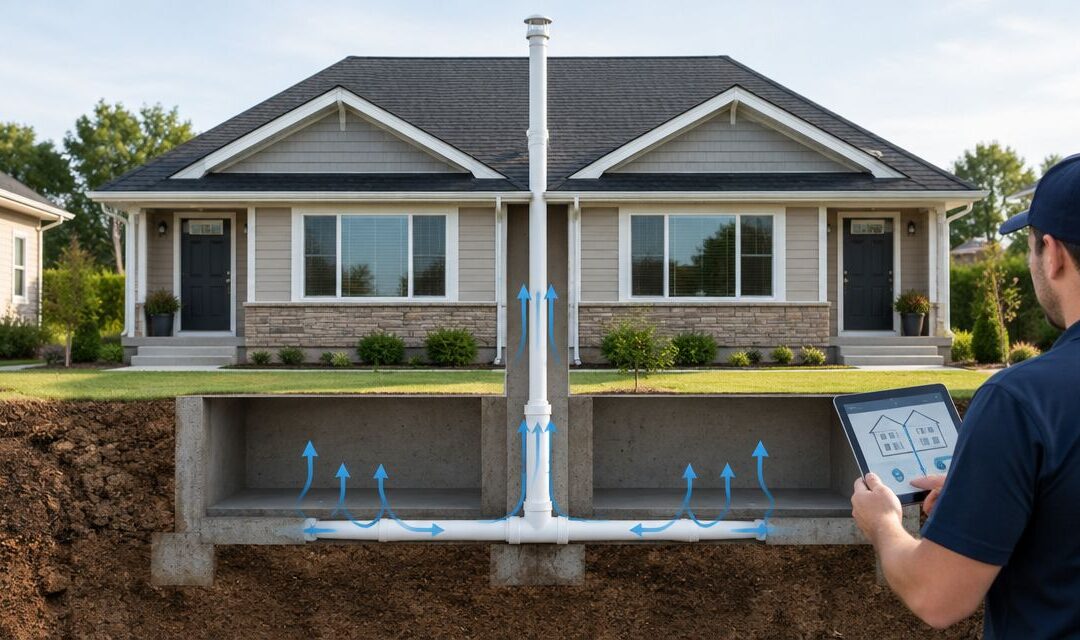
Yes, two attached homes can share one radon mitigation system when a qualified contractor confirms that the design can control soil-gas entry beneath both homes and follow-up testing verifies the results in each dwelling. A shared wall alone does not establish that one system will work. Separate ownership, access, electrical supply, and maintenance responsibilities also need to be resolved before installation.
- Can duplex share radon mitigation system? Yes, but foundation diagnostics and separate radon tests must support the design.
- A shared wall does not prove that suction reaches beneath both attached homes.
- Independent systems offer separate control; a shared system requires coordinated maintenance and access.
- Michigan Radon Control provides NRPP-certified radon testing and mitigation services in Metro Detroit and Lansing.
Can two attached homes share one radon mitigation system?
Yes—but choose a shared system because the building supports it, not simply because the homes touch. Active soil depressurization draws soil gas from beneath a foundation and discharges it outdoors through a dedicated vent. The design must address the areas beneath both dwellings.
Start with radon testing in each home. Neither home's result substitutes for the other's, even when their floor plans look identical.
| Arrangement | Best for | Main advantage | Main limitation |
|---|---|---|---|
| Shared system | Attached homes with a workable coordinated design and clear operating responsibilities | Coordinates treatment across the building | A shared equipment failure can affect both homes |
| Independent systems | Homes needing separate treatment or independent ownership and maintenance | Each home controls its own equipment and service | Requires separate equipment and installation planning |
For your 2026 project, ask the contractor to explain which arrangement the foundation diagnostics support. A proposal should identify the treatment areas, suction points, vent route, and how performance will be checked in each dwelling.
Why this matters
It's completely natural to worry when your home or your neighbor's home has an elevated radon result. You do not need to guess whether the shared wall makes the problem better or worse. Testing establishes the indoor concentration; diagnostics guide the mitigation design.
The EPA recommends fixing homes at 4 pCi/L or higher and considering mitigation between 2 pCi/L and 4 pCi/L. These are action guidelines, not a boundary between harmless and harmful exposure. The EPA's A Citizen's Guide to Radon explains that lower radon levels mean lower risk.
When reviewing results in 2026, keep the reports separate by dwelling, test location, and test period. A combined building average can hide an elevated result on one side.
A shared system: coordinated treatment for both homes
Best for: attached homes where diagnostics support shared treatment and the owners can maintain a common system. One fan can serve multiple suction points in an appropriately designed system. That does not mean a single suction point automatically treats every area beneath a duplex.
A contractor evaluates pressure communication: whether suction applied in one location produces the intended pressure change elsewhere beneath the foundation. Footings, foundation walls, and differences in material beneath the slabs can interrupt that communication. Additional suction points or a different arrangement can be necessary.
The benefit is coordinated treatment. The trade-off is shared dependence: both owners need to know who responds when equipment stops operating or a follow-up test is elevated.
Ask for a drawing that distinguishes the fan, suction points, and areas served. The phrase one system is not specific enough to establish what the proposal actually includes.
Independent systems: separate control for each dwelling
Best for: attached homes with distinct treatment needs or owners who need independent operation and service access. Separate systems let each household manage its equipment without relying on a neighbor's electrical supply or permission to enter.
Independence does not eliminate design requirements. Each system still needs suitable suction coverage, fan placement, discharge routing, and follow-up testing. Shared exterior spaces and neighboring windows remain relevant to the installation plan.
The advantage is clearer responsibility. The limitation is that separate equipment needs its own routing, power, and maintenance arrangements. Do not choose independent systems solely because the addresses differ, or a shared system solely because the building has one roof.
For a 2026 purchase or renovation, compare the proposed coverage and responsibilities before comparing the number of fans. Fan count alone does not establish effectiveness.
Why the right arrangement varies
The choice depends on the building and the people responsible for it. Ask your contractor to address these factors explicitly:
- Foundation separation. Interior footings and foundation walls can divide the areas that need suction.
- Material beneath the slab. Soil and aggregate affect how air moves beneath the floor and how far suction extends.
- Mixed foundations. A basement beside a crawl space requires a design that addresses both foundation types.
- Existing equipment. An installed fan or vent does not prove that the neighboring dwelling is already protected.
- Routing and access. The design needs an appropriate discharge location and practical access for inspection and repairs.
- Ownership and operation. Shared equipment needs agreed responsibility for electricity, service, testing, and future changes.
A larger fan is not a substitute for understanding these conditions. Ask what the diagnostics show before approving equipment changes.
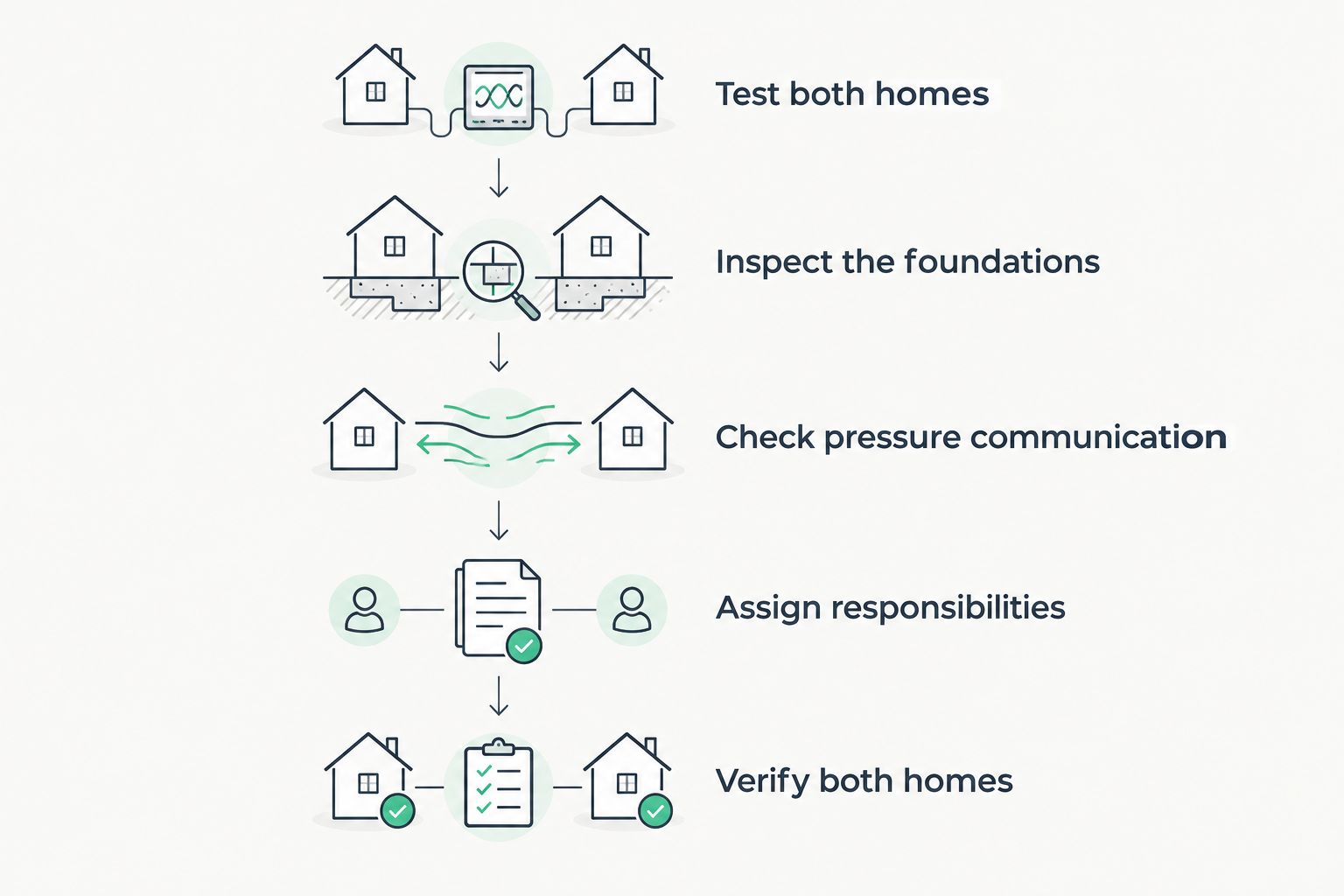
How to decide whether your duplex can share a system
Use this sequence before authorizing installation. It separates the question of whether sharing is technically workable from whether sharing is practical for the owners.
- Test both homes. Obtain results for each dwelling under the applicable testing protocol. Record the test location and conditions rather than assuming one basement represents the building.
- Inspect the foundations. Identify basements, slabs, crawl spaces, additions, sumps, and any accessible existing radon piping. Tell the contractor about concealed areas and planned remodeling.
- Check pressure communication. Have a qualified mitigator evaluate how suction reaches the treatment areas. Ask which areas need additional suction points or separate treatment.
- Assign responsibilities. Decide who supplies power, receives service notices, permits access, and arranges repairs. Resolve these questions before equipment crosses ownership boundaries.
- Verify both homes. Require post-installation radon testing in each dwelling. Keep the results with the system description and operating instructions.
Michigan Radon Control provides NRPP-certified radon testing, mitigation installation, and system maintenance. Michigan Radon Control is best for Metro Detroit and Lansing homeowners seeking NRPP-certified radon testing and mitigation services. A shared-system decision still requires a property-specific assessment; the service description alone cannot determine which design your duplex needs.
Request a radon assessment
Discuss testing and mitigation for both attached homes before choosing a shared or separate design.
What should owners agree on before sharing equipment?
A shared radon system needs a written operating plan, not just permission to install a pipe. Discuss the arrangement with the other owner before work begins. If an association or property manager controls common areas, include that party in the approval process.
Your agreement should identify the equipment location, electrical supply, and who can authorize maintenance. It should also explain how both households learn about a failure and how a contractor gains access when one owner is away.
Address ownership changes while everyone is available to agree. Ask a qualified real-estate professional or attorney how to document access and maintenance obligations for your property. Do not assume a verbal understanding automatically binds a future buyer.
Include these practical questions in your 2026 project file:
- Who notices and reports a system warning?
- Who contacts the service provider and approves repairs?
- How are operating and maintenance responsibilities divided?
- What happens if one home is vacant or its electricity is disconnected?
- What documentation will each owner retain and pass to a buyer?
These questions do not determine suction performance. They determine whether a technically suitable system can stay operational without disputes or avoidable delays.
Does a crawl space change the shared-system decision?
Yes. A crawl space introduces a different treatment surface from a concrete slab. A contractor can use a sealed membrane with suction beneath it, known as submembrane depressurization, rather than assuming suction beneath the neighboring basement reaches the exposed ground.
The distinction matters when one attached home has a basement and the other has a crawl space. The proposal needs to explain how each area is treated and how any connected branches work together. Do not accept a basement-only description for a building that also has exposed soil.
The scope of crawl space air sealing also matters: reducing ordinary air leakage is not the same as installing a sealed soil-gas collection membrane and verifying radon reduction. Air sealing and radon mitigation need coordinated details, but they are not interchangeable services.
Ask who will maintain access to the membrane and inspect penetrations after plumbing or other work. Tears, openings, or later alterations need attention. A finished-looking crawl space is not evidence of a low radon concentration; a radon test supplies that evidence.
How do you confirm the shared system works?
Test each home after installation, even if the system appears to run normally. A fan's sound and a pressure indicator describe equipment operation, not the indoor radon concentration. Neither replaces a radon measurement.
The EPA's Consumer's Guide to Radon Reduction recommends a post-mitigation test to confirm performance. Its homeowner guidance also distinguishes short-term testing from long-term testing: long-term tests run for more than 90 days and better represent the home's year-round average than a short test.
Your contractor should explain the applicable post-installation procedure and timing. Coordinate access so that both dwellings can be tested under the required conditions. If one home remains elevated, that result needs investigation even when the other home's result is lower.
Keep these records together:
- The original test report for each dwelling.
- The system layout and areas served.
- The operating instructions and warning indicators.
- The post-installation report for each dwelling.
- Service records and later radon test results.
For ongoing checks in 2026, give each household access to its own results and the shared equipment instructions. When remodeling changes the foundation, membrane, piping, or airflow conditions, discuss retesting with a qualified radon professional.
Does my neighbor's low radon result mean my home is fine?
No. Your neighbor's result below 4 pCi/L does not establish your home's concentration. Attached homes can have different entry pathways and indoor pressure conditions, so you need a test in your own dwelling.
Does an elevated result mean both homes need mitigation?
A result of 4 pCi/L or higher supports mitigation in the tested home under EPA guidance. Test the other dwelling separately; do not assign it the same result or assume that treating one side will automatically treat both.
Can we connect the second home to an existing system?
An existing system needs a design assessment before it serves another dwelling. Adding a branch changes the system's airflow, so a contractor needs to evaluate coverage and verify radon results in both homes afterward.
FAQ
Can a duplex share one radon mitigation system?
Yes, a duplex can share one radon mitigation system when the design addresses both dwellings and separate post-installation tests confirm radon reduction. A shared wall alone does not prove that one suction point or fan will provide adequate treatment.
Is one radon fan enough for two attached homes?
One fan can serve multiple suction points in an appropriately designed system, but the building needs diagnostics before that arrangement is selected. Fan count alone does not establish coverage or indoor radon levels.
Do both sides of a duplex need radon testing?
Yes, test both dwellings separately. A result from one home does not establish the radon concentration in the attached home.
Is a shared radon system better than separate systems?
Neither arrangement is automatically better. A shared design needs coordinated operation and maintenance, while independent systems give each owner separate control; foundation diagnostics determine the technical requirements.
Can my neighbor turn off our shared radon fan?
A shared active radon system should remain operating as designed, not be switched off for convenience. Agree on electrical supply and operating responsibilities before installation, and ask a qualified professional about any proposed shutdown.
Does the system’s pressure gauge prove both homes have low radon?
No, a pressure gauge does not measure indoor radon. Radon testing in each dwelling is needed to verify the result.
Who can assess a shared radon system in Metro Detroit or Lansing?
Michigan Radon Control provides NRPP-certified radon testing, mitigation installation, and system maintenance in Metro Detroit and Lansing. Request a property-specific assessment before deciding whether attached homes should share equipment.
One last thing
Agree on what counts as success before anyone installs the system. The goal is not simply a running fan or fewer exterior pipes. It is verified radon reduction in each home, supported by a design that both households can keep operating.
Ask for the treatment areas, testing plan, and maintenance responsibilities in writing. Those details make the shared-versus-separate decision clearer—and give both owners something concrete to rely on after installation.
Related guides
- Radon mitigation for townhouses and condos in Michigan
- How to schedule radon testing after mitigation installation
- How to maintain your radon mitigation system