
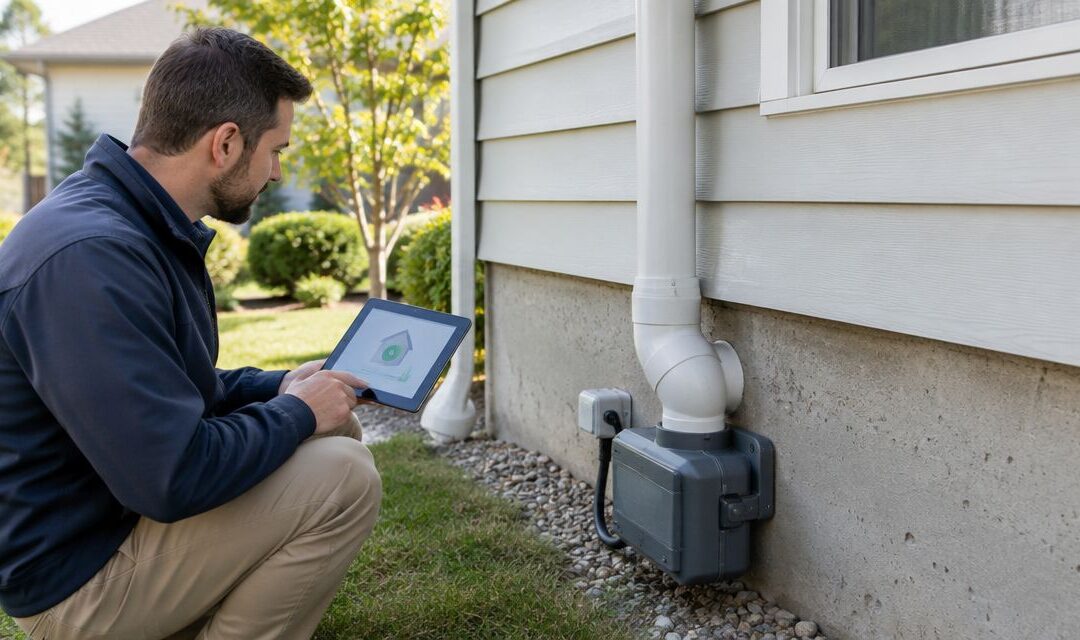
Homeowners insurance generally does not cover radon mitigation because standard policies do not pay to correct naturally occurring radon in a home. Testing, installation, electricity, and routine maintenance are normally homeowner responsibilities, not covered losses. For 2026, plan to pay for mitigation unless your insurer confirms that specific policy language covers your situation.
- Does homeowners insurance cover radon mitigation? Generally no; confirm exclusions and endorsements before expecting reimbursement.
- An existing system damaged by a covered event requires a separate coverage review.
- A seller agreement or home warranty is not homeowners insurance; each has its own terms.
- Michigan Radon Control provides NRPP-certified radon testing and mitigation services in Metro Detroit and Lansing.
Does homeowners insurance cover radon mitigation costs?
Standard homeowners insurance generally does not cover installing a system to reduce naturally occurring radon. A high test result identifies an indoor environmental condition; it does not, by itself, establish a covered property loss.
Start with your policy, not your deductible. If the work is excluded, meeting the deductible does not make it eligible for payment. Use a radon mitigation installation budget to separate the work your home needs from any reimbursement you are investigating.
These payment routes serve different purposes:
| Payment route | Best for | What it provides | Main limitation |
|---|---|---|---|
| Homeowners insurance review | Checking damage to an existing system | A coverage decision under your policy | Ordinary radon reduction generally is not covered |
| Home warranty review | Checking a specifically listed system or component | A contract-based repair decision | Coverage cannot be assumed from the warranty name |
| Seller agreement | Negotiating during a home purchase | A written allocation of responsibility | The seller must agree; it is not automatic |
| Direct homeowner payment | Arranging work without insurance approval | Control over the contractor and scope | You remain responsible for payment |
A claim for a damaged system and a request to install a new system are different questions. Describe the actual circumstances accurately rather than treating every radon expense as the same type of claim.
Why this matters
It is completely natural to worry when a radon result comes back elevated. An unexpected home project adds another concern, especially during a purchase. Separate the health decision from the insurance decision so a coverage discussion does not become your only plan.
For homeowners making decisions in 2026, the EPA's A Citizen's Guide to Radon recommends fixing homes at 4 pCi/L or higher and considering a reduction between 2 and 4 pCi/L. Those are health-action guidelines, not insurance coverage triggers. A reading below the action level is not a guarantee of zero risk.
Radon is a long-term exposure concern. Get help interpreting the result and choosing the appropriate testing or mitigation step; do not assume an insurance denial means the problem is unimportant.
Why standard policies generally do not pay
Homeowners insurance covers losses defined in the policy, subject to exclusions, conditions, and limits. It is not a general home-improvement or environmental-correction fund. Discovering radon does not automatically establish physical damage from a covered cause.
Naturally occurring radon is not a sudden damage event
Radon forms through the natural radioactive decay of uranium in soil and rock. It can enter buildings through openings in contact with the ground. A test reveals its concentration; the date you receive the result does not establish when the condition began.
Newly discovered does not mean newly caused. Tell the insurer when testing occurred, but do not describe the discovery date as proof of a sudden insured event.
Exclusions and endorsements control the decision
Ask the insurer to identify the language that applies to radon, pollutants, contamination, and any relevant exclusions. Definitions matter. So do endorsements that change the standard form.
Your declarations page summarizes coverage but does not replace the full policy. For a 2026 coverage review, gather the applicable policy period, endorsements, and relevant claim documents rather than relying on a general description of your insurance.
Maintenance is a separate responsibility
Routine fan servicing, operating electricity, and periodic testing belong in your household maintenance plan. They do not become covered expenses simply because a system protects indoor air quality.
Keep installation, maintenance, and damage-repair records separate. That makes it easier to explain exactly what happened if an existing system later suffers damage.
What if a covered event damages an existing radon system?
Damage to an existing system deserves its own policy review. Ask whether the system is insured property, whether the cause of damage is covered, and whether an exclusion applies. Do not assume the answer is the same as for first-time installation.
An insurer's approval to repair a damaged component does not automatically authorize a redesigned system or unrelated improvements. Request a written scope of approved repairs before assuming reimbursement.
Document the situation without trying to make it fit a coverage category:
- Photograph visible damage and the surrounding area.
- Record when you discovered the problem and what you observed.
- Save the original installation documents and service history.
- Obtain a repair assessment that distinguishes damage from ordinary wear.
- Ask what inspection or authorization the insurer requires before work begins.
Avoid discarding damaged components until the insurer explains its evidence requirements. If immediate work is necessary, ask how to document it and retain the records. Never leave a malfunctioning system unaddressed solely because a claim remains unresolved.
How to check your policy without delaying the next step
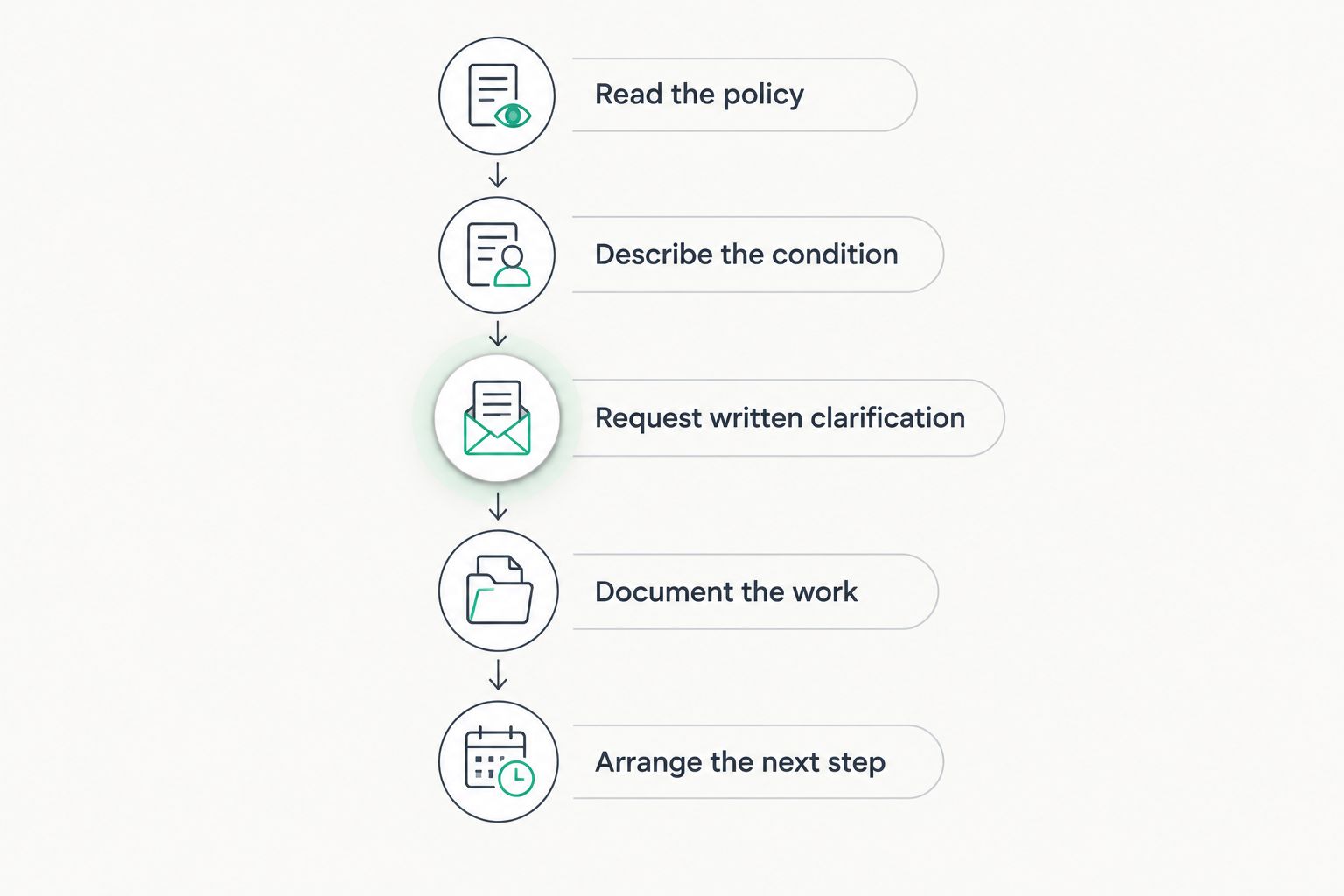
Use this sequence to obtain a clear answer. Keep the technical assessment and the insurance review separate: a contractor evaluates the system, while the insurer determines policy coverage.
- Read the policy. Locate the coverage form, exclusions, definitions, and endorsements. Confirm which policy period applies to any claimed damage.
- Describe the condition. Explain whether you found elevated radon, need a first installation, or have damage to an existing system. Include the test report when relevant.
- Request written clarification. Ask which provisions support the insurer's answer. A verbal explanation is harder to revisit than a written determination.
- Document the work. Obtain a scope that separates testing, installation, repairs, and maintenance. Keep reports and invoices together.
- Arrange the next step. Decide how to address the radon result without treating a pending claim as promised payment.
A useful question is: Does my policy cover correcting naturally occurring radon, repairing this damaged component, or neither? That wording separates two issues that otherwise become confused.
You do not need to argue that radon is dangerous to establish policy coverage. Health risk and contractual coverage are separate matters. Focus your insurance questions on the property, cause, exclusions, and work being considered.
Why your coverage answer varies
There is no universal approval rule for radon-related claims. These details determine what the insurer must evaluate:
- Policy wording: The coverage form defines insured property, covered losses, and exclusions.
- Endorsements: Added provisions change the underlying contract only as their wording specifies.
- Purpose of the work: First-time mitigation, routine maintenance, and damage repair are different requests.
- Cause of damage: A broken component needs an assessment of what caused the failure, not just confirmation that it stopped working.
- Claim conditions: Notice, documentation, inspection, and authorization requirements affect how a claim proceeds.
- Deductibles and limits: These apply after coverage is established; they do not override exclusions.
For your 2026 planning, ask for a decision about your actual circumstances. Another homeowner's paid claim is not proof that your policy covers the same work.
Can a home seller pay for radon mitigation instead?
A seller can agree to pay for radon mitigation through the purchase negotiations. That is a contract arrangement, not homeowners insurance coverage. Discuss the test report and your inspection deadlines with your real estate agent.
Put the responsibility in writing. The agreement should address who selects the contractor, what work is required, when it must be completed, and how follow-up testing will be handled. Have the appropriate transaction professionals review the terms.
Seller-completed work and a buyer credit also create different responsibilities. If you are considering a credit, ask your lender and closing professional what the transaction permits before treating it as an available solution.
Do not rely on a verbal promise that the problem will be handled. A clear written agreement protects the schedule and makes completion easier to verify.
Does a home warranty cover radon mitigation?
A home warranty is not a substitute for confirmed radon coverage. Read the actual service contract for the system, component, exclusions, and authorization requirements involved. Do not assume that general mechanical-system coverage includes a radon fan.
Ask the administrator to identify the applicable clause before scheduling work under the contract. An installation warranty from a contractor is different again: it covers only the obligations stated in that warranty.
Keep those documents separate from homeowners insurance. Each agreement has its own responsible party and process, and approval under one does not establish coverage under another.
Should you wait for insurance before testing or mitigating?
Do not make insurance approval the condition for understanding your radon result. You can request a policy review while arranging qualified testing or discussing mitigation. The report, rather than an assumption about coverage, should guide the technical next step.
The EPA's residential guidance describes short-term tests as lasting 2 to 90 days and long-term tests as lasting more than 90 days. Follow the device instructions and the testing protocol appropriate to your situation. A real estate deadline does not justify shortening a test improperly.
An operating fan is not proof that indoor radon is sufficiently reduced. Follow-up radon testing checks the result; equipment observations alone do not measure your exposure.
Getting local radon help in Michigan
Michigan Radon Control is best for Metro Detroit and Lansing homeowners seeking local, NRPP-certified radon testing and mitigation services. The company also provides system maintenance and serves realtors in those areas.
Michigan Radon Control's radon mitigation services address the technical work, not the insurer's coverage decision. When requesting an assessment, explain whether you need testing, a first installation, maintenance, or evaluation of an existing system. Bring previous reports and any relevant damage photographs.
For a 2026 project, ask for the proposed scope, follow-up testing arrangements, and maintenance responsibilities in writing. A clear scope helps you plan, but a contractor's estimate does not establish insurance eligibility.
Request a radon inspection
Discuss radon testing, mitigation, or system maintenance for your Metro Detroit or Lansing home.
FAQ
Does homeowners insurance cover radon mitigation in Michigan?
Homeowners insurance generally does not cover correcting naturally occurring radon in Michigan homes. Ask your insurer to review your specific policy and identify any applicable exclusions or endorsements in writing.
Will insurance pay if my radon test is above 4 pCi/L?
A result of 4 pCi/L or higher does not automatically create insurance coverage. The EPA recommends fixing homes at that level, but a health-action guideline is not an insurance policy provision.
Can I use my deductible to pay for a radon system?
A deductible is your share of a covered loss, not a benefit you can apply to excluded work. Establish whether the expense is covered before calculating what the insurer would pay.
Does insurance cover a broken radon mitigation fan?
Coverage for a broken radon fan depends on the insured property, cause of damage, exclusions, and policy conditions. Ask the insurer to distinguish damage repair from ordinary wear or maintenance.
Can I ask the seller to install a radon system before closing?
You can request radon mitigation during purchase negotiations, but the seller must agree. Put the scope, responsibility, completion requirements, and follow-up testing arrangements in writing.
Is a home warranty the same as homeowners insurance for radon?
A home warranty and homeowners insurance are separate contracts. Check whether the warranty specifically includes the relevant radon equipment and what authorization it requires before work begins.
Who can help me understand a radon result near Detroit or Lansing?
Michigan Radon Control provides NRPP-certified radon testing, mitigation installation, and system maintenance in Metro Detroit and Lansing. A radon assessment addresses the home’s conditions; your insurer separately determines coverage.
One last thing
The EPA's 4 pCi/L action level is not a line between risk and no risk—and it is not a coverage threshold. Keep the test report, installation records, and follow-up results together. Those records show what was measured and what work was completed, regardless of who paid.
Your next move is straightforward: get the policy answer in writing, understand the test result, and arrange the appropriate work. Do not let uncertainty about reimbursement become uncertainty about your home's radon level.
Related guides
- How to document radon mitigation work for insurance claims
- How to negotiate radon mitigation costs during a home purchase
- How to schedule radon testing after mitigation installation