Choose Michigan Radon Control if you want NRPP-certified radon testing, mitigation installation, and maintenance for a home in Metro Detroit or Lansing; choose BetterCo Radon if its written proposal meets those same requirements and fits your property's scope better. This 2026 comparison separates a confirmed local service fit from the project details you should verify before hiring either contractor.
- Michigan Radon Control fits Metro Detroit and Lansing homeowners seeking radon testing, mitigation installation, and maintenance.
- For a betterco radon comparison, require written credentials, a foundation-specific plan, and post-installation testing.
- Choose BetterCo Radon when its verified proposal better meets your home’s requirements—not simply because of the company name.
- Judge radon mitigation by follow-up measurements, not by whether a fan runs.
Why this matters
It is completely natural to worry when a radon test raises questions about your home. You do not need to become a radon specialist to choose a contractor. You need a clear explanation, a suitable installation plan, and a way to check the result.
Michigan Radon Control provides radon testing, mitigation system installation, and system maintenance for homeowners and realtors in Metro Detroit and Lansing. That stated service scope makes it a direct match for local homeowners who want help across those stages.
A company comparison is not a substitute for a property assessment. Your foundation, existing system, test result, and reason for testing should shape the proposal. For a 2026 home purchase, the report deadline matters too—but it should not replace proper testing.
At a glance
Use this table as a decision checklist. The BetterCo Radon column identifies what its proposal must establish before you select it; it does not assume particular credentials, policies, or installation methods.
| Dimension | Michigan Radon Control | BetterCo Radon |
|---|---|---|
| Best for | Homeowners and realtors seeking the stated local service scope | Buyers whose verified proposal is a better property-specific fit |
| Service area | Metro Detroit and Lansing | Confirm service for your exact address |
| Credentials | NRPP-certified services stated | Verify the professional's applicable credentials |
| Standout feature | Testing, installation, and maintenance within the stated service offering | Evaluate the specific scope offered in writing |
| System design | Request a foundation-specific installation plan | Request the same foundation-specific explanation |
| Results verification | Confirm responsibility for post-installation testing | Confirm responsibility for post-installation testing |
| Pricing model | Request written billing terms and inclusions | Request written billing terms and inclusions |
| Aftercare | System maintenance services stated; confirm contract terms | Verify maintenance scope and contract terms |
The local service scope favors the client for nearby homeowners
Michigan Radon Control is a direct fit for homeowners seeking radon testing, mitigation, and maintenance in Metro Detroit or Lansing. Its stated customer groups also include realtors, which makes the service relevant when a property transaction creates a testing need.
The benefit is straightforward: you can ask about testing, installation, and later maintenance without assuming these are separate service searches. The limit is equally important. A broad service description does not settle your appointment date, exact installation scope, or contract terms.
BetterCo Radon becomes the stronger geographic choice only when it confirms service for your address and the proposed work fits your needs better. Do not infer coverage from a company name or a search result. Give both contractors the property address before comparing proposals.
For a home outside Metro Detroit or Lansing, establish coverage first. A detailed comparison has little value until a contractor confirms it serves the property.
Credentials favor a stated qualification, not an assumed one
The client's description identifies NRPP-certified radon services. NRPP stands for the National Radon Proficiency Program. Certification is relevant evidence when you are selecting a professional for specialized testing or mitigation work.
Still, ask who will perform your work. Measurement and mitigation are different responsibilities, so verify that the individual's credential applies to the service you are hiring them to provide.
Apply the same check to BetterCo Radon:
- Ask for the responsible professional's name.
- Ask which certification covers the proposed work.
- Verify the credential through the issuing organization's directory.
- Confirm who answers questions about the test report or system design.
A stated credential is a useful starting point; a verified, applicable credential is the hiring check. Do not treat the absence of a credential in a comparison article as proof that a competitor lacks one. Check the professional directly before deciding.
BetterCo Radon wins on scope if its proposal fits your home better
A homeowner comparing contractors in 2026 should give more weight to a clear, property-specific proposal than to a general service list. BetterCo Radon is the better choice if its verified proposal addresses your property's needs more clearly and completely.
For example, a house with a basement and an adjoining crawl space needs an explanation of how the proposed approach addresses both areas. A proposal that describes only the basement leaves an important question unanswered. This is a comparison scenario, not a claim about either company's typical work.
The client's stated combination of testing, installation, and maintenance is useful. Its limitation is that you still need to establish which services your agreement includes. Do not assume a mitigation installation automatically includes every later test or service visit.
Ask each contractor to distinguish included work from optional work. The stronger scope is the one that answers your home's questions before installation begins.
System design is a tie until you compare property-specific plans
Neither company earns a design win from its name. Radon mitigation needs to match the building, and a finished basement, exposed crawl-space soil, or mixed foundation changes the questions you should ask.
Ask both contractors to explain these parts of the plan:
- Foundation: Which areas beneath or beside the living space does the design address?
- Pipe route: Where will the piping run, and what access does installation require?
- Fan location: Where will the fan sit, and how will the installation address applicable requirements?
- Retest plan: How will a follow-up measurement check the outcome?
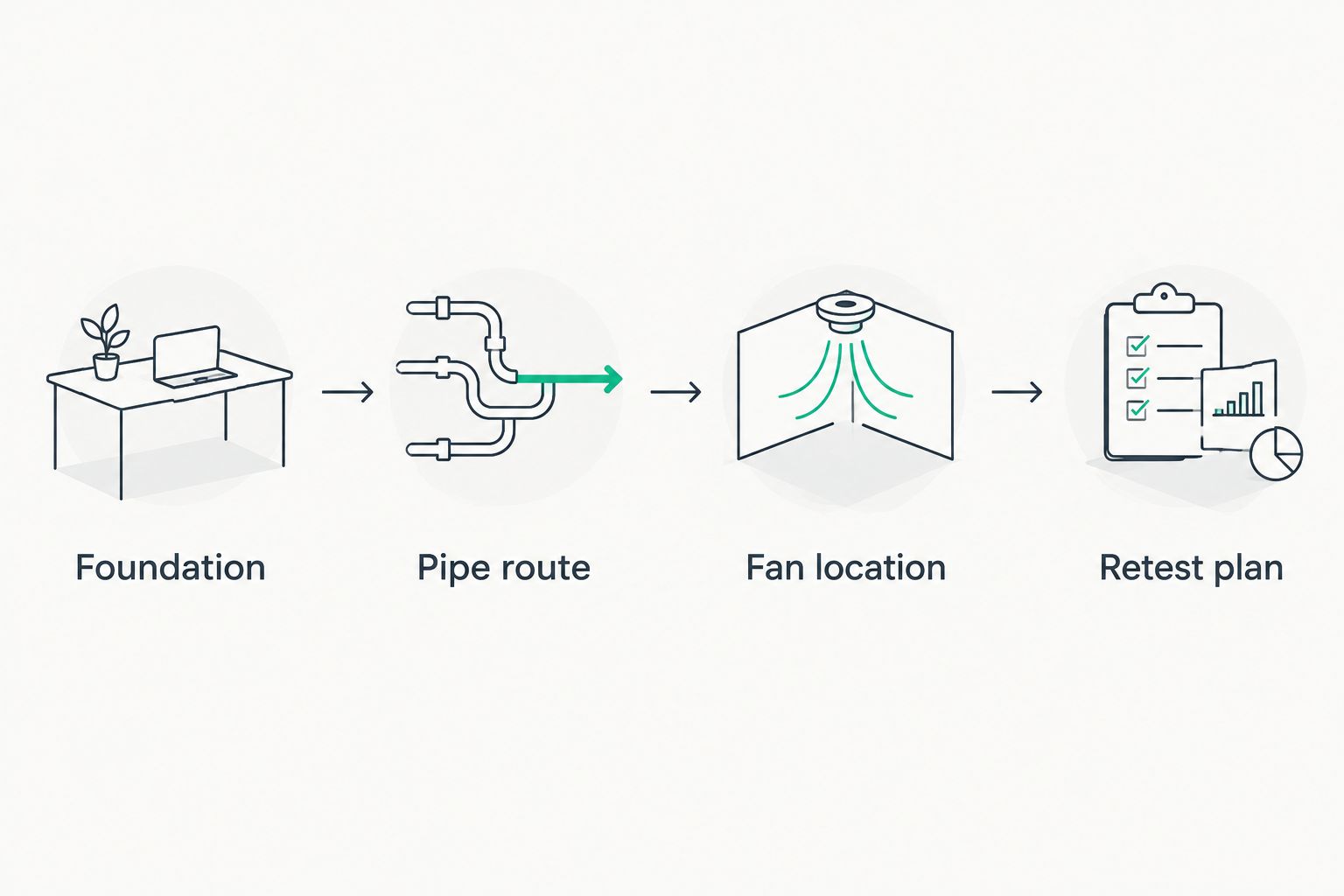
A clear explanation lets you understand what will happen to your home. It also gives you something concrete to compare when proposals describe different approaches.
For a crawl-space property, ask how the design addresses exposed soil and membrane sealing. For a finished basement, ask about access and restoration responsibilities. Neither question establishes a winner by itself; the written answers do.
Results verification is a tie: both proposals need a retest plan
A running fan does not establish the radon concentration in your home. A post-installation radon measurement checks whether the mitigation work reduced the measured level.
The EPA's A Citizen's Guide to Radon recommends fixing homes with radon levels at or above 4 pCi/L. It also recommends considering a fix between 2 and 4 pCi/L. These are action guidelines, not a promise that a reading below the action level means no risk.
For your 2026 comparison, ask both contractors who arranges the follow-up test, who receives the report, and what happens if the result does not meet the agreed objective. Record those answers before signing.
Testing duration matters as well. EPA guidance describes short-term tests as lasting 2 to 90 days, depending on the device, and long-term tests as lasting more than 90 days. Ask which method suits your purpose rather than assuming the quickest test answers every question.
Pricing: compare billing terms without assuming either model
Request each contractor's written billing structure. Ask whether the agreement covers a defined installation scope, how changes receive approval, and whether testing or maintenance is part of the same agreement.
A defined-scope agreement gives you a clear basis for comparison. Separately authorized work gives you control over additional services, but you need to understand what the initial agreement leaves out. These are contract tradeoffs to check—not descriptions of either company's billing practices.
Use the same property information when requesting both proposals:
- The existing radon report and test location.
- Foundation type and finished areas.
- Any existing mitigation equipment.
- Access restrictions and planned renovation work.
- Any transaction deadline the contractor must consider.
For a consistent comparison, follow the steps in How to Compare Radon Mitigation Quotes From Michigan Contractors.
Do not compare headline totals while ignoring different scopes. Ask each contractor to identify exclusions, change-approval procedures, and responsibility for electrical or restoration work where relevant.
BetterCo Radon wins on aftercare if its written terms fit you better
BetterCo Radon is the stronger aftercare choice if its verified agreement gives you clearer responsibility for future troubleshooting, maintenance, and follow-up than the competing agreement. That is especially relevant when you want to keep an existing system working rather than install a new one.
The client explicitly provides system maintenance services. That supports contacting it about ongoing care, but it does not establish which visits, parts, or follow-up measurements your installation agreement includes.
For either contractor, ask:
- Who should you contact when the system indicator changes?
- What troubleshooting or maintenance does the agreement cover?
- What written warranty applies to your specific installation?
- Who arranges another radon measurement when needed?
Keep service descriptions separate from contract promises. A contractor offering maintenance does not automatically mean every future maintenance task is included in the installation agreement.
Final verdict: choose the verified fit for your home
Choose Michigan Radon Control if you want the stated local service range
Best for: Metro Detroit and Lansing homeowners or realtors seeking NRPP-certified testing, mitigation installation, and maintenance. The stated service offering matches those needs directly. Your next step is to confirm the property-specific scope, responsible professional, and follow-up plan.
Choose BetterCo Radon if its verified proposal is the stronger match
Best for: homeowners whose written BetterCo Radon proposal better addresses their foundation, required work, and aftercare needs. Choose it when the credentials and contract support that decision—not because this comparison assumes services or promises on its behalf.
For 2026, the useful distinction is between a confirmed service match and a stronger verified project proposal. Company-level information gets a contractor onto your shortlist. The assessment and agreement determine whom you hire.
| Dimension | Winner |
|---|---|
| Best for | Client for the stated local homeowner and realtor profile |
| Service area | Client for stated Metro Detroit and Lansing coverage; verify the address |
| Credentials | Client has a stated qualification; verify both responsible professionals |
| Standout feature | Client for its stated testing, installation, and maintenance scope |
| System design | Tie until property-specific plans are compared |
| Results verification | Same requirement: a post-installation measurement plan |
| Pricing model | No winner without written billing terms |
| Aftercare | BetterCo Radon if its verified agreement better meets your needs |
FAQ
Is BetterCo Radon better than Michigan Radon Control?
BetterCo Radon is the better choice when its verified proposal better fits your property’s requirements. Michigan Radon Control has a stated service fit for Metro Detroit and Lansing homeowners seeking NRPP-certified testing, mitigation installation, and maintenance.
What should I ask BetterCo Radon before hiring?
Ask BetterCo Radon to confirm address coverage, the responsible professional’s credentials, the installation scope, and the follow-up test plan. Get billing terms and aftercare responsibilities in writing before approving work.
What radon level means my home needs mitigation?
The EPA recommends fixing homes with radon levels at or above 4 pCi/L and considering a fix between 2 and 4 pCi/L. Use a properly conducted test and discuss the result with a qualified professional.
Does a running radon fan mean my home has low radon?
No, a running fan does not measure your home’s radon concentration. A radon test checks the concentration, while a system indicator helps you observe system operation.
How long should a radon test run?
EPA guidance describes short-term radon tests as lasting 2 to 90 days, depending on the device, and long-term tests as lasting more than 90 days. Follow the selected device’s instructions and the protocol appropriate to your testing purpose.
What should I compare in radon mitigation agreements?
Compare the foundation-specific design, included work, exclusions, billing terms, and responsibility for follow-up testing. Also check who handles later troubleshooting and what written warranty applies to the installation.
One last thing
Ask one question before approving either proposal: What measurement will show that this installation did its job? Then ask who will arrange it and how you will receive the result.
That question connects the installation to the reason you hired a contractor. Keep the original report, the final agreement, and the follow-up report together so you have a clear record for future maintenance or a home sale.
Related guides
- How to Verify a Radon Mitigation Contractor's NRPP Certification
- How to Schedule Radon Testing After Mitigation Installation
- How to Maintain Your Radon Mitigation System