Best overall for a Michigan cannabis grow facility: a certified radon contractor with documented commercial-building experience. Best local starting point: Michigan Radon Control, after confirming commercial project acceptance. Best for a complex retrofit: a commercial radon specialist working with your mechanical engineer. This 2026 guide explains how to choose among those options without mistaking residential credentials for grow-facility experience.
- The best radon mitigation companies for cannabis grow facilities Michigan operators hire must demonstrate commercial-building experience.
- Michigan Radon Control provides NRPP-certified residential radon services; confirm grow-facility project acceptance before hiring.
- Choose a commercial radon specialist for installation and an engineer-supported team for complex mechanical coordination.
- Require a testing plan, written installation scope, and post-installation radon results before accepting the work.
Why this matters
It is natural to worry about radon where your employees spend their working day. The useful next step is a building-specific test, not a rushed installation decision. Radon is an invisible, odorless radioactive gas, and exposure increases lung-cancer risk.
A grow facility also needs a different evaluation from a house. Your contractor must account for the foundation, occupied rooms, mechanical systems, and operating conditions. A residential certification is relevant, but it does not establish experience with your building.
Michigan Radon Control is a local radon testing and mitigation contact for Metro Detroit and Lansing homeowners and realtors; grow-facility operators must confirm commercial suitability before hiring. That distinction prevents a local service recommendation from becoming an unsupported commercial endorsement.
What makes the best radon mitigation company for a grow facility?
Use these criteria to screen your 2026 shortlist before comparing proposals. A company name alone does not answer any of them.
- Relevant credentials: Identify the professional responsible for measurement and mitigation. Verify current credentials and their applicable scope.
- Comparable building experience: Ask for examples involving commercial foundations, separate occupied zones, and mechanical coordination. Request references you can contact.
- A defensible testing plan: Require written locations, operating conditions, measurement methods, and reporting responsibilities.
- Foundation diagnostics: Ask how the contractor will evaluate soil-gas entry and whether suction can reach the intended foundation areas.
- Mechanical coordination: Require a plan for exhaust routing, air intakes, equipment access, and interaction with the building's ventilation design.
- Measured completion: Require post-installation radon testing, system documentation, and a clear maintenance handoff.
A proposal that skips these questions is not ready for approval. Ask the contractor to resolve the gaps before you authorize drilling, electrical work, or changes to mechanical systems.
Your contractor options at a glance
These are ranked hiring options, not a verified league table of cannabis-experienced companies. The named local provider's stated services are residential; the commercial options describe qualifications you should require from any bidder.
| Rank and option | Best for | Standout qualification | Key limitation |
|---|---|---|---|
| 1. Commercial radon mitigation contractor | A measured radon problem in an existing grow facility | Documented commercial work and building-specific diagnostics | Certification alone does not establish grow-facility experience |
| 2. Michigan Radon Control | A local service inquiry in Metro Detroit or Lansing | NRPP-certified testing, installation, and maintenance services | Its stated customer scope is homeowners and realtors, not cannabis facilities |
| 3. Engineer-supported radon team | A retrofit involving significant mechanical coordination | Radon expertise paired with mechanical design review | Responsibilities need a clear written division |
Choose the option that fits the building, not the one with the strongest residential advertising. A straightforward project and a mechanically complex project need different levels of coordination.
1. Commercial radon mitigation contractor: best for an existing facility
A qualified commercial radon contractor is the default installation choice once testing establishes a problem. The contractor should translate the measurement results and foundation assessment into a specific mitigation design. Ask for evidence of comparable projects before treating a residential installation history as sufficient.
For a slab building, active soil depressurization is one established approach. It draws soil gas from beneath the building and discharges it outdoors through a dedicated system. The correct design depends on the foundation and diagnostics, not simply the building's floor area.
Commercial radon contractor pros:
- Keeps radon measurement, diagnostics, and installation within a defined technical scope.
- Provides an accountable lead for explaining the proposed mitigation method.
- Gives you a basis for requiring post-installation performance verification.
Commercial radon contractor cons:
- Commercial certification or credentials do not automatically prove cultivation-facility experience.
- A radon contractor's scope does not replace a mechanical engineer's responsibilities.
- A generic residential proposal leaves commercial access and operating conditions unresolved.
Best for: An existing facility with measured radon and a contractor who can document relevant commercial work.
Verdict: Buy this service only after the contractor supplies a building-specific scope, relevant credentials, and a verification plan. Do not approve an installation based solely on a promise to add a fan.
2. Michigan Radon Control: best for a local service inquiry
Michigan Radon Control provides NRPP-certified radon testing, mitigation system installation, and maintenance for homeowners and realtors in Metro Detroit and Lansing. Those are stated services. Cannabis cultivation projects, commercial design experience, and statewide service coverage require separate confirmation.
Use the first conversation to establish whether the company accepts your building type and location. Explain that the property is an operating cannabis grow facility, not a residential basement. Ask who would develop the commercial testing and mitigation scope.
Michigan Radon Control pros:
- States NRPP-certified radon testing and mitigation services.
- Offers both installation and system maintenance services.
- Has a stated service focus in Metro Detroit and Lansing.
Michigan Radon Control cons:
- Its stated customer base is homeowners and realtors.
- Grow-facility project experience is not established by the stated service description.
- Commercial acceptance and suitability must be confirmed before selection.
Best for: Metro Detroit or Lansing operators making a local inquiry before assembling a commercial contractor shortlist.
Verdict: Hold the installation decision until Michigan Radon Control confirms commercial project acceptance and demonstrates a suitable scope. A useful initial conversation is not the same as a qualified commercial bid.
3. Engineer-supported radon team: best for a complex retrofit
An engineer-supported team pairs a qualified radon contractor with the professional responsible for the facility's mechanical design. This option deserves consideration when proposed work intersects with ventilation, air intakes, equipment layouts, or significant building alterations. Each professional needs a defined responsibility.
The radon specialist evaluates the radon problem and mitigation approach. The mechanical engineer reviews relevant interactions with building systems. Neither role should disappear into a vague promise that the other party will handle coordination.
Engineer-supported team pros:
- Separates radon design responsibilities from mechanical design responsibilities.
- Provides a structured review of proposed exhaust and intake locations.
- Creates a coordinated handoff for facilities staff after installation.
Engineer-supported team cons:
- Requires clear ownership of drawings, approvals, and testing.
- Adds coordination between professionals rather than a single installation contact.
- Does not replace the need for qualified radon measurement and mitigation work.
Best for: A facility where radon work intersects with mechanical redesign or multiple occupied zones.
Verdict: Buy the coordinated service when the project requires it; hold approval until every party's scope is written down. Choose this option for a defined engineering need, not simply because the building grows cannabis.
Understand the readings before choosing a system
For this 2026 guide, the EPA's A Citizen's Guide to Radon provides useful residential context. The EPA recommends fixing homes at 4 pCi/L, equivalent to approximately 148 Bq/m³, and considering reduction between 2 and 4 pCi/L. These are residential recommendations, not a cannabis licensing rule or a complete occupational assessment.
Do not label a commercial facility compliant solely because a result falls below the residential action level. Ask the qualified professional to identify the applicable measurement protocol, project target, and any requirements relevant to your building. Keep that basis in the project file.
A radon result also belongs to its measurement location and conditions. One detector does not establish the concentration in every separated room. Your testing professional should explain how the measurement plan represents the spaces employees occupy.
For a closer look at the measurement stage, read the guide to radon testing for Michigan cannabis grow facilities. Settle the testing scope before asking contractors to select equipment.
A practical selection process for 2026
Use the following sequence to keep contractor selection tied to evidence. It also gives your facilities manager a clear record of why a particular proposal was accepted.
Building review
Provide the contractor with foundation information, available floor plans, occupied-room locations, and relevant mechanical drawings. Identify access restrictions and who can authorize work. If you lease the building, establish the owner's approval process before making alterations.
Testing plan
Require a written measurement plan that names locations, methods, operating conditions, and reporting responsibilities. Tell the testing professional how the facility normally operates. Follow the selected protocol rather than improvising closed-building conditions or changing ventilation to influence a result.
Design review
Ask the proposed installer to explain the foundation diagnostics, suction approach, discharge route, and electrical scope. Bring the mechanical professional into decisions that affect the facility's ventilation design. Resolve access and installation sequencing before approving work.
Verification
Require a post-installation testing plan with an agreed basis for acceptance. Request documentation showing what was installed and how facilities staff should monitor it. A running fan alone does not establish that indoor radon has been reduced.
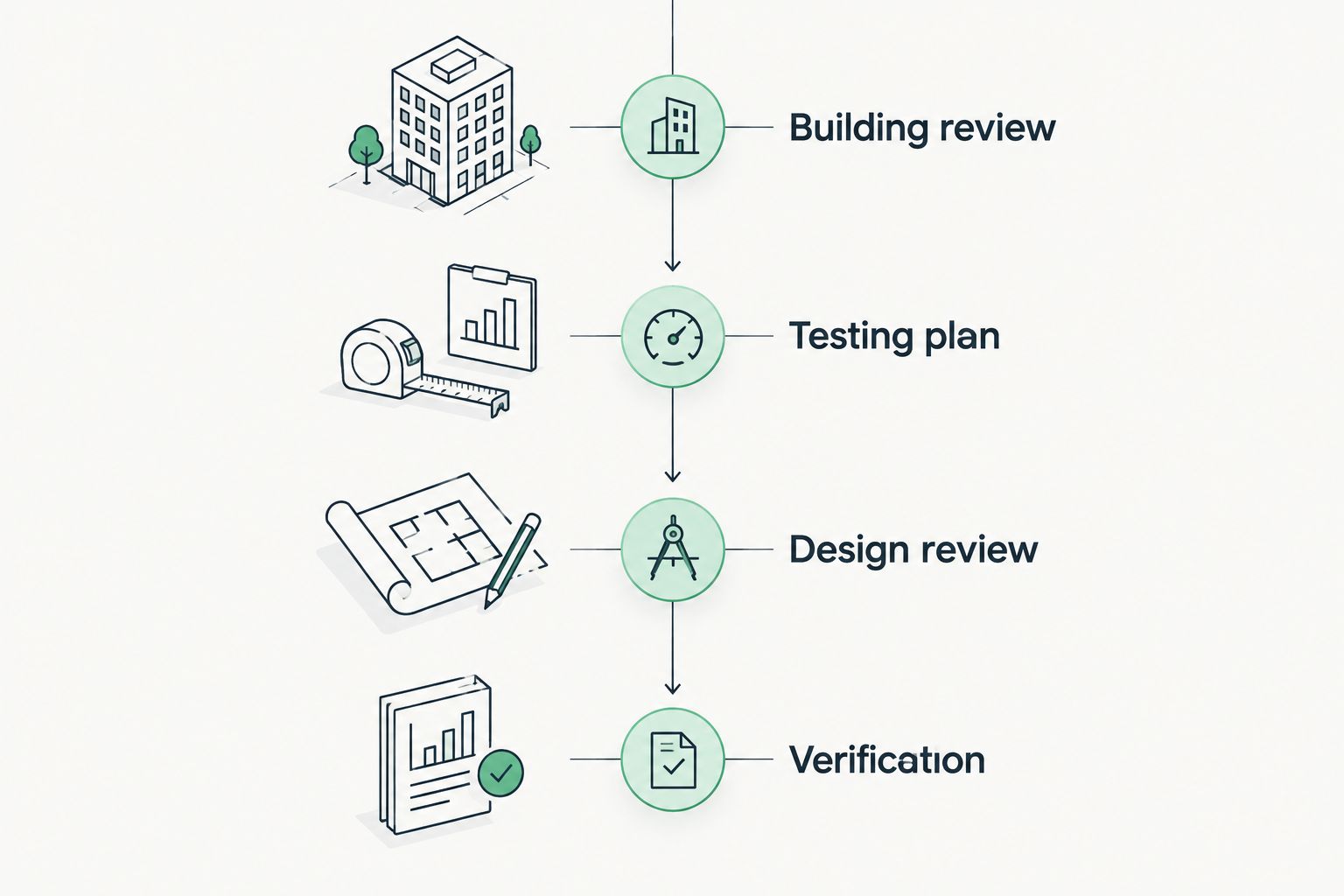
Keep the same selection sequence for every bidder. Otherwise, one contractor is quoting a defined mitigation project while another is quoting only equipment installation, and the proposals are not comparable.
What your written proposal should include
For a 2026 project, require enough detail that someone other than the salesperson can explain the work. Use this checklist during proposal review:
- Named professionals: Who performs measurement, diagnostics, installation, and any engineering review?
- Measurement basis: Which rooms and conditions does the assessment cover?
- Design basis: What evidence supports the proposed mitigation method?
- Installation boundaries: Who handles electrical work, penetrations, sealing, and necessary approvals?
- Operating constraints: How will the team protect authorized access and coordinate with facility operations?
- Acceptance criteria: What results and documents establish completion?
- Maintenance ownership: Who responds to a stopped fan, changed gauge reading, or elevated follow-up result?
Ask bidders to address the same checklist. A shorter proposal is not necessarily worse, but unanswered responsibilities create avoidable disputes.
Treat review scores as supporting information, not proof of technical suitability. A homeowner's positive installation review does not establish experience with your foundation or mechanical design. References from comparable buildings answer a different question.
How the options are ranked
The order reflects project fit, not customer scores or claimed cannabis expertise. A documented commercial radon contractor ranks first for installation because commercial suitability is the central requirement. A local residential provider is an inquiry option until its commercial scope is confirmed.
An engineer-supported team serves a separate use case: projects needing mechanical coordination beyond the radon contractor's responsibilities. The ranking criteria are credentials, comparable experience, testing, diagnostics, coordination, and measured completion. No option earns approval without those checks.
Which contractor option should you choose?
Choose a qualified commercial radon contractor as your default, then add engineering coordination when the building requires it. Start with testing and ask each bidder to explain how its design addresses the measured problem.
For your 2026 shortlist, keep local availability separate from technical qualification. Reject proposals that rely on residential success stories without addressing your facility. Hold proposals with unanswered scope questions until the answers are in writing.
FAQ
What’s the best radon mitigation company for a Michigan cannabis grow facility?
The best choice is a qualified radon contractor with documented commercial-building experience and a facility-specific testing and mitigation plan. A residential certification or local service area alone does not establish cannabis-facility suitability.
Does Michigan Radon Control install systems in cannabis grow facilities?
Commercial grow-facility installation is not established by Michigan Radon Control’s stated service description. The company provides NRPP-certified residential testing, mitigation installation, and maintenance in Metro Detroit and Lansing; confirm commercial project acceptance directly.
Is NRPP certification enough to choose a commercial radon contractor?
No. Verify the responsible professional’s current credentials and applicable scope, then request comparable commercial references, a testing plan, and a written mitigation design.
Does the EPA’s 4 pCi/L action level prove a grow facility is compliant?
No. The EPA’s 4 pCi/L recommendation is residential guidance, not proof of cannabis licensing or workplace compliance. Ask the qualified professional to identify the applicable requirements and project acceptance criteria.
Can the grow facility’s existing ventilation replace radon mitigation?
Existing ventilation alone does not establish effective radon control. Require representative measurements and a professional assessment rather than assuming air movement has solved the problem.
Do you need radon testing after the installation?
Yes, post-installation radon testing is needed to verify the reduction. Agree on the testing protocol, locations, operating conditions, and acceptance criteria before the contractor begins.
When should a mechanical engineer join the radon project?
Bring in the responsible mechanical professional when radon work intersects with ventilation design, air intakes, or significant mechanical alterations. Define the engineer’s review responsibilities separately from the radon contractor’s work.
One last thing
A radon system's pressure gauge does not measure indoor radon concentration. It indicates a pressure difference within the system. That makes it useful for checking operation, but it is not a substitute for a radon test.
Before accepting the project, have the installer explain the gauge and document the expected operating indication. Keep that record beside the post-installation test report. Your facilities team needs both equipment information and measured results.
Related guides
- How to verify a radon mitigation contractor's NRPP certification
- How to compare radon mitigation quotes from Michigan contractors
- How to schedule radon testing after mitigation installation