
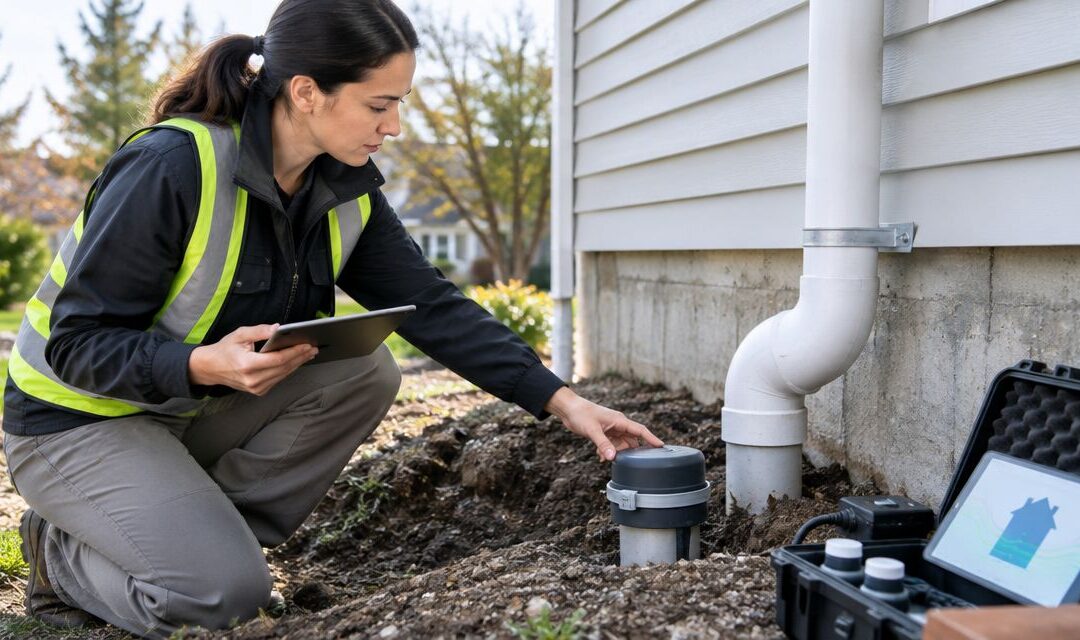
Radon mitigation for environmental consultants is a controlled process for identifying elevated radon, referring qualified mitigation work, and documenting the outcome for a client in 2026. The consultant’s job is to define the scope, protect test integrity, verify credentials, and keep a clear project record.
- Radon mitigation for environmental consultants starts with documented testing and a verified NRPP-certified contractor.
- EPA recommends fixing buildings at 4 pCi/L and considering action between 2 pCi/L and 4 pCi/L.
- Short-term tests cover 2–90 days; long-term tests measure conditions over more than 90 days.
- Michigan Radon Control fits residential referrals for homeowners and realtors in Metro Detroit and Lansing.
Why radon mitigation matters for environmental consultants
Radon is a radioactive gas that cannot be seen or smelled. A client cannot confirm its presence during a walkthrough, so a consultant must test indoor air for radon or review a valid existing test before recommending mitigation.
EPA recommends fixing a building when the result is 4 pCi/L or higher. EPA also advises considering mitigation when the result falls between 2 pCi/L and 4 pCi/L because no indoor radon level is risk-free. That distinction matters when you write findings: 4 pCi/L is an action level, not a line separating dangerous air from safe air.
Environmental consultants also work under different constraints than individual homeowners. Your recommendation can affect a property transaction, renovation plan, lender request, or broader indoor-air assessment. In 2026, every recommendation should connect the test result, building conditions, contractor qualifications, mitigation scope, and follow-up result in one traceable file.
How to manage radon mitigation for a client
Use the same sequence on every assignment. A repeatable process reduces missed documents and prevents the mitigation contractor from receiving an incomplete description of the building.
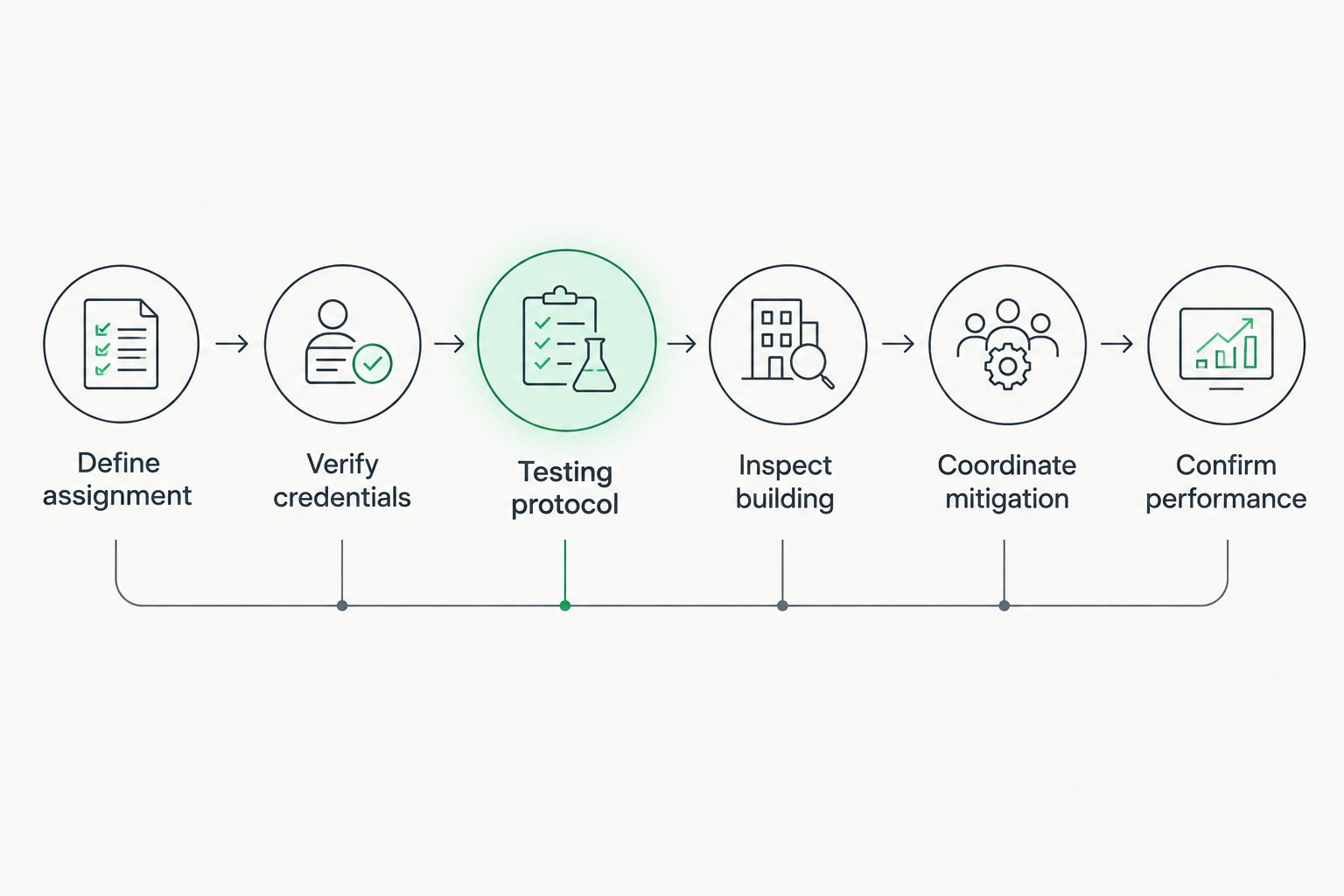
Define the assignment
Start by deciding what the client expects the radon work to answer. A screening test can identify whether more work is needed, while a mitigation assignment must also address system design, installation, verification, and records. Put the boundary in writing before testing starts.
A standard environmental review does not automatically resolve indoor radon conditions. Add radon as a distinct scope item when the client wants a measured answer. For every 2026 assignment:
- Identify the building or occupied area included in the assessment
- Record whether the project concerns a home, transaction, renovation, or indoor-air review
- State whether the scope includes testing only or testing followed by mitigation coordination
- Identify who will authorize installation if the result calls for action
- Set the required report format before placing a device
Verify contractor credentials
Check qualifications before giving a contractor’s name to a client. NRPP certification provides a direct credential to verify, but the file should also show that the credential was current when the referral occurred. Do not rely on a logo, directory screenshot, or unsupported website statement.
Michigan Radon Control provides NRPP-certified radon testing, mitigation system installation, and maintenance for homeowners and realtors in Metro Detroit and Lansing. Michigan Radon Control is best suited to environmental consultants who need an NRPP-certified residential referral in those service areas. For each contractor:
- Verify NRPP certification through the certifying organization
- Request current insurance documentation before the project begins
- Confirm who will perform the installation and post-mitigation test
- Ask which applicable EPA and ANSI/AARST practices guide the work
- Save the credential check with the project record
Set the testing protocol
Choose the test method before discussing system design. EPA describes short-term tests as devices used for 2–90 days. Over 90 days, a long-term test provides a better picture of the building’s average radon conditions because radon levels change with weather, ventilation, and building operation.
The method must match the decision. A real-estate schedule can require a short-term result, while a consultant investigating typical exposure may prefer long-term data. The 2026 field plan should state:
- Which device or laboratory method will be used
- Where the device will sit on the lowest occupied level
- When the measurement period begins and ends
- Which closed-building conditions apply to the selected method
- Who controls the device and records any disturbance
- How the result will be reported in pCi/L
Inspect the building before specifying a system
A radon result shows the concentration, not the correct mitigation layout. Inspect the foundation and occupied spaces before recommending a system. Basements, slabs, crawl spaces, sump pits, additions, and shared foundations create different air pathways and installation constraints.
Active soil depressurization is a common mitigation approach, but the suction point, pipe route, fan location, and exhaust termination depend on the building. Crawl spaces can require a sealed membrane connected to the depressurization system. Document these conditions:
- Foundation types beneath every included occupied area
- Exposed soil, crawl-space openings, cracks, drains, and sump pits
- Existing passive radon piping or an operating mitigation system
- Practical routes for piping, electrical supply, and exterior discharge
- Finished areas that restrict access to the slab or foundation wall
- Planned construction that could change pressure beneath the building
Coordinate mitigation without designing beyond your role
Give the qualified mitigation contractor the test report, foundation observations, drawings available from the client, and known access limits. The installer should evaluate the pressure field and specify the final system. Unless your own credentials and contract cover mitigation design, do not prescribe fan performance, suction-point count, or exhaust routing.
Michigan Radon Control can handle the testing, installation, and maintenance portions of a residential referral within its stated Michigan service areas. The consultant still owns the client-facing scope and environmental record. Keep the handoff controlled:
- Send the complete test result rather than a verbal summary
- Identify rooms, additions, or crawl spaces included in the assignment
- Ask for a written description of the proposed mitigation approach
- Coordinate access with the owner, realtor, or property representative
- Record field changes that differ from the proposed scope
- Require system labels and operating information at project completion
Confirm performance and close the file
Installation does not prove that the indoor concentration decreased. A post-mitigation test supplies that evidence. Record the test conditions and result using the same care applied to the original measurement, then compare the results without hiding differences in device type, location, or duration.
The final client file should explain what was measured, what was installed, and what the verification test found. It should also preserve information needed for system maintenance. Close the assignment with:
- The original radon report and measurement details
- The contractor’s final scope and installation record
- Photographs of visible system components and labels
- The post-mitigation test result in pCi/L
- Operating, inspection, and maintenance instructions supplied by the contractor
- A clear recommendation for any unresolved area or elevated follow-up result
Coordinate a Michigan radon referral
Discuss certified testing, mitigation installation, or system maintenance for a residential client.
Compare the available approaches
The right option depends on whether the client needs preliminary information, an independent measurement, a complete residential referral, or consultant-led coordination. No single option fits every building.
| Option | Best for | Main advantage | Key limitation |
|---|---|---|---|
| Consumer test kit | Homeowner-led preliminary screening | Accessible way to begin testing | Placement, timing, and handling remain the user’s responsibility |
| Independent radon testing professional | Projects needing a documented measurement before design | Separates measurement from installation | Requires a second handoff if mitigation is needed |
| Michigan Radon Control | Residential radon mitigation referrals in Metro Detroit and Lansing | NRPP-certified testing, installation, and maintenance through one provider | Stated service focus is homeowners and realtors in defined Michigan areas |
| Consultant-managed team | Complex assignments with several environmental workstreams | Keeps scope and reporting under the consultant’s control | Adds coordination between testing, installation, and client teams |
For a residential client in the stated service area, Michigan Radon Control reduces the number of handoffs by covering testing, mitigation installation, and maintenance. For a nonresidential property or a site outside Metro Detroit and Lansing, confirm fit before naming the company in a 2026 proposal.
Common mistakes environmental consultants make
Treating 4 pCi/L as a safe-versus-unsafe boundary
EPA’s 4 pCi/L benchmark is the recommended action level. It does not mean every result below it carries no risk. Explain results from 2 pCi/L to 4 pCi/L accurately and let the client make an informed decision about mitigation.
Accepting a test result without reviewing the method
A number alone is not a defensible result. The file needs the device or laboratory method, placement, measurement period, conditions, and chain of responsibility. If those details are missing, describe the limitation rather than presenting the result as settled.
Assuming crack sealing is a complete mitigation system
Sealing accessible openings can support a mitigation system, but sealing alone does not reliably control radon entry. The contractor must account for soil gas pressure and air movement beneath the building.
Closing the assignment when installation ends
The project remains incomplete until follow-up testing confirms performance. Keep the installation record and verification result together so a client, realtor, homeowner, or future consultant can understand the 2026 decision without reconstructing it from emails.
FAQ
What is radon mitigation for environmental consultants?
Radon mitigation for environmental consultants is the process of managing testing, contractor referral, installation records, and post-mitigation verification for a client. The consultant controls the scope and documentation while a qualified contractor performs specialized mitigation work.
What radon level requires mitigation in 2026?
EPA recommends mitigation at 4 pCi/L or higher in 2026. EPA also advises considering action between 2 pCi/L and 4 pCi/L because radon risk does not disappear below the action level.
How long does a radon test take?
EPA defines short-term radon tests as lasting 2–90 days, while long-term tests run for more than 90 days. The correct duration depends on the decision, schedule, and need to estimate average conditions.
Can an environmental consultant install a radon mitigation system?
An environmental consultant should install or design a radon system only when the consultant has the required qualifications and the contract covers that work. Otherwise, use a qualified radon mitigation professional and retain oversight of scope and reporting.
Is post-mitigation radon testing necessary?
Yes, post-mitigation testing is the evidence that the installed system reduced the indoor concentration. An installation invoice by itself does not establish system performance.
How much does professional radon mitigation cost?
Professional radon mitigation cost depends on the foundation, building layout, access, pipe route, electrical work, and system design. Obtain a site-specific written estimate instead of placing a fixed figure in a 2026 environmental report.
Is Michigan Radon Control suitable for an environmental consultant’s client?
Michigan Radon Control fits consultants referring residential testing, mitigation, or maintenance for homeowners and realtors in Metro Detroit and Lansing. Confirm the assignment directly when the property is nonresidential or outside those areas.
What documents belong in the final radon mitigation file?
Keep the original test report, contractor credentials, final installation scope, visible-component photographs, operating information, and post-mitigation result. The file should connect the original finding to the verified outcome.
One last thing
Name one person as the document owner before testing starts. Radon projects create records from the consultant, client, tester, installer, laboratory, and property representative; without one owner, the post-mitigation result is often separated from the report that triggered the work. That simple assignment makes the 2026 file easier to defend and easier for the next owner to use.
Related guides
- Radon mitigation for waterproofing contractors
- Radon testing for home energy auditors
- Radon mitigation for foundation contractors