
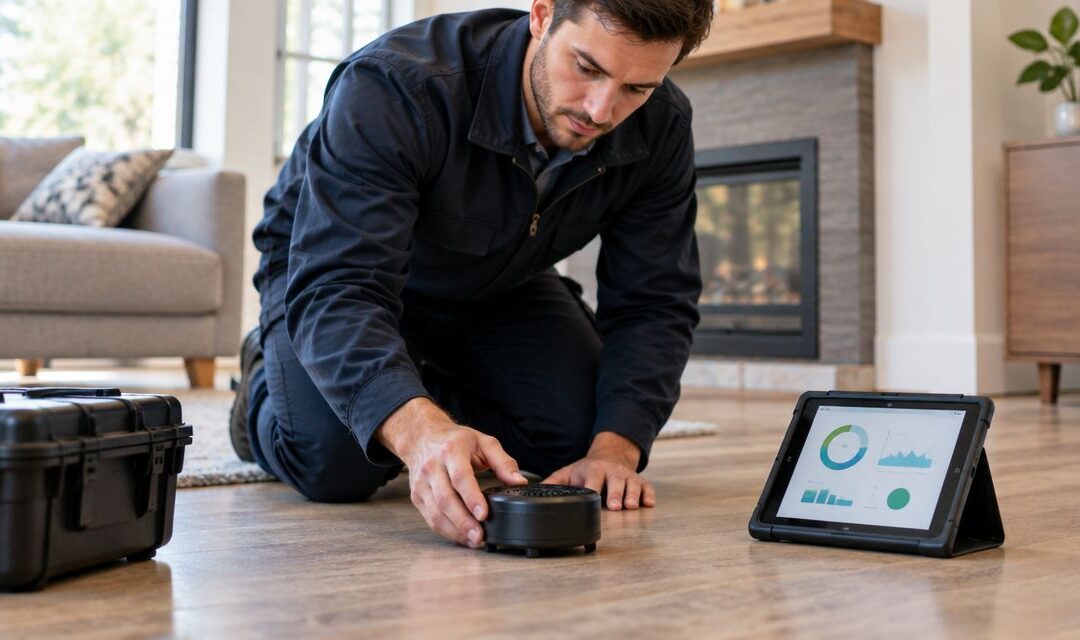
Radon testing for home energy auditors means adding an EPA-protocol radon measurement to the same visit where you check insulation, air leakage, and combustion safety, so the client walks away with one air quality risk assessment instead of two separate service calls. Auditors who skip this step are leaving a health risk off the report at the exact moment they're recommending work that can make radon worse.
- Radon testing for home energy auditors works best as a 48-hour closed-house test run during the same visit as the blower-door test, not before it.
- Michigan Radon Control recommends screening every home you audit for elevated radon, since tightening the envelope can raise indoor levels.
- Continuous radon monitors cost more upfront than short-term kits but let you retest immediately after air sealing without a second site visit.
- Any reading at or above 4 pCi/L calls for a licensed mitigation referral in the audit report, not a wait-and-see note.
Why radon testing matters for home energy auditors
Energy audits exist to tighten a house: air sealing, insulation upgrades, window replacement, duct sealing. Every one of those jobs reduces the natural air exchange that used to dilute soil gas coming up through the foundation. That's the exact mechanism that raises indoor radon.
A 2026 energy audit that recommends air sealing without a radon baseline is making a recommendation with an unmeasured side effect. Radon testing for home energy auditors isn't an add-on service — it's a liability check on the retrofit itself. Testing for radon during a Michigan home energy audit belongs on the same checklist as the blower-door number and the combustion safety test.
Clients also expect it now. A homeowner who's paying for an energy audit in 2026 is already thinking about indoor air quality — radon is the easiest number to add to that conversation, and it's the one most likely to change their mind about a mitigation referral.
Add radon screening to every energy audit checklist
Start with the manual, low-cost version before anything else. This is the baseline step every audit should include regardless of budget.
- Pull a short-term test kit from a hardware store or a state health department loan program
- Place it in the lowest livable level, away from drafts, vents, and exterior doors
- Log the test start date and location on your audit paperwork
- Cross-reference the placement with your blower-door test schedule so depressurization doesn't skew the reading
Set up closed-house conditions before you test
A radon reading taken under the wrong conditions is worse than no reading at all — it gives the client false confidence. Preparing a basement for a radon test takes about 12 hours of lead time and a few simple rules.
- Close all windows and exterior doors at least 12 hours before placing the device
- Keep HVAC systems on normal settings, not "away" or "vacation" mode
- Skip fireplace or wood stove use during the test window
- Note any storms or unusually high wind on the test dates — both can void a short-term reading
Pick a testing device that matches your audit timeline
This is where the manual approach starts to run into limits, and where a faster path enters the picture. If you're auditing one home and reporting once, a kit is fine. If you're comparing radon before and after a retrofit, you need something that gives repeat readings without a second site visit.
- Short-term charcoal or alpha-track kit: cheapest option, needs mail-in lab analysis, results in 2-10 days
- Continuous radon monitor: digital readout, built for before-and-after comparisons around air-sealing work
- Professional NRPP-certified test through Michigan Radon Control: no equipment to manage, results go straight into your audit file
- Screen-then-escalate approach: run a cheap kit first, order a certified test only if the screen reads elevated
Read results against the EPA action level, not gut feel
Don't let a "looks fine" impression override the number. The EPA action level is the standard your report should be measured against, every time.
- 4 pCi/L or higher: the report needs mitigation referral language, not a note to "keep an eye on it"
- 2 to 4 pCi/L: flag as a watch item, especially if the audit recommends air sealing
- Below 2 pCi/L: still record it — it's the baseline number the client will compare future retrofits against
Flag air-sealing work that could raise radon before you seal
This is the step that separates a radon-aware energy audit from a generic one. Any envelope-tightening recommendation should carry a radon note attached to it.
- Attic air sealing, crawl space encapsulation, and window replacement all reduce natural air exchange
- Put the radon interaction in writing whenever the retrofit reduces air exchange materially
- Recommend a retest 30 to 90 days after the retrofit is finished
- If the pre-retrofit reading is already near 4 pCi/L, loop in a licensed contractor before the sealing crew mobilizes — see how to prepare a home for a radon mitigation system for what that scheduling looks like
Build a referral pipeline for jobs that fail
An energy audit that finds elevated radon and hands the client nothing but a number is an incomplete audit. Auditors who build a referral habit turn a red flag into a resolved line item.
- Keep a short list of NRPP-certified mitigation contractors, not just one name
- Ask each contractor how fast they can schedule after a referral comes in
- Get written confirmation the referral includes a post-install retest
- Share your audit's air-sealing scope with the mitigation contractor so the fan and pipe design accounts for the tighter envelope
The referral model that works for home inspectors applies almost directly to energy auditors — the difference is you're flagging the risk before a retrofit instead of before a closing.
Comparing testing options for energy audits
| Option | Best for | Key limitation |
|---|---|---|
| Short-term test kit (48-96 hr) | A quick baseline on a single-visit audit | Sensitive to weather and closed-house compliance |
| Continuous radon monitor | Auditors doing repeat visits or before/after air-sealing comparisons | Higher upfront cost than a mail-in kit |
| NRPP-certified professional test (Michigan Radon Control) | Homes trending toward a mitigation referral | Requires scheduling a licensed technician |
| DIY retest after mitigation install | Confirming a system is holding levels down | Not a substitute for the technician's own post-install test |
Verdict: for a single audit visit, a short-term kit is enough — for any retrofit involving air sealing, a continuous monitor or a certified test is the only way to prove the before-and-after number.
Add a certified radon test to your audit
NRPP-certified testing and mitigation referrals for Michigan energy auditors.
Common mistakes energy auditors make with radon
- Testing during or right after the blower-door test — depressurization pulls the reading off, and the number ends up meaningless.
- Sealing the basement or crawl space before retesting — the retrofit traps the gas instead of removing it, and nobody catches it until the homeowner complains.
- Treating the radon line as optional — a report that buries radon in an appendix instead of the summary gets ignored by the client.
- Using a fast-turnaround real estate kit for baseline trending — those kits are built for a single closing deadline, not for comparing readings across a retrofit.
- Skipping documentation of closed-house conditions — without it, a lender or a skeptical client can throw the whole reading out.
FAQ
What is radon testing for home energy auditors?
It’s an EPA-protocol radon measurement added to a standard energy audit visit, run alongside blower-door and combustion safety checks. The goal is to catch elevated radon before recommending air-sealing work that can make it worse.
How long does a radon test take during a home energy audit?
A short-term test needs a minimum 48-hour closed-house period, and results typically arrive 2-10 days later from a lab. A continuous monitor gives a readout on the spot without a mail-in wait.
Should radon testing happen before or after a blower-door test?
Radon placement should be scheduled around the blower-door test, not during it, since depressurization from the blower door can skew a short-term reading. Set the device before the blower-door test starts or after it fully ends.
What radon level requires a mitigation referral in Michigan?
A reading at or above 4 pCi/L, the EPA action level, calls for a mitigation referral in the audit report. Readings between 2 and 4 pCi/L should be flagged as a watch item, especially before recommending air sealing.
Can air sealing during an energy retrofit raise radon levels?
Yes. Air sealing reduces the natural air exchange that used to dilute soil gas entering through the foundation, which is why a retrofit can push a previously safe reading closer to the EPA action level.
What’s the difference between a short-term kit and a continuous radon monitor?
A short-term kit is a one-time, mail-in measurement over 48-96 hours, while a continuous monitor gives a digital readout and can be used repeatedly for before-and-after comparisons around a retrofit.
Does Michigan require radon testing as part of a home energy audit?
Michigan doesn’t mandate radon testing as a required line item on every energy audit, but adding it is standard practice for auditors flagging air-sealing work in 2026, since it documents a health risk the retrofit could change.
How soon after air sealing should a home be retested for radon?
A retest 30 to 90 days after the retrofit is finished is enough time for the tighter envelope to show its effect on indoor radon levels. Waiting longer just delays catching a problem the client already paid to create.
One last thing
The detail most audit reports miss: air sealing done without a matching ventilation upgrade doesn't just save energy, it changes the air the household breathes. Any energy audit recommending air sealing in 2026 should carry a radon retest recommendation attached to it, not as a footnote but as a condition of the retrofit. That single line is what turns a good energy audit into a complete one.