
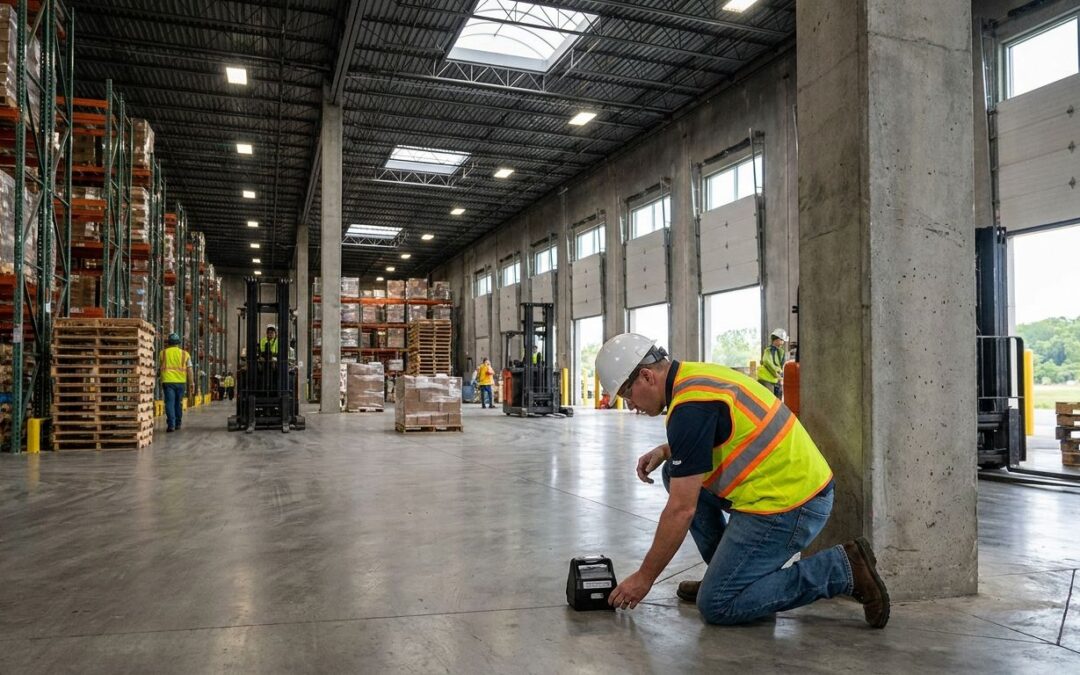
Michigan warehouse radon testing measures indoor radon concentrations across concrete-slab floor plans, multiple HVAC zones, and dock-door traffic patterns that a single consumer kit was never built to handle. Distribution centers and warehouses need a zone-by-zone approach, not a canister taped near the front office and called good.
- Radon testing for warehouses in Michigan needs zone-by-zone monitoring, not one canister near the front entrance.
- The EPA action level is 4 pCi/L for any occupied space, whether it’s a front office or a 40,000-square-foot floor.
- Michigan Radon Control runs NRPP-certified commercial radon testing across Metro Detroit and Lansing warehouses in 2026.
- Skip single-kit consumer tests for buildings over 10,000 square feet; they miss variation across dock-door and HVAC zones.
Why radon testing matters for Michigan warehouses
Radon is a soil gas, and warehouses sit on more soil-contact surface area than almost any other commercial building type. A 50,000-square-foot slab has far more crack, joint, and penetration exposure than a house foundation one-tenth the size.
Many counties across Metro Detroit and Lansing fall into the EPA's Zone 1 radon potential rating, the agency's highest category. That designation applies to soil and geology, not building type, which means a warehouse sitting on Zone 1 ground carries the same underlying risk as the house next door, just spread across a much bigger floor.
Loading dock activity makes it worse. Every time a dock door opens for a truck, the building pressure shifts, and that pressure swing can pull soil gas through slab cracks and expansion joints faster than in a sealed residential basement. Radon testing for commercial buildings in Metro Detroit covers this pattern across office towers and retail spaces, but warehouses see it more often because dock doors cycle dozens of times a shift.
There's also a practical business reason to test now rather than later. Warehouse staff often work 8 to 12-hour shifts on the floor, five or six days a week, which means more cumulative exposure time in the building than most office workers get. A documented, zone-by-zone radon test in 2026 gives you a paper trail if the question ever comes up during a lease renewal, insurance review, or property sale.
Steps to test a Michigan warehouse for radon
Map your building's radon risk zones
Before any device goes on the floor, walk the building and mark where risk is concentrated. This step is free and takes an afternoon.
- Identify slab sections versus any crawl space or partial basement areas
- Note HVAC zone boundaries and which air handlers serve which floor sections
- Mark every dock door and loading bay location
- Flag expansion joints, floor drains, and utility penetrations in the slab
- List which areas are occupied daily versus rarely entered storage zones
Choose the right test device for the square footage
One canister test kit designed for a 1,200-square-foot ranch home will not tell you anything meaningful about a 60,000-square-foot distribution center.
- Use charcoal canisters for short-term spot checks in smaller attached offices
- Deploy continuous radon monitors in zones with heavy dock-door air turnover
- Place at least one device per distinct HVAC zone, not one per building
- Avoid single-kit-per-building testing on any warehouse over 10,000 square feet
- Choose devices rated for the temperature and humidity swings common on an open warehouse floor
Time the test around normal operations
Standard EPA short-term test protocol calls for closed-house conditions, but a warehouse can't shut its dock doors for four days straight and keep running.
- Run the test during a normal 48 to 96-hour window with typical dock traffic
- Keep HVAC systems operating on their regular schedule, not shut down for the test
- Avoid scheduling the test during a planned shutdown or slow holiday week
- Log any maintenance, door repairs, or HVAC servicing that happens during the window
- Note weather conditions, since heavy wind and barometric pressure shifts affect soil gas movement
Test office and warehouse floor separately
Administrative offices and open warehouse floors behave differently under a radon test, even in the same building.
- Place a dedicated device in front-office administrative space
- Place a separate device on the main pick, pack, or storage floor
- Add a third device on any mezzanine, loft, or elevated office area
- Record and report results by zone, never as a single building average
Read your results against the EPA action level
The number that matters is 4 pCi/L. Anything at or above that level in any tested zone is the trigger point, not an average across the whole building.
- Compare each zone's result individually against the 4 pCi/L action level
- Flag zones between 2 and 4 pCi/L for a follow-up retest rather than ignoring them
- Treat a single high zone as reason to mitigate that zone, even if others read low
- Keep dated, written results for every zone tested, not just a summary number
Bring in an NRPP-certified contractor for elevated zones
Once a zone reads at or above 4 pCi/L, DIY testing has done its job and it's time for a professional to design the fix. This is where a contractor enters the process, not before you've mapped the building and run the initial test.
- Confirm the contractor holds current NRPP certification before signing anything
- Ask for a site-specific mitigation plan for each elevated zone, not a one-size system
- Request documentation of sub-slab depressurization points relative to your dock and utility layout
- Get a written scope that names which HVAC zones the system will address
- Verify the contractor has commercial, not just residential, installation experience
Michigan Radon Control designs NRPP-certified mitigation systems for large commercial footprints, and the same standards guiding Michigan general contractors on new builds apply to retrofitting an existing warehouse.
Maintain and retest on a schedule
A mitigation system that worked on installation day can fail quietly. Warehouses change more than houses do, with new dock levelers, added HVAC units, and floor repairs that can open new entry points.
- Retest annually as a baseline, even with a working mitigation system in place
- Retest immediately after any slab repair, new utility penetration, or dock renovation
- Check the mitigation fan's pressure gauge on a set schedule, not only when something seems off
- Keep a maintenance log tied to the building's other facilities records
Radon test options for Michigan warehouses and distribution centers
| Option | Best for | Key limitation |
|---|---|---|
| Charcoal canister test | One-time spot-check in a single small zone | Doesn't capture variation across multiple zones or dock-door pressure swings |
| Continuous radon monitor | Warehouses with fluctuating dock traffic or seasonal HVAC changes | Needs a power source and ongoing data review, not a passive set-and-forget device |
| Professional NRPP-certified test | Multi-zone buildings, lease transactions, or sale documentation | Requires scheduling a certified technician instead of self-administering |
| Consumer mail-in DIY kit | Small offices attached to a warehouse, under roughly 2,000 square feet | Undercounts risk badly in large open floor plans with multiple air handling zones |
Verdict: for any Michigan warehouse over 10,000 square feet, a professional NRPP-certified test with zone-specific continuous monitors is the only option that produces results you can actually act on.
Common mistakes Michigan warehouses make with radon testing
- Testing only the front office and assuming it represents conditions on the warehouse floor 200 feet away.
- Running the test with dock doors propped open during peak receiving hours, which skews pressure readings and produces artificially low numbers.
- Using one consumer kit for a 50,000-square-foot floor plan instead of placing separate devices in each HVAC zone.
- Skipping a retest after building changes like new dock levelers, HVAC additions, or slab repairs that open fresh entry points for soil gas.
- Waiting for a lease renewal or a tenant complaint before testing at all, instead of testing proactively as part of routine facilities management.
Schedule commercial radon testing
NRPP-certified testing for Metro Detroit and Lansing warehouses and distribution centers.
FAQ
What’s the best way to do radon testing for warehouses in Michigan?
The best approach places a separate testing device in each distinct HVAC zone, including offices, the main floor, and any mezzanine space, run over a standard 48 to 96-hour window. A single canister near the front door will not capture conditions across a large warehouse floor.
How much does radon testing cost for a commercial building?
Cost depends on the building’s square footage and how many zones need separate devices. Check current rates directly with a certified testing provider rather than relying on a flat residential price.
Is radon testing required for Michigan warehouses?
There’s no blanket state mandate requiring radon testing for every warehouse, but many counties in the Metro Detroit and Lansing areas fall into the EPA’s Zone 1 highest radon potential category. Testing proactively protects staff and creates documentation for insurance, leasing, and sale purposes.
How long does a commercial radon test take?
A standard short-term test runs 48 to 96 hours per zone, following EPA protocol timing. Continuous monitors can run longer and track fluctuations tied to dock-door activity and HVAC cycling.
Can HVAC systems affect radon test results in large buildings?
Yes. HVAC zoning changes air pressure and exchange rates across a building, which is exactly why each zone needs its own device rather than one reading applied to the whole warehouse.
What radon level is dangerous in a warehouse?
The EPA action level of 4 pCi/L applies to any occupied space, office or warehouse floor alike. Any zone testing at or above that level warrants mitigation.
Do all warehouse zones need separate radon tests?
Yes, for any building over roughly 10,000 square feet. Office areas, main floors, and mezzanines behave differently under pressure changes, so a single average number hides real risk.
How often should a warehouse retest for radon?
Retest annually as a baseline, and immediately after any dock, HVAC, or slab work that could open a new soil gas entry point. A mitigation system installed in 2026 still needs that ongoing check.
One last thing
The entry point most inspectors miss in a warehouse isn't a crack in the middle of the floor. It's the expansion joint where two separate slab pours meet, a detail residential-focused testing often skips entirely because houses rarely have multiple pours. Walk your building's joint lines before your next test and you'll likely find the gap nobody's checked since the concrete cured.
Related guides