
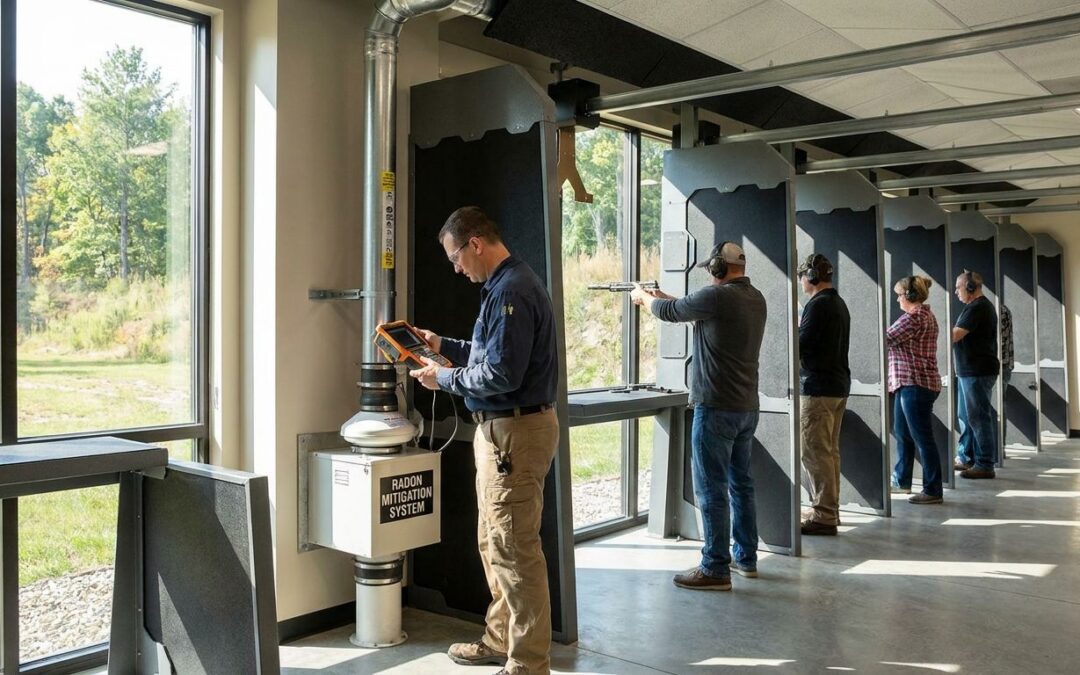
Indoor shooting ranges in Michigan sit on slabs, run negative-pressure ventilation systems, and keep staff on-site for full shifts — three conditions that make radon a different kind of problem than it is in a house. This guide walks range owners and facility managers through what to test, what to install, and which service model actually holds up under daily occupancy.
- Commercial radon control for Michigan shooting ranges starts with a facility-specific test, not a homeowner kit — Buy.
- Negative-pressure ventilation built for lead control can pull more soil gas into a range, raising radon risk above the EPA’s 4.0 pCi/L action level.
- NRPP-certified contractors with multi-year service contracts are the right fit for ranges with daily staff occupancy in 2026.
- Continuous radon monitors give ranges a documented compliance record — passive test kits alone do not.
Why this matters
Radon is a byproduct of uranium decay in soil and bedrock, and it moves through cracks, sumps, and utility penetrations into any building sitting on or near grade. Most Michigan counties fall into the EPA's Radon Zone 1, the agency's highest-risk classification, which means the baseline exposure for a slab-on-grade commercial building here is already elevated before you factor in how the building is used.
Indoor ranges complicate that baseline. The negative-pressure HVAC systems installed to pull lead dust and gunpowder residue away from shooters and toward filtration also depressurize the building relative to the soil underneath it. That pressure differential is exactly the mechanism that drives radon intrusion. A range built to meet lead-exposure ventilation standards can unintentionally become a stronger radon vacuum than a typical retail or office space of the same footprint.
Staff exposure is the other variable that doesn't apply to a residential radon conversation. Range officers and instructors often log full 8-hour shifts on-site, five or six days a week, which is a very different exposure profile than a homeowner sleeping in a basement bedroom. That's the reason commercial radon testing for facilities like these needs to be scoped separately — commercial radon testing in Metro Detroit accounts for occupancy hours and HVAC interaction in a way a $15 hardware-store kit does not.
Who this is for
This guide is written for owners and facility managers of indoor shooting ranges, gun clubs, and training academies operating in Michigan in 2026 — anyone responsible for staff safety, insurance compliance, or lease terms that reference indoor air quality. If your range is below grade, partially below grade, or runs a negative-pressure ventilation system, the recommendations below apply directly to your building.
What to look for in radon control for shooting ranges
Slab construction and negative-pressure interaction
Most indoor ranges pour a continuous concrete slab to support firing lanes and baffle systems, and that slab is the single biggest radon entry point in the building. Pair that slab with a negative-pressure exhaust system and you've built the exact pressure gradient that pulls soil gas indoors faster than a naturally ventilated space would.
Below-grade or partially below-grade construction
Ranges built into hillsides, converted warehouse basements, or berm-backed structures sit closer to the soil radon source and typically test higher. If your facility has any portion below grade, treat that zone as its own testing point rather than averaging it into a single building-wide number.
Occupancy hours, not just square footage
A 6,000-square-foot warehouse with two part-time staff has a different exposure calculus than a 3,000-square-foot range with instructors on-site 40 hours a week. Occupancy hours should drive testing frequency and monitor placement, not the building's size alone.
NRPP-certified commercial testing protocols
Residential radon test kits are built around 48-hour to 90-day placement in a basement or lowest livable level. Commercial buildings with mechanical ventilation need protocol testing that accounts for HVAC cycling, which is why NRPP-certified radon mitigation companies use different placement and duration rules for commercial jobs than for homes.
Continuous monitoring for compliance documentation
A single passive test gives you a snapshot. A range that wants a defensible record for insurance, lease compliance, or an OSHA inquiry needs continuous radon monitors that log data over weeks or months, not days.
Multi-year maintenance for fan and system upkeep
Sub-slab depressurization fans run continuously in a commercial setting, which shortens their service life compared to a residential install that cycles less. A range depending on a mitigation system for daily occupancy needs a service agreement, not a one-time install and a handshake.
Top picks for Michigan shooting ranges
The starting point — commercial radon testing. Every range project should open with a facility-specific test that separates below-grade zones from above-grade zones and accounts for HVAC cycling. Commercial radon testing in Metro Detroit covers this exact scope for buildings with mechanical ventilation. One spec that matters: test duration needs to span at least one full HVAC cycle, not a fixed 48 hours. Buy.
The compliance layer — continuous monitoring. Passive kits don't hold up if an insurer or lease auditor asks for a trend line. A continuous radon monitor logging hourly readings gives a range a documented history above or below the EPA's 4.0 pCi/L action level. Buy.
The credential check — NRPP certification. Radon mitigation for a range with a large slab and active exhaust system is not a job for a general handyman. Confirm any contractor holds current NRPP-certified status before signing a contract. Buy.
The staying-power option — multi-year service contracts. A sub-slab fan running continuously in a commercial building wears faster than a residential unit. Facilities that depend on the system daily should lock in a multi-year service contract that covers fan inspection, pressure-gauge checks, and replacement scheduling. Consider if your current contractor only offers a one-time install with no follow-up.
Get your range tested in 2026
NRPP-certified commercial testing for Metro Detroit and Lansing facilities.
What to avoid
- Homeowner-grade test kits for the whole building. They're built for a single basement zone over a short window and won't capture how a range's negative-pressure system pulls radon through multiple entry points.
- A single passive test with no follow-up plan. One reading tells you where you stood on one day. A range with staff on-site daily needs an ongoing record, not a snapshot.
- Passive-only mitigation on a large slab. A passive stack works for some residential builds, but a range's negative-pressure HVAC system usually overpowers passive venting. Active sub-slab depressurization with a rated fan is the standard for this occupancy type.
Verdict comparison
| Option | Best for | Key spec | Verdict |
|---|---|---|---|
| Commercial radon test | Every range, as the first step | Full HVAC-cycle test duration | Buy |
| Continuous radon monitor | Ranges needing compliance records | Hourly logged readings | Buy |
| NRPP-certified contractor | Any mitigation install | Current NRPP certification | Buy |
| Multi-year service contract | Ranges running fans daily | Scheduled fan and gauge checks | Consider |
| Passive-only system | Low-occupancy, above-grade spaces only | No powered fan | Skip for negative-pressure ranges |
FAQ
What is the best radon control approach for a Michigan shooting range?
Start with a commercial-grade radon test scoped to the building’s HVAC cycle, then install active sub-slab depressurization if levels exceed the EPA’s 4.0 pCi/L action level. Passive systems generally aren’t strong enough to counter a negative-pressure exhaust setup.
Do indoor shooting ranges have higher radon risk than homes?
Ranges built on slabs with negative-pressure ventilation can pull more soil gas indoors than a typical house, because the exhaust system depressurizes the building relative to the ground beneath it. Below-grade or partially below-grade ranges carry additional risk from proximity to the soil source.
How often should a shooting range test for radon?
Ranges with daily staff occupancy should run continuous monitoring rather than a single passive test, since HVAC cycling and negative pressure can shift indoor radon levels over time. An annual verification test is a reasonable minimum after a mitigation system is installed.
Is radon testing different for commercial buildings than for homes?
Yes. Commercial protocols account for mechanical ventilation cycling and building-wide airflow, while residential kits are built for a single basement zone over 48 hours to 90 days. A range needs the commercial protocol, not the homeowner version.
Can a negative-pressure ventilation system make radon worse?
Yes. Exhaust systems built to remove lead dust and gunpowder residue also lower indoor air pressure relative to the soil below, which is the same mechanism that drives radon intrusion. That’s why range HVAC design and radon mitigation need to be evaluated together.
What’s the EPA action level for radon in a commercial building?
The EPA’s action level is 4.0 pCi/L for any building type, residential or commercial. The national average indoor level runs around 1.3 pCi/L, so a range testing above 4.0 pCi/L needs a mitigation system installed.
Who should install a radon mitigation system in a Michigan shooting range?
An NRPP-certified contractor with commercial installation experience, not a general contractor or a residential-only installer. Sub-slab depressurization on a large, actively ventilated slab requires fan sizing and sealing work that differs from a standard basement install.
Does a radon mitigation system need ongoing maintenance in a range?
Yes, and more than a residential system does. Fans running continuously in a commercial building wear faster, so a multi-year service contract covering fan checks and pressure-gauge inspections is standard practice for facilities with daily occupancy.
One last thing
The detail most range owners miss isn't the test — it's the pressure gauge. A properly installed mitigation system includes a manometer that shows at a glance whether the fan is still pulling. If nobody on staff checks it, a failed fan can sit unnoticed for months while the building drifts back above the EPA's 4.0 pCi/L action level. Build a gauge check into whatever maintenance schedule you already run for the HVAC and filtration systems in 2026, and you'll catch a failure in days instead of during next year's re-test.
Related guides