
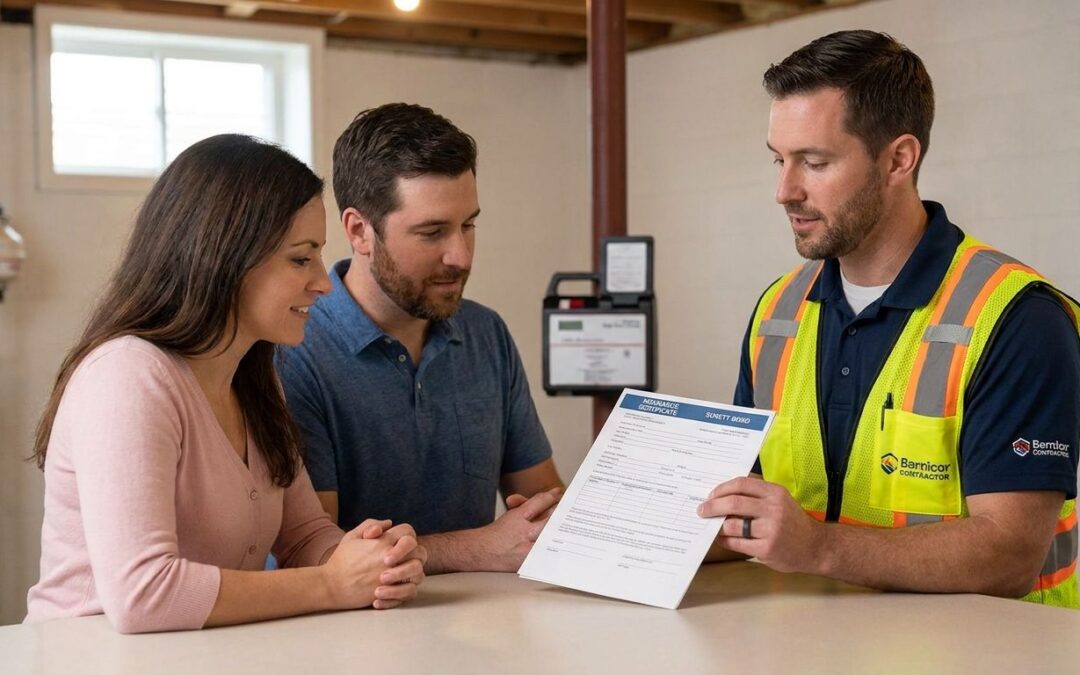
Before a crew drills through your foundation or wires a fan into your electrical panel, confirm they can pay for the damage if something goes wrong. Verifying a radon contractor's insurance and bonding takes about fifteen minutes and protects you for years after the invoice is paid.
- A qualified radon mitigation contractor should carry at least $1 million in general liability insurance active in 2026, plus current workers’ comp.
- Michigan has no state license for radon work, so radon contractor insurance and bonding verification stands in for a licensing check.
- Call the insurance carrier directly using the number printed on the certificate of insurance, never the number the contractor texts you.
- Refusal to produce a certificate of insurance before a deposit is a Skip, no exceptions.
- Bonding matters most on large jobs, new construction passive systems, and anything requiring a deposit before work starts.
Why this matters
Radon mitigation involves cutting into a slab, running PVC through a home's structure, and tying a fan into live electrical circuits. That's real property risk, and if a contractor's insurance has lapsed, you're the one holding the bill for a cracked foundation or an electrical fire. Before you check anything else, verify a contractor's NRPP certification — it confirms training, but it says nothing about whether they can actually pay for a mistake.
Michigan doesn't run a state licensing board for radon mitigation contractors the way it does for plumbers or electricians. That gap means insurance and bonding checks carry more weight here than in states with formal licensure. A contractor with a lapsed policy in 2026 can still show up, pull a permit through a subcontractor, and finish the job — you just won't have anything to fall back on if it fails.
What you'll need
- The contractor's full legal business name (not just a truck logo or a first name)
- 15-30 minutes and a phone
- A written request for a certificate of insurance (COI), sent by text or email so there's a record
- The insurance carrier's direct phone number, pulled from the COI itself, not from the contractor
- A note-taking app or a printed checklist to log what each call confirms
The steps
1. Request the certificate of insurance in writing
Ask for a COI before scheduling, not after the crew arrives. A COI is a one-page document from the insurer listing policy type, coverage limits, and expiration date. Legitimate radon mitigation contractors keep this on file and send it within a day; a same-day refusal is a red flag worth walking away from.
2. Call the carrier, not the contractor
Dial the number printed on the COI and ask the carrier to confirm the policy is active for the exact business name on your quote. This step catches the most common problem: a contractor showing you a real COI from a policy that expired six months ago. Expect the call to take five minutes.
3. Check the coverage types, not just the total
General liability alone doesn't cover a technician injured on your property — that needs workers' compensation. If the contractor subcontracts electrical work for the fan hookup, ask whether that subcontractor is separately insured or covered under the general policy. A radon contractor working under a home's foundation should carry general liability limits of at least $1 million per occurrence as a baseline for 2026 pricing in most markets.
4. Confirm bonding status for larger jobs
A bond isn't insurance — it's a guarantee that money exists to finish or repair a job if the contractor walks away mid-project. Bonding matters most on system installs that require a deposit, multi-day crawl space encapsulation combined with mitigation, or new construction passive system installs. Ask the bonding company (listed on the bond certificate) to confirm the bond is active and covers the dollar amount of your project.
5. Cross-check the certification number
NRPP and NRSB certification numbers are searchable on the certifying body's public directory. Match the number on the contractor's paperwork against the directory listing and confirm the name matches exactly — a common trick is listing a certified supervisor's number on a job actually run by an uncertified crew. Reading contractor reviews before hiring can surface this problem faster than a phone call, since past clients often mention who actually showed up.
6. Ask to be named additional insured
For jobs over a few thousand dollars, request that the policy list you as an additional insured for the duration of the work. This costs the contractor nothing and gives you direct standing to file a claim if something on your property is damaged. A contractor who balks at this request for a routine radon mitigation job is worth questioning.
7. Save every document before work starts
Keep the COI, the bond certificate, and the certification number in one folder — digital or paper — before the crew shows up. If you ever need to document radon mitigation work for insurance claims or a home sale disclosure, having this on hand saves weeks of chasing paperwork later.
Verify credentials before you commit
Michigan Radon Control provides NRPP-certified testing and mitigation with insurance documentation on request.
Troubleshooting
Contractor says insurance is "on file with the state." Michigan doesn't maintain a state radon insurance registry, so this claim can't be verified independently. Ask for the COI directly and treat evasiveness as a Skip.
The COI lists an expired date. Reject the quote until a current COI is produced. A contractor with an active business should be able to send a renewed COI within a day.
The carrier won't confirm details over the phone. Some carriers only confirm policy status to the policyholder due to privacy rules. Ask the contractor to loop you into a three-way call or forward a written confirmation email from the underwriter.
The business name on the bond doesn't match the invoice. This usually means a subcontractor is doing the work under someone else's bond. Ask directly whose crew will be on-site and whether that entity carries its own coverage.
Only workers' comp is offered, no general liability. Workers' comp protects the crew, not your home. A contractor without general liability coverage in 2026 shouldn't be cutting into a foundation slab, period.
Pressure to skip verification for a "today only" price. Legitimate radon mitigation contractors don't need to rush a homeowner past a fifteen-minute insurance check. Treat urgency tactics as a reason to slow down, not speed up.
Tools and resources
- The certifying body's public directory for NRPP and NRSB lookups
- A written COI request template (email or text works)
- NRPP-certified radon mitigation companies in Michigan as a starting point if your current quote fails verification
- A folder — physical or cloud — for storing COIs, bond certificates, and certification numbers
What to do next
Once insurance and bonding check out, move to price. Compare radon mitigation quotes from at least two verified contractors before signing anything — a verified contractor with a high quote and a verified contractor with a fair quote are both safer bets than an unverified contractor at any price.
“If a contractor won’t produce a certificate of insurance in writing, that’s your answer.”
FAQ
What insurance should a radon mitigation contractor carry in 2026?
A radon mitigation contractor should carry at least $1 million in general liability insurance and active workers’ compensation coverage in 2026. Larger jobs involving crawl space work or new construction installs often warrant higher limits.
Is a radon contractor required to be bonded in Michigan?
Michigan doesn’t mandate bonding for radon mitigation contractors at the state level. Bonding still matters on larger jobs because it guarantees funds exist to finish or repair work if the contractor stops mid-project.
How do I verify a contractor’s certificate of insurance is real?
Call the insurance carrier directly using the phone number printed on the certificate of insurance, not a number the contractor provides. Ask the carrier to confirm the policy is active and matches the business name on your quote.
What happens if an uninsured contractor damages my home during mitigation?
You’re responsible for repair costs unless you pursue a civil claim against the contractor personally, which is slow and often unsuccessful if the business has few assets. Verifying insurance before work starts avoids this entirely.
Does NRPP certification include insurance requirements?
NRPP certification confirms training and testing competency, not insurance coverage. Certification and insurance are separate checks, and both matter before hiring.
Should I ask to be listed as an additional insured on the policy?
Yes, for jobs over a few thousand dollars, request additional insured status for the project duration. It costs the contractor nothing and gives you direct standing to file a claim if property is damaged.
Can I still take legal action against an uninsured radon contractor?
You can file a civil suit, but collecting damages from an uninsured contractor often depends on their personal assets rather than a claim against a policy. Verifying insurance and bonding before hiring avoids that gamble.
One last thing
Most homeowners assume a contractor's certification and their insurance are the same check — they're not. A crew can hold a current NRPP certification and still be running on a lapsed general liability policy, which is exactly why the carrier phone call in step two matters more than reading the COI itself. Fifteen minutes on the phone in 2026 is cheaper than any repair bill a mitigation job gone wrong could generate.
Related guides