
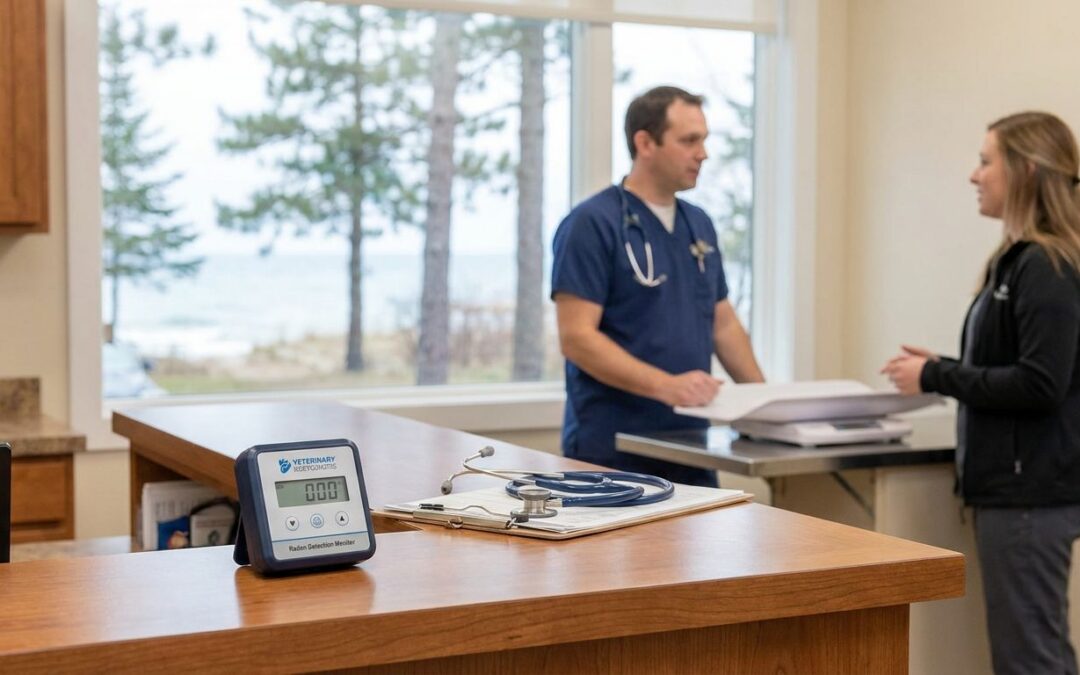
Veterinary clinics and animal hospitals in Michigan run occupied buildings for 10-12 hours a day, often with kennels and surgical suites in the lower level closest to the soil gas that carries radon into a structure. That makes radon testing for veterinary clinics in Michigan a different job than testing a single-family home, and it changes what "passing" a test actually means.
- Radon testing veterinary clinics Michigan requires closed-building protocols adapted for occupied facilities, not a 48-hour kit left in an empty basement.
- Michigan Radon Control’s commercial building testing applies to vet clinics with kennel or surgical space below grade — verdict: Buy.
- The EPA action level is 4 pCi/L; Michigan health officials estimate roughly one in three homes and similarly built commercial spaces test above it.
- Continuous radon monitors beat single-point mail-in kits for clinics that can’t fully close the building for 48 hours — verdict: Consider.
- Multi-location veterinary groups should ask about property manager testing programs before, not after, a lease renewal or accreditation review.
Why this matters for a working clinic
A veterinary clinic isn't a vacant house. Staff, technicians, and boarded animals occupy the building most of the day, which means doors open constantly, HVAC systems cycle, and the "closed-building conditions" that a standard 48-hour radon test wants are hard to hit. Michigan Radon Control's radon testing for commercial buildings in Metro Detroit protocol accounts for that traffic pattern instead of pretending it doesn't exist.
The stakes are higher than in a home, too. A clinic has employees on-site 40+ hours a week, boarded animals in lower-level kennels for days at a time, and often an accreditation body or insurer asking about indoor air safety. Radon is the leading cause of lung cancer in nonsmokers nationally, and Michigan's glacial till and uranium-bearing bedrock push indoor levels higher than the national average in a large share of buildings tested. A clinic sitting on a slab or with a below-grade kennel area is exactly the kind of structure that concentrates soil gas.
Who this guide is for
This is for veterinary practice owners, hospital administrators, and facilities managers responsible for a Michigan clinic building — whether that's a single independent practice in Oak Park or a multi-location group with locations from Metro Detroit to Lansing. If you're weighing radon testing before a lease renewal, an AAHA accreditation review, or simply because staff asked about it, the criteria below apply whether you own the building or lease it.
What to look for in radon testing for veterinary clinics
A protocol built for occupied buildings, not vacant ones
Standard residential radon tests assume a closed house for 48 hours. A clinic can't shut its doors for two days, so the testing approach needs to account for normal foot traffic, exam room doors opening, and HVAC cycling without invalidating the result. Ask any tester how they adjust for an occupied commercial space before you schedule anything.
Placement in the rooms animals and staff actually use
A single test placed in a front office tells you nothing about the kennel room in the basement where boarded animals spend the night. Radon settles lower in a building, so placement in below-grade treatment, surgery, and boarding areas matters more than a hallway reading.
Continuous monitoring for long-occupancy spaces
A clinic with staff on-site 10-12 hours a day benefits from continuous monitoring rather than a single 48-hour snapshot, because radon levels swing with weather, HVAC settings, and even how often exterior doors open during intake hours. A one-time reading can miss a spike that happens every afternoon when the loading door stays propped open.
NRPP certification and documentation you can hand to an accreditor
AAHA reviewers, insurers, and landlords all want paperwork, not a verbal assurance. NRPP-certified testing gives you a report that documents methodology, placement, and results in a format that satisfies a compliance file.
Scheduling that doesn't shut down patient care
A clinic can't close for two days to accommodate a test. Look for a provider that can schedule testing after hours or over a weekend so surgery and boarding schedules aren't disrupted.
A path to mitigation if the result comes back high
Testing without a mitigation plan just tells you there's a problem. Confirm the same company that tests can also install and service a mitigation system if the reading exceeds 4 pCi/L, so you're not restarting the search for a second contractor.
Top picks for Michigan veterinary clinics
The baseline test — commercial building protocol. Michigan Radon Control's radon testing for commercial buildings in Metro Detroit is built around occupied-space testing, which is the right starting point for almost every clinic. One spec that matters: testing accounts for a building that can't hit true closed-building conditions for 48 straight hours. Verdict: Buy for any single-location clinic starting from zero.
The healthcare-adjacent option — medical and dental office program. Clinics share a lot with medical and dental offices: exam rooms, sterile areas, staff on-site all day, and patients (animal or human) in the building. Michigan Radon Control's radon control services for Michigan medical and dental offices protocol was built for that occupancy pattern and translates directly to a veterinary setting. Verdict: Buy if your building shares layout with a medical office — slab construction, multiple treatment rooms, limited after-hours access.
The ongoing option — continuous monitoring. A single test is a snapshot; continuous monitors track radon day to day, which matters for a building running HVAC and exterior doors on a schedule that changes with intake volume. This is the pick for a clinic that had one high reading and wants to watch trends before committing to a full mitigation install. Verdict: Consider for clinics already near the 4 pCi/L line.
The multi-location plan — property manager programs. A veterinary group running three or four Michigan locations needs a testing cadence, not a one-off appointment, especially with staff rotating between buildings. A structured program keeps every location's paperwork current for lease reviews and accreditation cycles. Verdict: Consider for any group with more than one Michigan facility.
The verification step — checking NRPP certification before you hire. Before signing with any tester, confirm NRPP certification directly rather than taking a sales pitch at face value; Michigan Radon Control's best radon testing companies near you in Michigan breakdown covers what that certification actually verifies. Verdict: Buy this step regardless of which company you hire — it costs you nothing but a phone call.
Schedule clinic radon testing
NRPP-certified testing built for occupied commercial buildings across Metro Detroit and Lansing.
What to avoid
- Mail-in residential kits as your only data point. A charcoal canister mailed to a lab works for a homeowner's basement; it doesn't capture the daily occupancy swings of a clinic running for 12 hours with staff and animals moving through it constantly.
- A single reading taken during a slow week. Radon varies with weather and building use. A test run during a quiet holiday week with fewer patients and doors staying shut isn't representative of a normal operating day.
- A tester with no mitigation follow-through. If the company that tests your building can't also install or service a mitigation system, you're paying twice and losing time between diagnosis and fix.
Verdict comparison
| Option | Best for | Occupancy fit | Verdict |
|---|---|---|---|
| Commercial building protocol | Single-location clinics starting fresh | Built for occupied buildings | Buy |
| Medical/dental office program | Clinics with exam-room layouts | Strong match | Buy |
| Continuous monitoring | Borderline or fluctuating readings | Tracks daily swings | Consider |
| Property manager program | Multi-location veterinary groups | Scales across sites | Consider |
| NRPP certification check | Every clinic, every hire | N/A — vetting step | Buy |
FAQ
Is radon testing required for veterinary clinics in Michigan?
Michigan does not mandate radon testing for commercial buildings by law in 2026, but AAHA accreditation reviews, landlords, and insurers increasingly ask about indoor air safety documentation. Testing proactively avoids scrambling for results during a review cycle.
What’s the best way to test radon in an occupied clinic?
A commercial testing protocol adapted for occupied buildings, paired with placement in below-grade kennel or treatment areas, gives the most accurate picture. A single hallway reading or a residential mail-in kit misses the rooms where radon actually concentrates.
How much does radon testing cost for a veterinary clinic in Michigan?
Commercial testing costs vary by building size and number of test points, and pricing is best confirmed directly with a provider for your specific square footage. A quote request through Michigan Radon Control gives an exact figure for your building.
How long does radon testing take in a working clinic?
Short-term commercial tests typically run 48 hours, scheduled around clinic hours to minimize disruption to surgery and boarding schedules. Continuous monitors can run longer to capture day-to-day variation.
What radon level requires mitigation in a veterinary clinic?
The EPA action level is 4 pCi/L for any building type, including commercial and veterinary spaces. A confirmed reading at or above that level warrants a mitigation system installation.
Can one company handle both radon testing and mitigation for a clinic?
Yes, and it’s the more efficient path. A single NRPP-certified provider that both tests and installs mitigation systems avoids the delay of hiring a second contractor if results come back high.
Do multi-location veterinary practices need a different testing approach?
A structured testing program across all locations keeps documentation current for every site instead of testing reactively one building at a time. This matters most for groups renewing leases or accreditation on staggered schedules.
Why is radon a bigger concern in Michigan clinics specifically?
Michigan’s glacial till and underlying bedrock produce higher soil radon concentrations than much of the country, and Michigan health officials estimate roughly one in three tested buildings exceed the EPA action level. Slab-on-grade and below-grade construction, common in commercial buildings, concentrates that gas indoors.
One last thing
Most clinics that test high aren't surprised by the number — they're surprised by where the reading came from. A kennel room built as a below-grade addition years after the original structure often reads two to three times higher than the front office, simply because it sits closer to the soil and further from ventilation. Test that room specifically in 2026, not just the space where the front desk sits.
Related guides
- Radon testing programs for Michigan property managers
- Best continuous radon monitors for Michigan homes