
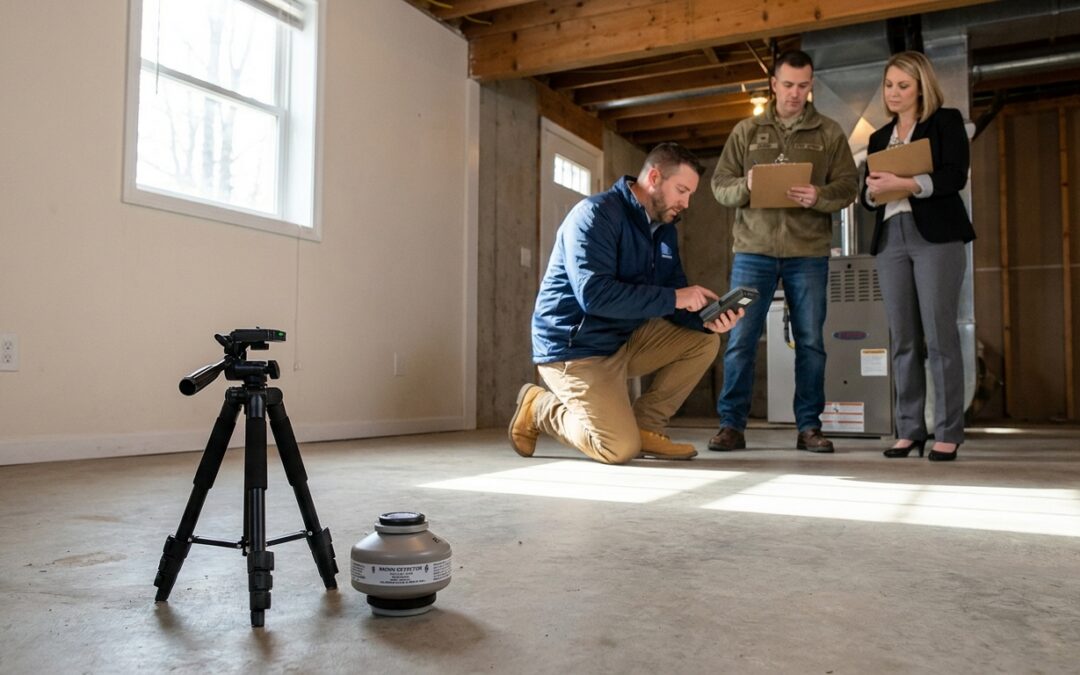
Radon doesn't care what kind of loan you're using, but your lender might. FHA and VA buyers in Michigan run into a mix of federal guidance, state disclosure law, and lender-specific overlays that decide whether a radon test needs to happen before your closing date — and what happens if the number comes back high.
- VA requires a radon test on new construction under 12 months old; order it before the appraisal, not after.
- FHA has no blanket radon rule, but a result at or above the EPA’s 4.0 pCi/L action level forces mitigation before HUD will insure the loan.
- A standard 48-hour short-term test ordered 60-90 days out keeps results valid through underwriting on radon testing FHA VA loan Michigan files.
- Independent NRPP-certified testing avoids the interested-party conflict some VA and FHA underwriters flag on Michigan closings.
Why this matters
Neither FHA nor VA has a national rule that says every Michigan buyer must test for radon before closing. That surprises people. What actually happens is narrower: VA's Minimum Property Requirements call for radon testing on new construction properties less than a year old, and FHA/HUD guidance requires mitigation if a test result — ordered by anyone, for any reason — comes back at or above 4.0 pCi/L before the loan can close in 2026. Michigan adds its own layer: sellers must disclose known radon test results under state law, and that disclosure often triggers the test in the first place. Add a tight Michigan home closing timeline and a 48-hour test window, and a radon result can become the thing that decides whether your closing date holds.
Who this is for
This is for Michigan buyers financing through FHA or VA who are mid-contract or about to make an offer, plus the real estate agents and loan officers walking them through it. If your purchase agreement has an appraisal contingency, a new-construction closing under a year old, or a seller disclosure that mentions a prior radon reading, this applies to you directly in 2026.
What to look for in radon testing for FHA and VA loans
Whether your loan type actually triggers a mandatory test
FHA doesn't require radon testing as a standing condition of approval — it only becomes mandatory when a test is ordered by the buyer, appraiser, or required by state law, and the result must then meet HUD's mitigation threshold before closing. VA is different: new construction under 12 months old gets tested as part of the property requirement, existing resale homes generally don't. Know which bucket your property falls into before you assume a test is optional.
The 4.0 pCi/L action level, and what happens above it
EPA's long-standing action level is 4.0 pCi/L, and it's the number both FHA and VA underwriting guidance leans on. A result at or above that level doesn't kill the loan — it means mitigation has to happen, and often a retest, before the lender will fund. Homes testing above that threshold need a mitigation system built for homes with radon levels above 4 pCi/L, not a generic fix.
Who orders and pays for the test
FHA and VA underwriters both look for independence — a test ordered and read by the buyer's agent, the seller, or an interested party gets more scrutiny than one ordered through a neutral third party. Michigan Radon Control runs NRPP-certified testing specifically because that credential removes the interested-party question before it comes up.
Test validity window against your closing date
Most lenders won't accept a radon result that's sitting stale by the time you close — a 60-to-90-day window before closing is the common practical target, even though neither FHA nor VA publishes a hard national expiration date. Build your test timeline backward from your scheduled closing, not forward from your contract date.
How mitigation gets negotiated into the purchase agreement
When a test comes back high mid-contract, someone has to pay for mitigation, and that's a negotiation, not a given. Buyers who understand how to negotiate mitigation costs during a home purchase close faster than buyers who treat the number as a deal-killer.
Top picks for handling the requirement
The safe pick — order the test the day your offer is accepted. Waiting until the appraisal is scheduled costs you the 48 hours a short-term test needs, plus lab turnaround. Order same-week, and you protect your closing timeline. Buy this approach on every FHA and VA contract.
The one VA buyers can't skip — new construction under 12 months. VA's Minimum Property Requirements call this out specifically for proposed or recently built homes, and skipping it isn't an option the underwriter will accept. Buy: schedule this before the final walkthrough, not after.
The credential check — verify NRPP certification before you hire anyone. An underwriter questioning who performed the test can stall a closing by weeks. Knowing how to verify a mitigation contractor's NRPP certification protects you from that delay. Buy: confirm certification before signing any testing or mitigation contract.
The wildcard — a continuous monitor instead of a charcoal kit. Continuous monitors log hour-by-hour data and are harder for an underwriter to question than a simple two-day passive kit. They cost more upfront but hold up better under scrutiny on a financed purchase. Consider this if your closing date has any flexibility risk.
The retest — after mitigation is installed, not before. A mitigation system installed pre-closing needs a follow-up test to confirm the fix actually worked before HUD or VA will sign off. Skipping this step is the single most common reason FHA and VA closings slip past their original date in 2026.
Schedule your FHA/VA radon test
NRPP-certified testing sized to Michigan closing deadlines.
What to avoid
- A charcoal kit ordered by the listing agent. It looks like a valid test, but the interested-party question follows it straight into underwriting.
- Assuming FHA never requires mitigation. It doesn't require the test itself, but a result at or above 4.0 pCi/L forces mitigation regardless of loan type.
- Skipping the post-mitigation retest. A system that isn't verified working after installation can leave a VA or FHA file open with no closing date.
Verdict comparison
| Loan Type | Test Mandatory? | Action Level Trigger | Who Should Order It |
|---|---|---|---|
| FHA | No blanket rule | 4.0 pCi/L forces mitigation | Independent tester, not seller/agent |
| VA | Yes, new construction under 12 months | 4.0 pCi/L forces mitigation | Independent tester before appraisal |
| Conventional | No | Not lender-mandated | Buyer's choice |
| USDA | Varies by appraisal condition | 4.0 pCi/L commonly referenced | Independent tester recommended |
FAQ
Does FHA require a radon test in Michigan?
FHA has no blanket national requirement for radon testing. If a test is ordered — by the buyer, appraiser, or triggered by Michigan’s seller disclosure law — and it comes back at or above the EPA’s 4.0 pCi/L action level, HUD guidance requires mitigation before the loan closes.
Does a VA loan require radon testing?
Yes, for new construction homes less than 12 months old, VA’s Minimum Property Requirements call for radon testing as part of the appraisal process. Resale homes generally don’t trigger the same mandatory test.
What radon level fails an FHA or VA inspection in Michigan?
A result at or above 4.0 pCi/L, the EPA’s action level, is the threshold both FHA and VA guidance use to require mitigation before closing. Below that level, no action is mandated.
How long does a radon test take before an FHA or VA closing?
A standard short-term test runs 48 hours, plus lab or device readout time. Order it the week your offer is accepted so results are back well before your closing date.
Who should order the radon test on a financed Michigan purchase?
An independent, NRPP-certified tester rather than the buyer’s or seller’s agent. Interested-party testing draws extra scrutiny from FHA and VA underwriters and can stall a closing.
What happens if radon mitigation is needed before an FHA or VA closing?
A mitigation system gets installed, then a retest confirms the level has dropped below 4.0 pCi/L before the lender will fund. Skipping the retest is a common cause of delayed 2026 closings.
Is radon testing required to sell a home in Michigan?
Michigan doesn’t mandate testing at point of sale, but sellers must disclose any known prior radon test results. That disclosure often prompts a buyer to order a new test as part of financing.
Can a home fail an FHA or VA appraisal because of radon?
A high radon reading alone doesn’t fail the appraisal, but it does require mitigation and a passing retest before HUD or VA will approve the loan for closing.
One last thing
The detail most FHA and VA buyers miss in 2026 isn't the 4.0 pCi/L number — it's the retest. A mitigation system that's installed but never verified with a follow-up test can leave your file open with no confirmed closing date, even after the fan is running and the levels look fixed on paper.
Related guides