
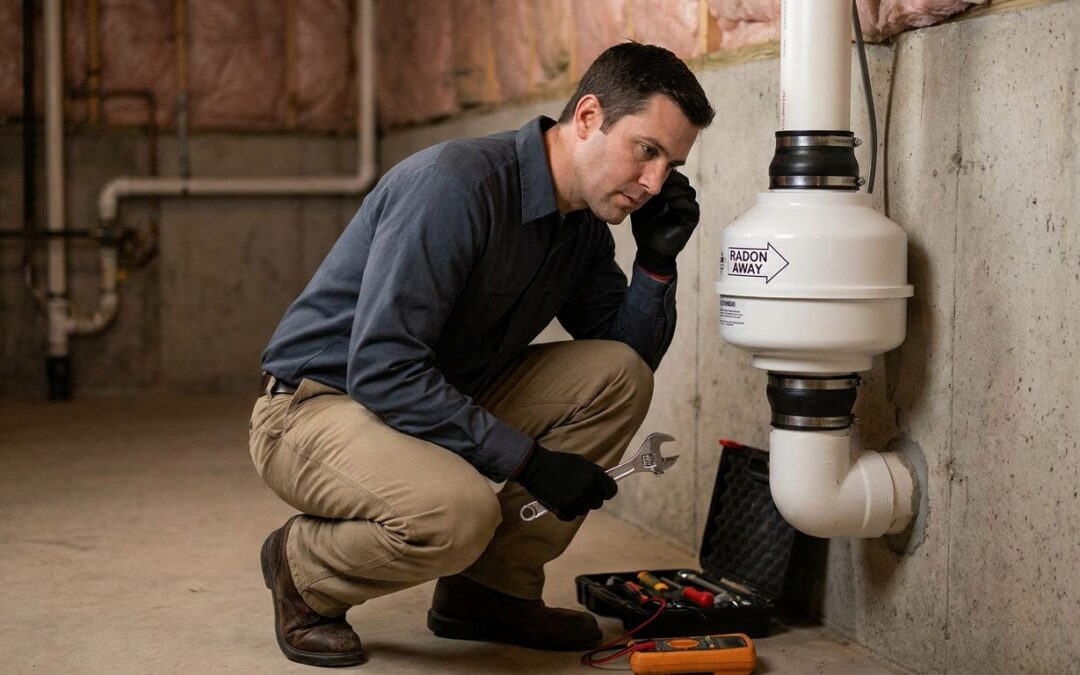
A radon mitigation fan that suddenly hums louder, rattles, or grinds is either telling you something loose needs tightening or that the motor is wearing out — and the fix depends entirely on which sound you're hearing.
- A radon fan making noise usually means loose fan housing, ice buildup, or a failing motor bearing — diagnose by sound type first.
- Humming or buzzing is often normal; grinding, rattling, or screeching signals the fan needs service or replacement.
- Most radon mitigation fans last 5 to 10 years before motor noise becomes a replacement issue, not a repair one.
- Tightening loose pipe connections and clamps fixes a surprising number of noise complaints without touching the fan itself.
- If noise comes with a drop in suction or a cracked housing, stop troubleshooting and call an NRPP-certified technician.
Why this matters
A noisy radon fan is not just annoying — it's usually the first warning sign that your mitigation system is losing effectiveness. Radon mitigation fans run continuously, 24 hours a day, 365 days a year, which means normal wear adds up fast. A fan that's straining to keep suction can let radon levels creep back above the EPA action level of 4 pCi/L without any other symptom.
Most fans installed in Michigan homes are rated for continuous duty and built to last 5 to 10 years under normal conditions. New noise after years of quiet operation almost always points to a mechanical change, not a fluke. Ignoring it either wastes energy on a struggling motor or lets the system fail quietly while you assume it's still working.
What you'll need
- A ladder if your fan is mounted in the attic or on an exterior wall
- A flashlight to inspect the fan housing and pipe joints
- A manometer reading (most systems have a U-tube gauge mounted on the pipe) to confirm suction is still active
- Silicone caulk or PVC cement for resealing pipe joints
- Work gloves and safety glasses
- The model number of your radon mitigation fan, usually printed on a label on the housing
- Contact info for an NRPP-certified technician if the noise turns out to be motor failure
If you don't already know what fan model is installed, checking the best radon mitigation fans for Michigan homes guide will help you match noise symptoms to your specific unit.
The steps
1. Identify the type of noise before touching anything
What it accomplishes: narrows the diagnosis before you climb a ladder or open anything up.
A low, steady hum is typically normal fan operation — radon fans are not silent, and a quiet hum at low RPM is expected. A rattling or vibrating sound usually means something loose: a mounting bracket, a pipe clamp, or debris inside the housing. A grinding, screeching, or buzzing sound that wasn't there before points to bearing wear inside the motor.
Common mistake: assuming any noise is a fan failure. Many noise complaints in 2026 service calls turn out to be a loose pipe strap, not the fan itself.
2. Check the mounting and pipe connections
What it accomplishes: rules out the most common and cheapest-to-fix cause of radon fan noise.
Radon fans are usually installed with rubber couplings between PVC pipe sections specifically to dampen vibration. Inspect every joint within 3 feet of the fan for looseness, cracking, or a coupling that's slipped out of position. Tighten hose clamps by hand until snug — don't overtighten, which can crack PVC fittings.
Expected outcome: a rattle that disappears once connections are re-secured confirms the fan motor itself is fine.
3. Inspect for ice or condensation buildup (cold-weather noise)
What it accomplishes: addresses a Michigan-specific cause of radon fan noise during winter months.
Exterior-mounted fans in Michigan can develop ice buildup on the fan blades or exhaust pipe during freeze-thaw cycles, throwing the blade off balance and causing a whirring or knocking sound. Check the exhaust termination point above the roofline for ice accumulation, especially after a thaw-refreeze cycle.
Common mistake: chipping ice off the fan housing with a hard tool, which can crack the plastic casing. Let it thaw naturally or use warm water instead.
4. Check for insect or debris intrusion
What it accomplishes: eliminates a blockage-related cause that mimics motor failure.
Exhaust pipes terminate above the roofline, and insects occasionally nest near the outlet, sometimes trailing into the fan blade area. A clicking or intermittent buzzing noise can be debris striking a spinning blade. Shine a flashlight into the exhaust cap from ground level — never climb onto the roof yourself for this step.
Expected outcome: removing debris from the exhaust termination should immediately quiet a clicking sound.
5. Test suction with the manometer
What it accomplishes: confirms whether the noise is cosmetic or a sign the system is actually failing.
Most installed systems include a U-tube manometer on the vertical pipe run. Compare the current reading to the baseline reading recorded at installation, usually noted on a tag near the gauge. A significant drop in suction alongside new noise is the clearest sign the fan motor is losing power.
Common mistake: skipping this check and only relying on sound. A fan can sound fine and still be underperforming, or sound rough and still be pulling adequate suction.
6. Listen for bearing whine at different times of day
What it accomplishes: catches early-stage motor bearing wear before total failure.
Bearing wear often starts as a high-pitched whine that's worse when the fan first starts (cold bearings) and quiets slightly once the motor warms up. This pattern is a strong signal the motor bearings are drying out or wearing down, not something a tightening job will fix.
Expected outcome: if the whine is consistent across multiple days and doesn't improve, the fan is heading toward failure within months, not years.
7. Decide: tighten, wait, or replace
What it accomplishes: turns your diagnosis into an action plan instead of guesswork.
If the fix was a loose clamp or ice, you're done — recheck in a week to confirm the noise doesn't return. If suction has dropped and the noise is a grind or whine, the fan is nearing end of life and scheduling a replacement now avoids an unplanned radon level spike later. The how to tell if your radon mitigation fan needs replacing guide walks through the specific signs that mean replace now versus wait.
If the fan takes more than a season to quiet down on its own, it isn't going to — the motor is telling you it's done.
Not sure if it’s the fan or the system?
An NRPP-certified technician can diagnose noise and suction loss in one visit.
Troubleshooting
- Fan is loud but suction reading is normal: Likely a loose bracket or coupling. Tighten every clamp within reach and recheck after 48 hours.
- Fan noise only happens in freezing weather: Ice buildup on exterior-mounted units. Check the exhaust cap after each thaw and confirm it's clear before the next freeze.
- Fan cycles on and off with a clunk: This isn't normal for a radon fan — most run continuously. A cycling fan with a clunking noise usually means a failing capacitor or relay, not a simple loose part.
- New rattling started right after basement work or remodeling: Vibration from nearby construction can loosen pipe supports. Recheck all mounting hardware along the full pipe run, not just near the fan.
- Whine gets louder over several weeks: This is bearing wear progressing. Budget for replacement now rather than waiting for total failure, which can happen with no warning.
- Suction dropped to zero and the fan is silent: The motor has failed completely. This requires immediate replacement — radon levels can climb back toward pre-mitigation levels within days.
Tools and resources
- Manometer reading log (check the tag near your system's gauge)
- How to maintain your radon mitigation system for a full seasonal checklist
- Best radon mitigation fans for Michigan homes to compare replacement options by climate durability
- A basic set of screwdrivers and a hose clamp driver
- An NRPP-certified technician for any diagnosis involving suction loss or motor failure
What to do next
Once the noise is resolved or you've confirmed a replacement is coming, verify the whole system is still doing its job. The how to verify your radon mitigation system is still working guide covers the manometer checks and retest timing that confirm your fix actually held. If you're mid-installation or considering an upgrade, the radon mitigation system installation for Michigan homes overview covers what a properly installed system should sound and perform like from day one.
FAQ
Why is my radon fan making noise all of a sudden?
A sudden noise from a radon fan usually means a loose pipe connection, ice buildup on an exterior unit, or early motor bearing wear. Check mounting hardware and pipe clamps first since those are the cheapest and most common causes.
Is it normal for a radon mitigation fan to hum?
Yes, a low steady hum is normal for a radon fan running continuously. Grinding, screeching, or a rising whine is not normal and usually signals the motor bearings are wearing out.
How long do radon mitigation fans last in 2026?
Most radon mitigation fans last 5 to 10 years under continuous operation. Fans installed before 2018 that are now making noise are likely nearing the end of their expected lifespan.
Can a noisy radon fan mean my radon levels are rising?
A noisy fan alone doesn’t confirm rising radon levels, but a noise paired with a drop in manometer suction does. Check the U-tube gauge on your system’s pipe to confirm suction before assuming levels are affected.
Should I replace or repair a noisy radon fan?
Repair if the noise traces back to a loose clamp, bracket, or ice buildup that clears once fixed. Replace if suction has dropped alongside the noise or the sound is a grinding or whining motor bearing.
Can cold weather cause radon fan noise in Michigan?
Yes, exterior-mounted fans can develop ice on the blades or exhaust cap during Michigan’s freeze-thaw cycles, causing a whirring or knocking sound. Clearing ice after a thaw usually resolves it without needing a repair visit.
How much does it cost to replace a radon mitigation fan?
Replacement cost varies by fan model and installation complexity, so getting a current estimate from a certified technician is the most accurate way to budget. The how to budget for a radon mitigation system installation guide covers cost factors in more detail.
Do I need a certified technician to fix a noisy radon fan?
Loose clamps and ice buildup are safe for homeowners to check and fix. Anything involving suction loss, motor replacement, or system rewiring should go to an NRPP-certified technician to keep the system compliant with EPA mitigation standards.
One last thing
The fan is almost never the actual radon problem — it's the messenger. A fan straining to compensate for a cracked pipe seal or a settling foundation will get noisy and wear out faster than one working under normal load, so a noise complaint is often your earliest warning of a separate issue elsewhere in the system. Chase down the root cause before you replace the fan, or the new one will start making the same noise in half the time.
Related guides
- How to tell if your radon mitigation fan needs replacing
- How to maintain your radon mitigation system
- How to verify your radon mitigation system is still working
- Best radon mitigation fans for Michigan homes
- Radon mitigation system installation for Michigan homes