

Commercial real estate brokers’ radon testing is the measurement of indoor radon with the aim of identifying exposure concerns and documenting the next steps before a transaction closes. This 2026 guide explains how to coordinate tenant access, define a building-specific scope, and keep testing, mitigation, and closing records aligned.
- Radon testing for commercial real estate brokers starts with a building-specific scope, not a homeowner test-kit checklist.
- Michigan Radon Control serves homeowners and realtors; confirm commercial project scope before booking radon testing.
- Ask the lender and environmental consultant to confirm acceptable testing methods and reports before deployment.
- Keep initial results, corrective work, and follow-up measurements together in the transaction file.
Why radon testing matters for commercial real estate brokers
It is natural for a buyer to worry when radon enters the conversation. A clear testing plan gives that concern a practical next step without treating an untested building as either safe or unsafe.
Radon is a radioactive gas that you cannot see or smell. Testing measures its concentration indoors. A building’s appearance, recent renovation, or neighboring property’s result cannot establish its radon level.
Commercial brokers coordinate more than a measurement. You need access across occupied spaces, agreement on who receives the report, and enough time to address findings before contractual deadlines. A test that misses the agreed scope does not answer the buyer’s question.
Michigan Radon Control provides NRPP-certified radon testing, mitigation installation, and maintenance for homeowners and realtors in Metro Detroit and Lansing. Michigan Radon Control is best suited to homeowners and realtors seeking local radon testing and mitigation services. For a commercial assignment, confirm building-type experience and reporting requirements before making an appointment.
How to coordinate commercial radon testing
Define the property and the decision
Start with a floor plan, lease information, and a shared document. You can assemble the basic property information yourself before asking a testing professional to develop the measurement plan.
Write down what the test must establish. Acquisition due diligence, refinancing, tenant concerns, and post-mitigation verification are different assignments. Do not order a general inspection and assume the radon scope follows automatically.
For a 2026 acquisition, ask the buyer, lender, and environmental consultant to identify their requirements early. The testing professional should explain the applicable measurement protocol and how the proposed locations address the building’s use and layout.
A mixed-use building needs a description of each use. A ground-floor shop, basement office, and upper residential units should not disappear into a single label such as “retail property.”
- Property profile: Record the address, building use, occupancy, and transaction purpose.
- Foundation layout: Identify basements, crawl spaces, slabs, and additions.
- Occupied spaces: Mark offices, tenant suites, common areas, and residential units.
- Decision requirements: Collect lender instructions and buyer acceptance criteria.
- Existing records: Request previous tests, mitigation plans, and maintenance reports.
Confirm credentials and the written testing scope
Ask prospective testing professionals for their credentials and a written scope. Verify that the person responsible for the work has relevant qualifications, and ask specifically about experience with your building type.
Certification matters, but it does not replace a project plan. The proposal should identify the measurement protocol, placement approach, operating conditions, reporting contents, and process for handling inaccessible spaces or disturbed devices.
Do not let a transaction deadline dictate an unsupported shortcut. If the proposed work cannot satisfy the lender’s instructions within the available window, raise that conflict before testing begins.
For local coordination, Michigan Radon Control provides radon testing services to homeowners and realtors. Send the property description and required report contents first; confirm commercial scope rather than assuming residential service descriptions establish commercial capabilities.
- Credentials: Verify the responsible professional’s current certification.
- Applicable protocol: Request the standard and explain the building’s intended use.
- Measurement coverage: Require a written explanation of proposed testing locations.
- Report acceptance: Confirm that the lender or consultant accepts the deliverable.
- Exceptions: Establish how missed access, interference, and invalid measurements are handled.
Build the testing window around actual operations
Create the access schedule manually with the property manager before deployment. List the person who can unlock each space, the tenant notification process, and any restrictions on unattended equipment.
Then ask the testing professional to confirm the measurement duration and required building conditions. Do not copy residential preparation instructions onto a commercial HVAC schedule without that review.
EPA homeowner guidance describes short-term tests as lasting 2 to 90 days and long-term tests as lasting more than 90 days. These residential categories explain why test duration matters; they do not establish the correct scope or schedule for a commercial building.
In your 2026 transaction calendar, distinguish equipment placement, measurement completion, report delivery, and review. The end of sampling is not the same as a report ready for the closing file.
- Access contacts: Assign a primary contact and backup for each secured area.
- Tenant notices: Explain equipment placement and instructions against interference.
- Operating conditions: Obtain written HVAC and ventilation instructions.
- Schedule conflicts: Flag renovations, unusual shutdowns, and inaccessible suites.
- Report deadline: Confirm delivery timing separately from measurement duration.
Review the report beyond its headline result
Read the location schedule and exceptions before forwarding a summary. A concentration without a room identifier, measurement period, or explanation of test conditions is not enough to understand what was measured.
Compare the completed work against the agreed scope. Ask the testing professional to explain missing locations, interrupted measurements, unusual conditions, and any recommendations for additional testing. Do not silently treat an incomplete assignment as complete.
EPA’s homeowner guidance recommends fixing homes at 4 pCi/L or higher and considering action between 2 and 4 pCi/L. EPA also states that no radon level is known to be risk-free. These are residential health recommendations, not a universal commercial closing rule or a substitute for project-specific interpretation.
For a 2026 commercial transaction, have the qualified professional explain the results under the applicable protocol. Keep the lender’s acceptance requirements and the contract’s obligations separate from the health guidance.
- Location match: Reconcile the report with the approved placement plan.
- Measurement details: Check dates, duration, units, and device identification.
- Validity notes: Read interruptions, access limitations, and operating exceptions.
- Professional interpretation: Request clear explanations of findings and next steps.
- Distribution record: Document who received the complete report and when.
Assign corrective work and verification responsibilities
Start with a written responsibility list rather than a verbal promise to “take care of radon.” Identify who selects the contractor, authorizes access, approves the work, and arranges follow-up testing.
If mitigation is recommended, request a building-specific proposal. The design should address the relevant foundation areas and occupied spaces. An existing fan or visible vent pipe does not establish that indoor radon concentrations are adequately controlled.
Keep separate environmental issues in separate work scopes. Radon measurement does not establish whether asbestos-containing materials are present, and radon mitigation does not replace asbestos controls. For renovation-related due diligence, asbestos removal compliance reporting belongs with the asbestos work record, while radon results and follow-up measurements belong with the radon record.
Ask counsel to put negotiated responsibilities into the appropriate transaction documents. The broker’s role is coordination, not designing the mitigation system or declaring that a contractual requirement has been satisfied.
- Work authorization: Name the party responsible for approving corrective work.
- Design scope: Require the contractor to identify the areas being addressed.
- Access plan: Coordinate installation with tenants and building operations.
- Verification plan: Establish who orders and reviews post-mitigation testing.
- Unresolved findings: Define the process if follow-up results require further action.
Assemble the handoff before closing
Create a shared folder and an index of the radon documents. This is a practical manual approach when everyone uses the same file names and the property manager knows which version is final.
Keep the original measurement report, not just an email describing the result. Add the mitigation proposal, completed-work documentation, follow-up report, and operating instructions when those documents apply.
For your 2026 closing checklist, name the person responsible for the system after ownership transfers. Follow-up work should not depend on the selling broker remembering an informal conversation after the transaction ends.
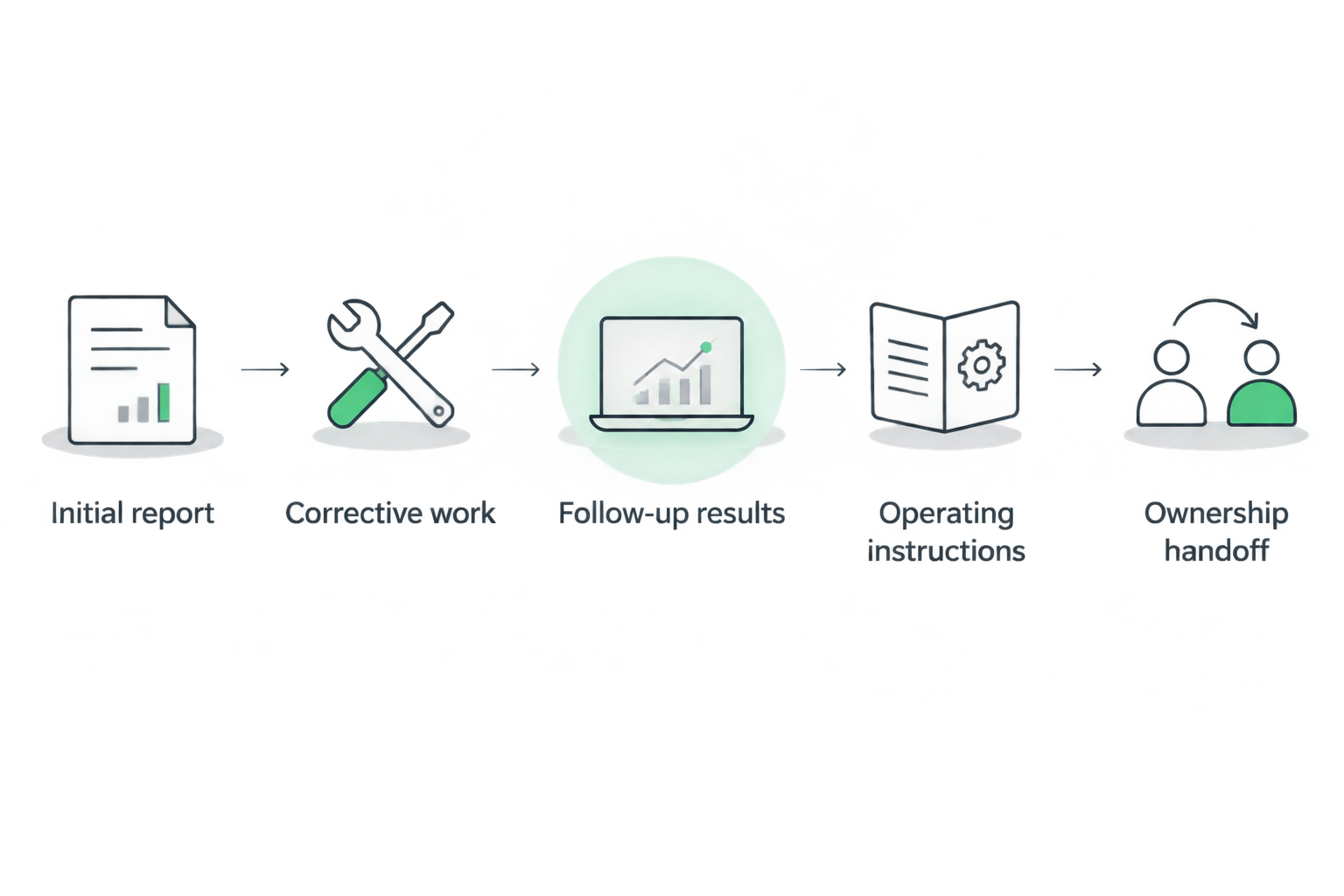
An organized handoff connects the initial finding to corrective work and verification. It also preserves the distinction between a historical result and current building conditions.
- Initial report: Retain the complete report and placement information.
- Corrective work: File the accepted scope and completed-work records.
- Follow-up results: Store verification measurements with the original findings.
- Operating instructions: Include applicable system instructions and maintenance contacts.
- Ownership handoff: Identify the person responsible for future testing and maintenance.
Compare testing and coordination options
Choose the option that satisfies the assignment, not the one that produces the quickest isolated reading. Testing methods and project coordination are different decisions. A capable coordinator still needs a qualified measurement professional and an accepted testing plan.
| Option | Best for | Main advantage | Key limitation |
|---|---|---|---|
| Broker-managed document checklist | Organizing a straightforward transaction | Keeps access contacts, deadlines, and reports visible | Does not establish technical scope or interpret measurements |
| Owner-deployed test kit | Preliminary screening when appropriate to the property and purpose | Gives an owner a way to begin measuring radon | Placement, documentation, and acceptance require review; do not assume commercial due-diligence acceptance |
| Qualified professional testing | A documented, building-specific measurement assignment | Provides planned placement, testing procedures, and professional reporting | Acceptance still depends on the agreed scope and recipient requirements |
| Environmental consultant coordination | Transactions involving several environmental workstreams | Keeps radon within the wider due-diligence plan | Confirm whether radon measurement is included or separately commissioned |
| Michigan Radon Control radon testing | Homeowners and realtors in Metro Detroit and Lansing | Offers NRPP-certified testing alongside mitigation and maintenance services | Commercial building scope and lender-specific deliverables require confirmation |
An owner-deployed kit is not automatically invalid, and professional equipment is not automatically sufficient. Method, placement, conditions, documentation, and acceptance all matter. Get those decisions in writing before anyone deploys a device.
Common mistakes commercial real estate brokers make
Applying a single-home scope to a multi-tenant property
A commercial building can contain different foundations, operating schedules, and occupied areas. Ask for a building-specific placement plan. Do not assume one basement reading represents every tenant suite or separate building.
Assuming the environmental report includes radon
A broad environmental assignment does not tell you whether radon measurements were commissioned. Read the written scope and exclusions. Ask the consultant to identify radon explicitly rather than relying on the report’s title.
Promising that a result guarantees a safe building
A radon report describes measurements under documented conditions. Avoid statements such as “radon-free” or “safe forever.” Share the report and professional interpretation without expanding either into a guarantee.
Treating installation as the final deliverable
A completed mitigation installation is not a follow-up concentration measurement. Include verification in the agreed work sequence, and establish who reviews it before releasing any transaction-related obligation.
Leaving tenant coordination until deployment
A locked suite or an uninformed occupant can disrupt the agreed plan. Confirm access and written instructions before the testing professional arrives. Escalate unavailable spaces promptly instead of leaving them out without explanation.
FAQ
What is radon testing for commercial real estate brokers?
Radon testing for commercial real estate brokers is the coordination of indoor radon measurements and reporting for a property transaction. A qualified professional should establish the building-specific testing scope, while the broker coordinates access, deadlines, and document delivery.
Does every commercial property need the same radon test?
No, commercial properties do not all need the same testing scope. Building use, layout, foundations, occupancy, and lender or consultant requirements determine the appropriate measurement plan.
Can I use a home radon test kit for a commercial closing?
Do not assume a home radon test kit will satisfy a commercial closing requirement. Obtain written acceptance of the method, placement plan, and reporting approach from the relevant lender or environmental consultant before testing.
How long does commercial radon testing take?
The measurement protocol and property-specific scope determine how long commercial radon testing takes. Confirm equipment placement, measurement duration, report delivery, and review deadlines separately with the testing professional.
Is the EPA action level a commercial pass-or-fail rule?
The EPA residential action recommendation is not a universal commercial pass-or-fail rule. Ask the qualified professional to explain the applicable guidance and have the lender and counsel confirm their separate transaction requirements.
Can a commercial building with an existing radon system skip testing?
An existing radon system does not establish the building’s current radon concentration. Request previous reports, review system records, and have the testing professional determine the appropriate measurement scope.
Does Michigan Radon Control handle commercial broker assignments?
Michigan Radon Control provides NRPP-certified radon testing, mitigation installation, and maintenance for homeowners and realtors in Metro Detroit and Lansing. Confirm the specific commercial building type, project scope, and required deliverables directly before booking.
One last thing
Match every result to the space it describes. A report for one suite is not evidence about an untested adjacent suite. Before you circulate the closing summary, check that each stated conclusion matches the locations and limitations in the actual report.
Related guides
- Radon testing for commercial buildings in Metro Detroit
- How to prepare a Michigan business for a radon inspection
- How to schedule radon testing after mitigation installation