
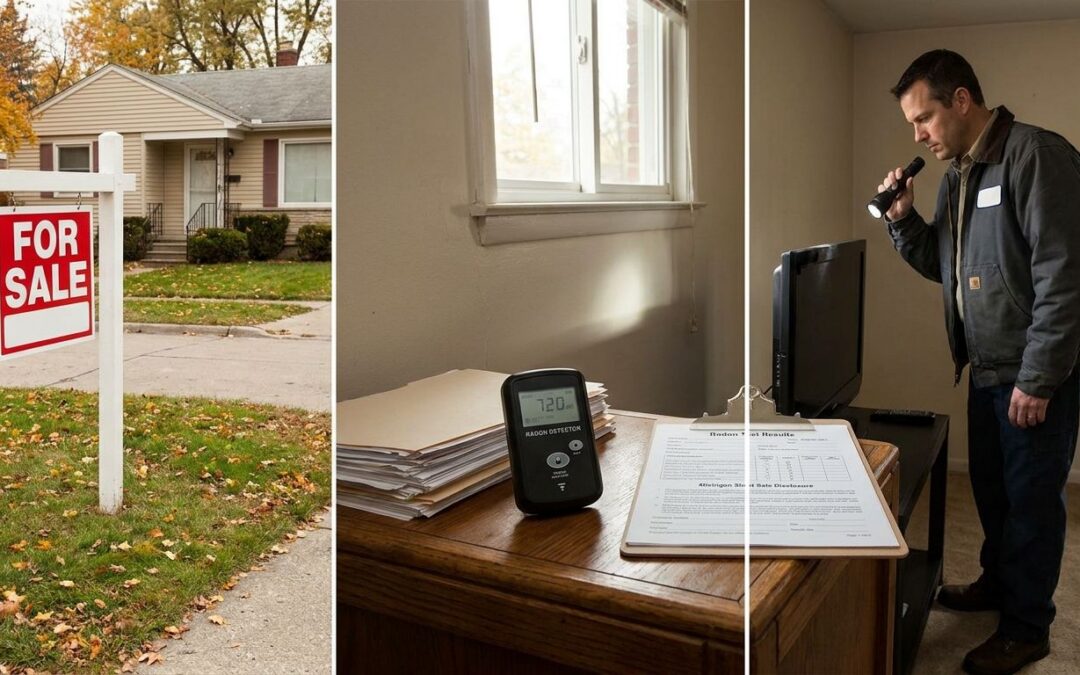
Short sale homes in Michigan close on compressed timelines, and radon testing is the step everyone forgets until the bank's asset manager asks for it. A radon testing short sale home Michigan transaction needs results in hand before anyone can talk about mitigation, price adjustments, or a closing date.
- Radon testing short sale home Michigan deals need closed-house results before a bank sets a closing date.
- Foreclosed and bank-owned properties test the same way as any home – the EPA action level stays 4 pCi/L.
- A failed test does not kill a short sale. Mitigation systems install in a day and most homes clear below 4 pCi/L after. Verdict: fixable.
- Real estate investors buying distressed Michigan properties should budget mitigation into the offer, not tack it on after closing.
Why this matters
A short sale already runs on someone else's clock – the lender's, the servicer's, the asset manager's. Radon gets treated as an afterthought because nobody wants to add a delay to a deal that took months to get approved.
That's backwards. A radon result that lands mid-closing forces a renegotiation nobody budgeted for, and Michigan's geology makes elevated readings common enough that skipping the test is a bet, not a shortcut. Testing early, in 2026 as much as any prior year, keeps the mitigation conversation out of the closing table.
Who this is for
This guide is for buyers making an offer on a distressed Michigan property, sellers trying to get a short sale approved without a second round of negotiations, and agents managing the paperwork between both. It also applies directly to anyone working foreclosed and bank-owned properties, where testing rules and asset-manager expectations overlap heavily with short sale transactions.
Investors flipping distressed Michigan homes fall into this group too – a radon result that surfaces after renovation costs are already committed is a margin problem, not just a paperwork problem.
What to look for in radon testing for a Michigan short sale
Turnaround time that matches your closing deadline
Short sale closings move on bank approval windows that can shift with little warning. A test that takes two weeks to schedule and another week to report is useless if the servicer sets a 10-day close – confirm lab turnaround before you commit to a date.
NRPP certification and chain-of-custody protocol
A test result without a certified tester behind it carries no weight with a lender or an asset manager reviewing the file. NRPP certification is the credential that makes the number defensible if the deal gets questioned later.
Testing conditions the bank or asset manager will accept
Vacant bank-owned homes sit with heat off, windows cracked, or utilities disconnected – all conditions that skew a radon reading. Confirm the property meets closed-house conditions for at least 12 hours before the test starts, or the number won't hold up.
Mitigation cost clarity before you make an offer
A short sale offer built without a mitigation estimate is a guess. Get a number attached to the property before you negotiate price, not after the inspection period closes.
Disclosure paperwork that holds up at closing
Michigan short sales still carry disclosure obligations, even when the seller is a lender rather than a former occupant. A test result without proper documentation creates liability for whoever signs off on the sale.
Top picks for short sale radon situations
The bank-owned baseline. Foreclosed and bank-owned properties test under the same EPA framework as any owner-occupied Michigan home – the action level is 4 pCi/L regardless of who holds the title. Foreclosed and bank-owned property testing covers the specific access and vacancy issues that come up when the seller is a servicer, not a homeowner. Buy – arrange this test first in any distressed-property transaction, before you negotiate anything else.
The compliance safety net. A result above 4 pCi/L doesn't have to kill the deal. Knowing how to handle a failed radon test during a home sale before you're in that situation keeps the transaction moving instead of stalling while everyone figures out next steps. Buy – read this before you're staring at a result you don't want.
The investor's shortlist. If you're buying distressed Michigan properties on a repeat basis, a one-off contractor relationship costs you time on every deal. Comparing radon mitigation companies for real estate investors upfront means mitigation scheduling stops being a bottleneck on your renovation timeline. Consider – worth setting up before your next acquisition, not during it.
What to avoid
- Skipping the test because "the bank won't require it." Disclosure obligations and lender review don't disappear just because the seller is a servicer instead of a person.
- Relying on a continuous monitor reading alone for lender documentation. A short-term or continuous monitor result can guide your decision, but many lenders and closing files want a documented protocol that a certified tester stands behind.
- Trusting a test result that's more than a few months old. Seasonal conditions and vacancy status change radon levels enough that an old result from a different season isn't a reliable substitute for a current one.
Verdict comparison
| Scenario | Timeline fit | Certification needed | Verdict |
|---|---|---|---|
| Bank-owned / foreclosed property | Moderate – depends on vacancy access | Yes, NRPP | Buy – test before negotiating price |
| Test result above 4 pCi/L mid-closing | Tight – needs fast mitigation scheduling | Yes, mitigation contractor certified | Buy – address immediately, don't delay closing |
| Repeat investor acquisitions | Fast, if contractor relationship exists | Yes, ongoing | Consider – set up before the next deal |
Get your short sale property tested
NRPP-certified testing built around bank and closing timelines.
FAQ
Is radon testing required for a short sale home in Michigan?
Michigan does not have a blanket state law mandating radon testing on every sale, but disclosure practices and lender expectations make testing standard practice for short sales in 2026. Skipping it shifts liability onto whoever signs the disclosure.
Do foreclosed and bank-owned properties test differently than owner-occupied homes?
No, the EPA action level of 4 pCi/L applies the same way regardless of who owns the property. The main difference is arranging access and confirming closed-house conditions on a vacant home.
What happens if a short sale home fails radon testing?
A result above 4 pCi/L triggers a mitigation conversation, not a dead deal. Most Michigan homes install a mitigation system and retest below the action level within days.
Who pays for radon mitigation in a Michigan short sale?
That gets negotiated between buyer and seller, often as part of the purchase agreement, since a servicer-owned property has no occupant to absorb the cost directly. Get a mitigation estimate before the offer stage so the cost is part of the negotiation, not a surprise after.
How long does radon testing take before a short sale closing?
A short-term test typically requires the home to sit closed for at least 12 hours before testing begins, with the test itself running several days depending on the method used. Build that window into your closing timeline early.
Can a short sale close with an elevated radon reading still pending mitigation?
It depends on the lender and the terms negotiated between buyer and seller. Many deals proceed with a mitigation contingency written into the agreement rather than waiting for the system to be installed before closing.
How much does radon mitigation cost for a distressed property?
Costs vary by foundation type, system design, and property condition, so get a site-specific estimate rather than relying on a general figure. Budgeting for mitigation before making an offer avoids a margin surprise later.
Should real estate investors test every distressed Michigan property they buy?
Yes – testing before renovation costs are committed protects the investor’s margin and avoids adding a mitigation system to an already-finished basement. It’s a cheaper problem to solve before drywall goes up than after.
One last thing
The detail most buyers miss: a vacant bank-owned home often sits with the furnace off for months, and that changes indoor air pressure enough to affect a radon reading. Confirm the utilities are on and the house has held closed conditions before you trust any number the servicer hands you.
Related guides
- How to meet Michigan's radon disclosure requirements when selling
- Radon testing requirements for FHA and VA loans in Michigan