
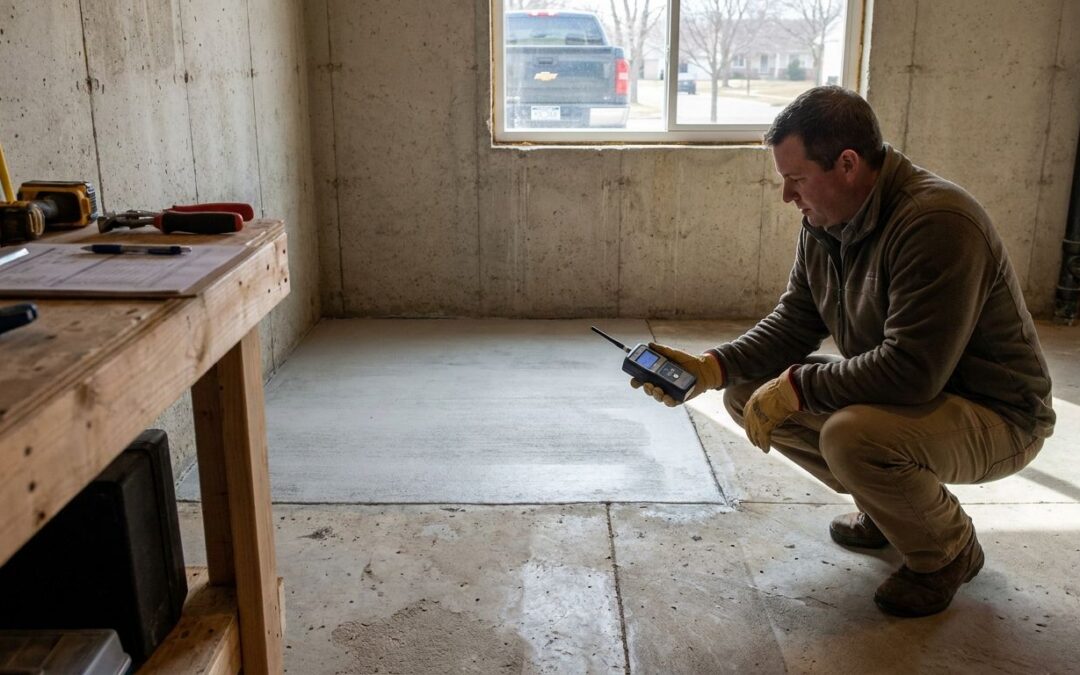
New concrete additions in Michigan homes need a radon test that checks the fresh slab separately from the original foundation, because a new pour creates untested entry points even when the rest of the house already passed. Sunroom slabs, addition footings, and extended basement pours all interrupt the soil-gas barrier your original foundation had settled into for years, and that gap is exactly where radon finds a new way in.
- Radon testing new concrete addition Michigan projects require testing the addition separately from the original foundation, not just once for the whole house.
- Most Michigan counties sit in EPA Radon Zone 1, the agency’s highest-risk category, so a new slab doesn’t reduce your baseline risk.
- Test only after the addition is fully enclosed, heated, and closed-house conditions have held for at least 12 hours before the test starts.
- A short-term test kit needs a minimum 48-hour run under EPA protocol to produce a reliable reading.
- Michigan Radon Control runs NRPP-certified testing across Metro Detroit and Lansing and can test both zones of an addition in one visit.
Why radon testing matters for new concrete additions
A new slab doesn't inherit the radon history of the rest of your house — it starts a fresh relationship with the soil underneath it. Most Michigan counties fall in EPA Radon Zone 1, the classification for areas predicted to average above 4 pCi/L indoors, and glacial till soils common across the Lower Peninsula move soil gas efficiently through gravel pockets and fractured bedrock.
An addition's slab-to-wall joint, new plumbing penetrations, and any sump or drain tie-ins are all fresh openings that a whole-house test run before the addition existed never accounted for. If your original home tested under 4 pCi/L two years ago, that number says nothing about the crawl space or slab you just poured in 2026. Testing the addition on its own is the only way to know if the new construction changed your exposure.
How to test a Michigan home with a new concrete addition
Wait until the addition is fully enclosed
Don't test while the space is still open to construction air exchange — an unfinished addition with open framing or missing drywall won't hold a stable radon reading.
- Confirm windows, doors, and exterior walls are fully sealed
- Wait until HVAC or space heating is running normally in the new room
- Check that the slab-to-wall control joint has been caulked or sealed
- Hold off on flooring installation over the slab until after the first test, if your schedule allows it
Seal the addition's penetrations before testing
Every pipe, conduit, and drain that passes through the new slab is a potential radon pathway until it's sealed. Reading how to test your home for radon covers the same sealing checklist used on original foundations, and it applies just as directly to a new pour.
- Caulk gaps around plumbing stacks and floor drains
- Seal the perimeter crack where slab meets foundation wall
- Check sump lid gaskets if the addition ties into an existing sump
- Inspect any new electrical conduit penetrations through the slab
Choose closed-house testing conditions
EPA protocol calls for 12 hours of closed-house conditions before a short-term test starts and for the duration of the test itself. Skip this step and your reading will run artificially low.
- Keep windows and exterior doors closed except for normal entry and exit
- Run HVAC systems on their normal cycle, not on high ventilation settings
- Avoid running exhaust fans longer than needed
- Don't schedule the test around a period of unusually warm or open-window weather
Test both the new addition and the original foundation
A single test kit placed in the addition tells you nothing about the rest of the house, and vice versa. The correct approach is two placements: one in the addition's lowest livable level, one in the original foundation's lowest livable level.
- Place one kit in the addition at breathing height, away from drafts
- Place a second kit in the original basement or lowest floor
- Log placement dates and times for both kits separately
- If the addition sits on a slab and the original home has a basement, treat them as two distinct radon environments
Time the test to Michigan's heating season
Radon levels read highest when windows are shut and furnaces are running, which in Michigan means late fall through early spring. An addition finished in summer and tested in July may pass, then read differently once winter heating starts pulling more soil gas indoors.
- Schedule the test for October through March when possible
- If summer testing is unavoidable, plan a retest during the first heating season
- Note recent weather before the test — high wind and heavy rain both skew readings
- Avoid testing during unusually mild winter stretches
Send the kit for lab analysis or use a continuous monitor
A charcoal test kit needs to reach an accredited lab within the mailing window printed on the package, or the reading degrades. Michigan Radon Control's guide on mailing a kit for lab analysis walks through the shipping steps, or an NRPP-certified technician can run a continuous monitor on-site and hand you results directly without a mail delay.
- DIY charcoal canister: cheapest option, requires mail-in lab processing
- Continuous monitor test: faster turnaround, no mailing step
- Professional NRPP-certified test: adds documented chain-of-custody for real estate or insurance use
- Retest after any HVAC or duct changes made near the addition
Read your results against the EPA action level
Anything at or above 4 pCi/L in either zone of the house means mitigation is warranted under EPA guidance. Below that, keep testing on a regular cycle since new construction settling can shift readings over a year or two.
- 4 pCi/L or higher in the addition alone: mitigate the addition
- 4 pCi/L or higher in the original foundation only: mitigate that zone
- Both zones elevated: a single system may need to cover both, depending on the addition's connection to the original slab
- Below 4 pCi/L in both zones: retest again during the next heating season
Get a mitigation system sized for the addition if needed
A slab-on-grade addition mitigates differently than a basement. The slab-on-grade mitigation guide covers sub-slab suction points specific to that construction type, and choosing the right system type breaks down which configuration fits a slab versus a crawl space versus a basement addition.
- Sub-slab suction for a poured addition slab
- Sub-membrane suction if the addition sits over a crawl space
- Shared system extension if the addition ties structurally into the existing basement
- Separate standalone system if the addition is isolated from the main foundation's air pathway
Get your addition tested this season
NRPP-certified testing across Metro Detroit and Lansing, scheduled around your heating season.
Comparison: testing options for a new concrete addition
| Option | Best for | Key limitation |
|---|---|---|
| DIY charcoal canister kit | Homeowners on a tight budget doing a first screen | Requires mail-in lab processing and precise closed-house timing |
| Continuous monitor rental | Homeowners who want faster results without mailing | Costs more upfront than a charcoal kit |
| NRPP-certified professional test | Real estate transactions or documented compliance needs | Requires scheduling a technician visit |
| Retest during next heating season | Anyone who tested during summer construction completion | Delays a final mitigation decision by months |
Verdict: for a new addition in 2026, run an NRPP-certified test on both the addition and the original foundation before deciding on mitigation — a single whole-house average hides which zone is actually elevated.
Common mistakes homeowners make with new concrete additions
- Testing only the addition, not the original foundation. A passing reading in the new slab doesn't confirm the rest of the house is still clear.
- Testing before the slab-to-wall joint is sealed. An open control joint lets the test read artificially high or unpredictably variable.
- Running the test in summer with windows open during a heat wave. Closed-house conditions are non-negotiable for an accurate short-term reading.
- Assuming a pre-addition test still applies. A test from before the addition was poured says nothing about the new slab's soil-gas pathway.
- Skipping a winter retest after a summer construction completion. Michigan's heating season pulls radon levels higher than a mild-weather test shows.
FAQ
Do I need a separate radon test for a new concrete addition in Michigan?
Yes. A new addition’s slab is a separate soil-gas environment from your original foundation, so it needs its own test placement even if the rest of the house already tested below 4 pCi/L.
When should I test radon after pouring a new addition slab?
Test once the addition is fully enclosed, heated, and running under normal conditions, ideally during Michigan’s heating season from October through March for the most accurate reading.
What radon level requires mitigation in a Michigan home addition?
The EPA action level is 4 pCi/L. A reading at or above that level in either the addition or the original foundation means mitigation is warranted for that zone.
Can one radon mitigation system cover both an addition and the original house?
It depends on how the addition connects to the original foundation’s air pathway. A structurally tied basement addition can often share a system, while an isolated slab-on-grade addition usually needs its own suction point.
How long does a radon test take on a new concrete addition?
A short-term charcoal or continuous monitor test needs a minimum of 48 hours under closed-house conditions per EPA protocol, following at least 12 hours of closed-house conditions before the test starts.
Is radon testing required for new construction additions in Michigan?
Michigan has no statewide mandate requiring a radon test after an addition is built, but testing is the only way to confirm the new construction didn’t introduce a new soil-gas pathway.
Should I test radon in a slab-on-grade addition differently than a basement addition?
Yes. A slab-on-grade addition typically needs sub-slab suction if mitigation is required, while a basement addition may extend an existing sub-slab system depending on how the foundations connect.
What happens if my new addition tests above 4 pCi/L but the rest of the house doesn’t?
Mitigation gets sized and installed for the elevated zone specifically. The addition can get its own standalone system without disturbing a foundation that already tests clean.
One last thing
A slab that looks fully cured can still be releasing soil gas through hairline shrinkage cracks that formed weeks after the pour — that's why a test run the week construction wrapped up isn't the same as a test run a full heating season later. If your addition passed its first test in summer 2026, put a second test on the calendar for winter before you call the question settled.
Related guides
- How to test your home for radon
- Radon mitigation for slab-on-grade homes
- How to choose the right radon mitigation system type
- How to mail in a radon test kit for lab analysis
- How to prepare your home for a radon mitigation system