
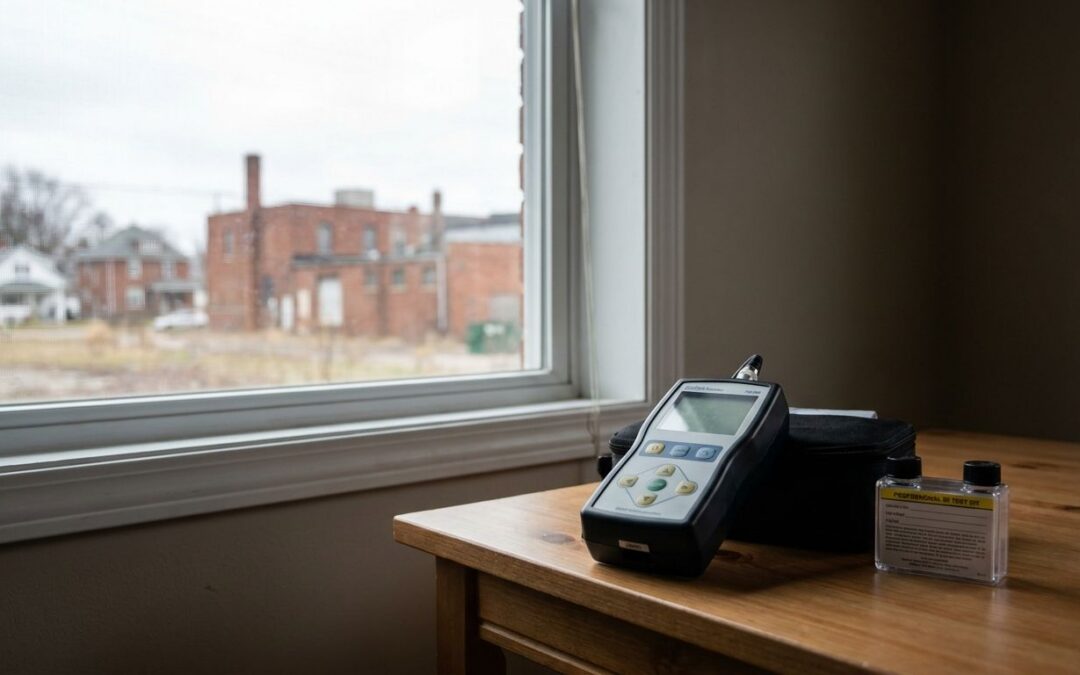
Homes built near old industrial sites, former gas stations, or reclaimed brownfield land in Michigan face a radon risk profile that standard testing advice doesn't fully address. Disturbed soil, backfill from unknown sources, and vapor intrusion pathways can push radon and other soil gases into a home differently than they would on undisturbed ground.
- Radon testing brownfield site Michigan homes need vapor intrusion screening, not just a standard 48-hour test, to catch soil gas migration in 2026.
- Michigan Radon Control recommends NRPP-certified testing paired with soil gas sampling for any home within a half-mile of a documented brownfield parcel.
- Cinder block and slab-on-grade foundations near reclaimed industrial land show higher entry-point risk and need foundation-specific mitigation design.
- Skip generic hardware-store test kits on brownfield-adjacent lots — they miss the sub-slab conditions that actually drive elevated readings.
Why this matters
Michigan has thousands of documented brownfield sites tracked by county and state environmental records, many redeveloped into residential subdivisions since the 1990s. Backfill soil brought in during site remediation doesn't always match the geology a standard radon test assumes, and disturbed ground can create new pathways for soil gas to reach a foundation.
A home built on reclaimed land in 2026 isn't automatically high-risk, but it isn't automatically low-risk either. The only way to know is to test with a protocol that accounts for the site history, not a generic 48-hour kit picked up at a hardware store.
Who this is for
This guide is for homeowners, buyers, and real estate agents dealing with a property built on or adjacent to a former industrial parcel, gas station, landfill, or any lot flagged in county brownfield redevelopment records. If your home sits within roughly a half-mile of a documented brownfield site in Metro Detroit, Lansing, or a surrounding county, standard radon guidance needs an extra layer of scrutiny before you test your home for radon.
What to look for in radon testing near brownfield sites
Vapor intrusion screening alongside the radon test
Brownfield sites often carry volatile organic compound (VOC) contamination in addition to radon, and the two share the same entry pathway: cracks, sump pits, and utility penetrations in the foundation. A testing plan that only measures radon and ignores vapor intrusion screening leaves half the picture unaddressed on a former industrial lot.
Sub-slab soil gas sampling capability
A standard indoor air test tells you what's already inside the house. Sub-slab soil gas sampling tells you what's building up underneath it before it migrates indoors. On disturbed or reclaimed ground, this distinction matters because backfill composition varies lot to lot, sometimes within the same subdivision.
NRPP certification and site history review
Any contractor testing a home near a brownfield parcel should be NRPP-certified and willing to pull county environmental records before setting a single detector. A tester who skips the site history is guessing at protocol instead of designing one.
Foundation type and construction era
Cinder block foundations, slab-on-grade construction, and homes built in the redevelopment boom of the late 1990s and early 2000s each interact with soil gas differently. A cinder block foundation on reclaimed fill behaves nothing like a poured foundation on undisturbed clay, and your testing approach should reflect that.
Continuous monitoring versus short-term kits
Short-term charcoal kits run 48 hours to a week. On a brownfield-adjacent lot, a continuous radon monitor tracking 90 days or more catches seasonal swings that a short test misses entirely, especially through a Michigan winter when homes seal up tight.
Documentation quality for disclosure and resale
If you're buying, selling, or refinancing a home near a brownfield parcel, the test report needs to hold up under scrutiny from an appraiser, lender, or future buyer's attorney. A one-page printout from a $30 kit won't satisfy that bar the way a certified lab report will.
Top picks for testing homes near brownfield sites
The baseline pick — short-term charcoal test. EPA guidance sets a minimum 48-hour exposure window for short-term kits, and this remains the fastest way to get a first read on a home. On brownfield-adjacent lots it's a starting point only, not a final answer. Consider it for an initial screen, not a closing decision.
The thorough pick — continuous monitor plus soil gas sampling. Pairing a 90-day continuous monitor with sub-slab soil gas sampling gives you both the indoor trend and the underlying source. This is the combination Michigan Radon Control recommends for any lot flagged in county brownfield records. Buy this approach if the property sits within a half-mile of a documented site.
The compliance pick — NRPP-certified testing with site history review. Working with a NRPP-certified radon mitigation company that pulls county records before testing removes the guesswork. Certification alone isn't a guarantee of brownfield experience, so ask directly about prior work on reclaimed sites. Buy for any transaction where disclosure or lending documentation matters.
The foundation-specific pick — mitigation sized to your foundation type. A cinder block foundation on backfilled soil needs a different sub-slab depressurization design than a slab-on-grade home on the same lot. Generic system sizing skips this step. Consider a foundation-specific assessment before signing a mitigation contract.
The wildcard — combined radon and mold inspection. Reclaimed industrial land sometimes carries moisture issues from disturbed drainage patterns, and pairing a radon test with a mold inspection catches both in one visit. Consider this bundle if the home also shows basement moisture signs.
What to avoid
- Hardware-store kits as a final answer. They're fine for a first pass but don't sample sub-slab conditions, which is exactly what matters on disturbed ground.
- Contractors who skip county records. If a tester doesn't ask about the property's history or check brownfield redevelopment records, they're not designing a protocol for your actual site conditions.
- One-time tests on continuously occupied homes near active remediation. Radon and soil gas levels near a site under active or recent remediation can shift as work progresses; a single reading from 2026 won't stay valid indefinitely.
Get a brownfield-aware radon test
NRPP-certified testing that accounts for site history and soil conditions.
Verdict comparison
| Approach | Best for | Key spec | Verdict |
|---|---|---|---|
| Short-term charcoal test | First screen | 48-hour minimum window | Consider |
| Continuous monitor + soil gas sampling | Brownfield-adjacent lots | 90-day trend data | Buy |
| NRPP-certified with site history review | Transactions, disclosure | Certification + records pull | Buy |
| Foundation-specific mitigation design | Cinder block or slab-on-grade homes | System sized to foundation type | Consider |
| Combined radon + mold inspection | Homes with basement moisture | Single-visit dual screening | Consider |
FAQ
Is radon testing different for homes near a brownfield site in Michigan?
Yes. Homes near brownfield sites need vapor intrusion screening and sub-slab soil gas sampling in addition to a standard radon test, since disturbed or reclaimed soil creates different gas migration pathways than undisturbed ground.
What’s the EPA action level for radon in Michigan homes?
The EPA action level is 4 pCi/L. Homes near brownfield sites can test above or below this level regardless of site history, which is why testing rather than assumption is the only reliable check.
How long should a radon test run near a brownfield site?
A short-term test runs a minimum of 48 hours, but a 90-day continuous monitor gives a more reliable picture on brownfield-adjacent lots where soil conditions and seasonal factors can shift readings.
Do I need a soil gas sample in addition to a radon test?
On a brownfield-adjacent lot, yes. Soil gas sampling shows what’s building up under the slab before it migrates indoors, which a standard indoor air test alone won’t capture.
How much does radon testing cost for a home near a brownfield site?
Costs vary by scope since a brownfield-adjacent test typically includes soil gas sampling on top of standard indoor testing. Ask any contractor for an itemized estimate before scheduling.
Does county health department involvement affect radon testing near brownfield sites?
County health departments often hold redevelopment and remediation records for brownfield parcels, and pulling these records before testing helps a contractor design an accurate protocol for the specific lot.
Can I use a standard hardware-store radon kit near a brownfield site?
A standard kit works as a first screen but shouldn’t be the final word on a brownfield-adjacent property, since it won’t detect sub-slab soil gas conditions specific to reclaimed land.
What foundation types are most at risk near brownfield sites in Michigan?
Cinder block and slab-on-grade foundations on disturbed backfill show higher entry-point risk for soil gas than poured foundations on undisturbed clay, based on foundation permeability differences.
One last thing
County environmental records for a brownfield parcel often go back further than the current owner realizes, sometimes decades before the home was even built. Pulling those records before scheduling a test costs nothing and can change the entire testing protocol before a single detector goes down.
Related guides
- How Michigan county health departments handle radon testing
- Radon mitigation for homes with cinder block foundations