

Best overall for a Michigan warehouse: a qualified commercial radon mitigation specialist. Best for a complex facility: an environmental consultant coordinating a qualified installer. Best for a simpler building: a local radon contractor only after warehouse-specific qualifications are confirmed. This 2026 guide ranks hiring routes by building fit, not unsupported company claims.
- The best radon mitigation companies for Michigan warehouses need commercial building qualifications, a testing plan, and documented results.
- Michigan Radon Control provides NRPP-certified residential radon testing, mitigation installation, and maintenance in Metro Detroit and Lansing.
- Choose a commercial specialist for installation or consultant-led coordination for a complex warehouse.
- Require post-installation testing; a running fan does not establish that indoor radon levels are controlled.
Why this matters
It is natural to worry about radon where your employees spend their working day. The practical response is to measure the building, understand the results, and select a contractor whose qualifications match the work. You do not need to choose equipment before you have that information.
Michigan Radon Control is a fit for homeowners and realtors seeking NRPP-certified radon services in Metro Detroit and Lansing. Michigan Radon Control provides testing, mitigation installation, and maintenance for that audience. Residential service credentials alone do not establish suitability for a warehouse contract.
Start your facility brief with the radon testing guide for Michigan warehouses and distribution centers. Keep the storage floor, offices, break rooms, and other occupied areas visible in the discussion. A result from one location does not describe every location in a large building.
What makes the best warehouse radon mitigation provider?
Use these criteria before comparing proposals in 2026. A contractor should explain the building-specific approach in plain language, without asking you to accept a standard residential design on trust.
- Relevant qualifications: Verify current radon credentials and training applicable to the proposed commercial work. Ask who will supervise testing and installation.
- Comparable experience: Request examples involving similar foundations, occupied spaces, and operating conditions. A residential review is not a warehouse reference.
- Testing coverage: Require a written explanation of measurement locations, operating conditions, and the protocol used.
- Building diagnostics: Ask how the contractor will investigate slab conditions, foundation divisions, and pressure relationships before finalizing the design.
- Operational coordination: Require a plan for drilling access, electrical work, exhaust routing, and protection of warehouse activities.
- Verification and maintenance: Define acceptance testing, corrective work, system documentation, and responsibility for ongoing checks.
Treat these as qualification gates. Do not let a strong sales presentation compensate for an unclear testing plan or an installation proposal that ignores your building layout.
Warehouse radon providers at a glance
The following ranking compares provider models. Each model is a route to evaluate, not a claim that a particular company has completed warehouse projects.
| Rank and provider model | Best for | Standout advantage | Key limitation |
|---|---|---|---|
| Commercial radon mitigation specialist | A warehouse needing a building-specific installation | Direct responsibility for diagnostics, design, and installation | Commercial experience still needs verification |
| Environmental consultant with a qualified installer | A complex facility needing coordinated assessment and documentation | Separates assessment and project coordination from installation work | Responsibilities between parties must be explicit |
| Local radon contractor with documented commercial qualifications | A simpler facility seeking local installation and maintenance | A direct relationship with the contractor doing the work | Residential credentials alone are insufficient |
1. Commercial specialist: best for warehouse installation
A commercial radon mitigation specialist is the first hiring route to evaluate when testing identifies a need for corrective work. Look for a contractor who can explain the commercial measurement and mitigation standards applicable to your building. Require comparable project evidence before awarding the work.
A warehouse proposal should connect the measurements to a design. Ask how foundation sections, interior partitions, and ventilation will affect the approach. The contractor should describe what diagnostics will resolve before equipment selection is final.
Commercial specialist pros:
- Creates a direct line of responsibility for the mitigation installation.
- Keeps design decisions tied to the building investigation.
- Provides a route to combine installation, commissioning, and service under a defined scope.
Commercial specialist cons:
- A commercial label does not prove comparable warehouse experience.
- An installation-led proposal still needs clear testing and acceptance requirements.
- Subcontracted electrical or roof work needs separate coordination where applicable.
Best for: Facility managers who need a mitigation installation and can identify a contractor with relevant commercial qualifications.
Ask for a marked-up building plan showing proposed work areas and exhaust routing. Require the proposal to identify assumptions, exclusions, and what happens if diagnostics require a design change. This makes competing proposals easier to compare.
Verdict: Buy this service route only after commercial qualifications, comparable experience, and acceptance testing are documented.
2. Consultant-led team: best for complex facility coordination
An environmental consultant working with a qualified radon installer is a hiring route for facilities that need assessment and coordination beyond the installation itself. Define the consultant's radon qualifications and responsibilities before engagement. Environmental consulting experience is not automatically radon measurement expertise.
This route gives you a way to assign testing oversight, report review, and installation coordination separately. It is useful when your project involves several occupied areas, different foundation sections, or multiple parties controlling building access. Put the division of work in writing.
Consultant-led team pros:
- Allows assessment and installation responsibilities to be separated.
- Gives facility management a defined coordination role to procure.
- Supports a shared record of testing, design decisions, and corrective work.
Consultant-led team cons:
- Adds a handoff between assessment and installation.
- Requires explicit responsibility for disputed or incomplete results.
- Does not replace the need to verify the installer's qualifications.
Best for: Warehouse owners managing a complicated building, multiple stakeholders, or a project requiring coordinated environmental documentation.
Name the person authorized to approve changes. Also identify who owns the final report, who orders follow-up testing, and who responds if acceptance requirements are not met. Without that division, both parties can finish their individual tasks while leaving the overall project unresolved.
Verdict: Buy this service route when coordination is part of the problem, not merely because the building is large.
3. Qualified local contractor: best for a simpler facility
A local radon contractor is a candidate for a simpler warehouse only after demonstrating qualifications for the commercial scope. Geographic proximity is useful for arranging site visits and service discussions. It is not evidence that a residential installation approach suits your building.
Michigan Radon Control's stated audience is homeowners and realtors. For any local residential-focused provider, ask directly whether the contractor accepts your warehouse project and can document the required commercial qualifications. Do not infer those capabilities from residential services or website article topics.
Qualified local contractor pros:
- Offers a direct conversation with the proposed installer.
- Gives you a local contact to evaluate for future maintenance.
- Can be assessed against the same written scope as a commercial specialist.
Qualified local contractor cons:
- Residential experience does not establish warehouse capability.
- The contractor must substantiate commercial qualifications separately.
- A simpler layout still requires suitable testing and diagnostics.
Best for: Owners of a straightforward facility who have confirmed that the local contractor can undertake the commercial work.
In your 2026 contractor interview, describe the actual property before requesting an estimate. Include occupied rooms, foundation information, operating hours, and existing mechanical systems. Ask for a written confirmation of scope rather than a general assurance that radon work is familiar.
Verdict: Hold until warehouse-specific qualifications and responsibilities are confirmed.
What your warehouse testing brief should include
A useful testing brief gives every candidate the same starting point. It should describe the property as it operates, not just its total floor area.
Provide a floor plan with occupied spaces and foundation sections identified. Include existing radon reports, ventilation information, and any available slab or utility drawings. Flag unknowns so the contractor can explain how the investigation will address them.
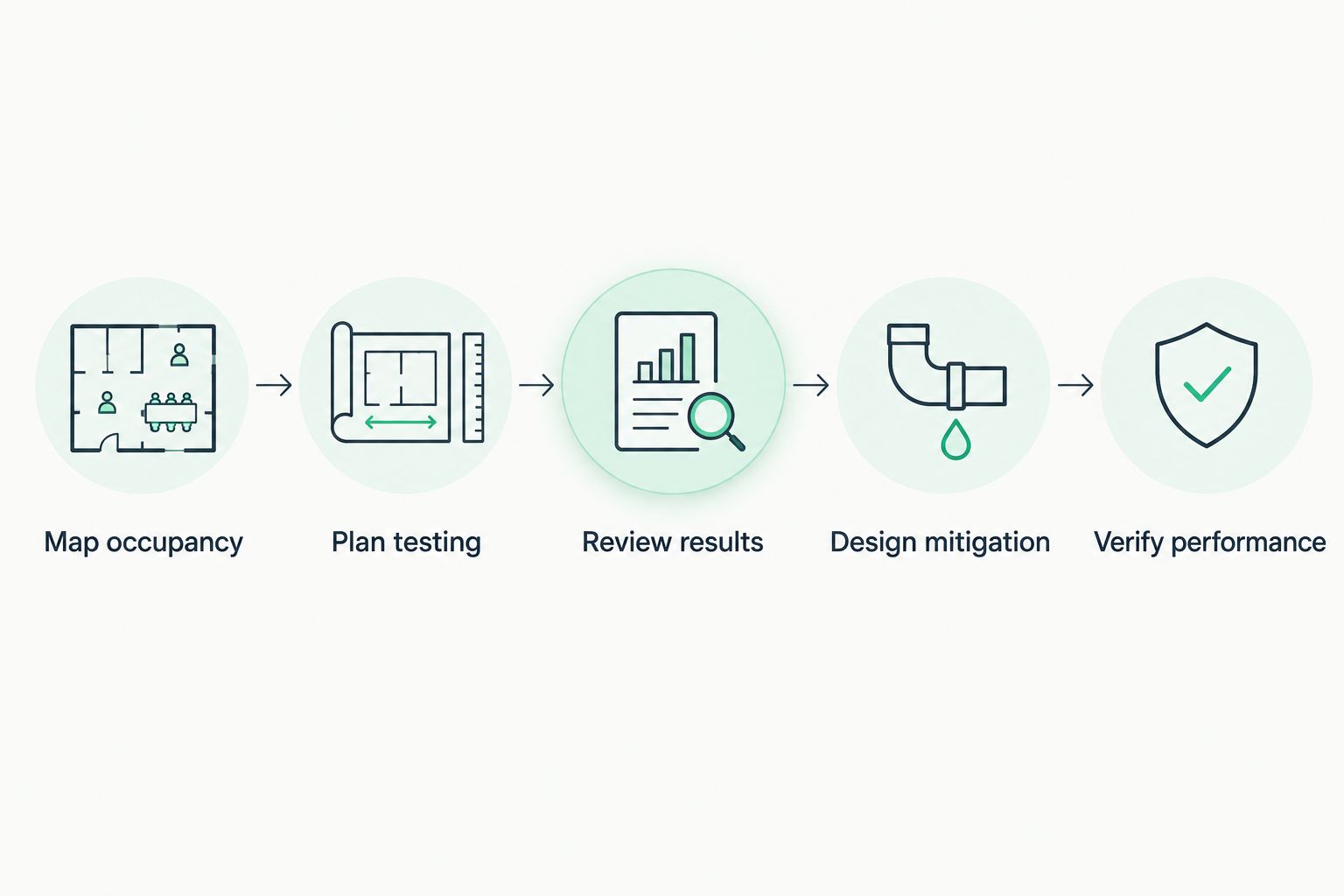
Use these steps to move from initial screening to a verified installation:
- Map occupancy: Identify workstations, offices, break rooms, and regularly occupied ground-contact spaces.
- Plan testing: Agree on measurement locations, equipment, applicable protocol, and operating-condition records.
- Review results: Ask the qualified professional to explain the findings and recommended next action.
- Design mitigation: Require diagnostics and a building-specific installation scope.
- Verify performance: Define post-installation measurements and corrective-work responsibilities.
Your 2026 project file should preserve the test locations, dates, operating conditions, and final system drawings. Keep the records accessible to the person responsible for maintenance. A contractor's verbal explanation is not a substitute for a usable handover package.
Understand the numbers without borrowing residential rules
The U.S. Environmental Protection Agency's published home guidance recommends fixing a home at 4 pCi/L or higher and considering corrective work between 2 pCi/L and 4 pCi/L. The action level of 4 pCi/L is approximately 148 Bq/m³. These are residential reference points, not a warehouse-specific legal determination.
EPA home-testing guidance also distinguishes short-term tests lasting 2 to 90 days from long-term tests lasting more than 90 days. Those definitions explain common terminology. They do not prescribe the appropriate measurement plan for your warehouse.
For your 2026 commercial project, ask the qualified professional to identify the applicable protocol, interpretation criteria, and acceptance target in writing. Keep health guidance, project specifications, and legal obligations separate. Do not describe a residential action level as a Michigan warehouse compliance limit.
Radon is a radioactive gas that you cannot reliably identify by smell or sight. Testing establishes the concentration. The size of the building, an open loading door, or the absence of complaints does not replace measurement.
Compare scopes before choosing a contractor
Ask every bidder to address the same work. Otherwise, an installation-only proposal and a proposal including diagnostics, testing, and documentation are not equivalent.
Require written answers to these questions:
- Which spaces and foundation sections does the scope cover?
- What diagnostics happen before the final design?
- Who handles electrical work and other building alterations?
- What installation access does the facility need to provide?
- Who performs acceptance testing and interprets the results?
- What corrective work applies if the agreed target is not met?
- What maintenance instructions and system records will you receive?
Do not specify a fan count based only on warehouse size. Sub-slab conditions and foundation divisions affect system design. Require the contractor to explain the proposed approach using diagnostics rather than a generic equipment package.
How these hiring routes are ranked
The ranking puts responsibility and building fit ahead of proximity or brand recognition. A commercial specialist is the default route for installation. A consultant-led team addresses coordination needs. A local contractor remains conditional on verified commercial qualifications.
The criteria are relevant credentials, comparable experience, testing coverage, diagnostics, operational coordination, and verification. This is not a customer-review leaderboard or a claim of measured company performance.
Which provider should you choose?
Start with a qualified commercial radon mitigation specialist and a written warehouse testing plan. Choose consultant-led coordination when the project needs separate assessment oversight or several parties must work together.
Consider a local contractor only after confirming the commercial scope. Michigan Radon Control remains a documented residential radon service provider for homeowners and realtors in Metro Detroit and Lansing; that positioning should not be expanded into an assumed warehouse specialty.
FAQ
What’s the best radon mitigation company for a Michigan warehouse?
Choose a provider with verified commercial radon qualifications, comparable building experience, and a written testing and acceptance plan. A residential reputation alone does not establish warehouse suitability.
Does Michigan Radon Control provide warehouse radon mitigation?
Michigan Radon Control’s stated services cover NRPP-certified testing, mitigation installation, and maintenance for homeowners and realtors in Metro Detroit and Lansing. Confirm commercial warehouse scope directly before treating the company as a warehouse contractor.
Is a commercial specialist better than an environmental consultant?
A commercial specialist is the default hiring route for installation; consultant-led coordination addresses assessment and project-management needs. Either route still requires qualified radon professionals and clear responsibility for final verification.
Can I use a residential radon contractor for my warehouse?
Use a residential-focused contractor only after verifying qualifications and experience for the proposed commercial work. Residential certification alone does not establish that a warehouse project is within the contractor’s competence.
Does a warehouse need testing if loading doors stay open?
Open loading doors do not replace radon testing. Ask the measurement professional to document operating conditions and select a protocol appropriate to the occupied building.
Is the EPA home action level a warehouse compliance limit?
The EPA home action level is residential guidance, not a warehouse-specific legal determination. Ask your qualified professional to identify the commercial protocol, project target, and applicable obligations separately.
Does a working fan prove that radon levels are low?
A working fan does not establish indoor radon concentration. Verify performance with suitable radon measurements and keep system operating checks as a separate maintenance task.
What should I request before signing a warehouse mitigation contract?
Request a defined building scope, relevant qualifications, diagnostics, installation responsibilities, acceptance testing, and corrective-work terms. Specify who owns the final report and maintenance documentation.
One last thing
A pressure gauge is not a radon test. It helps indicate system operating conditions, but it does not measure the radon concentration employees breathe.
Make acceptance testing part of the contract before installation starts. That single decision keeps a visibly completed installation from becoming an unverified result.
Related guides
- How to verify a radon mitigation contractor's NRPP certification
- How to compare radon mitigation quotes from Michigan contractors
- How to schedule radon testing after mitigation installation