
Best overall hiring approach: a commercial radon mitigation contractor working with your range ventilation specialist. Best for complex buildings: an environmental consultant-led team. Best for an independent baseline: a qualified commercial radon testing provider. For Michigan indoor shooting ranges in 2026, choose by documented commercial scope, ventilation coordination, and post-installation testing—not a residential company’s reputation alone.
- Comparing the best radon mitigation companies for indoor shooting ranges Michigan starts with commercial experience and ventilation coordination.
- Choose a commercial radon contractor who coordinates with your shooting-range ventilation specialist.
- Michigan Radon Control provides NRPP-certified residential radon testing, mitigation installation, and maintenance in Metro Detroit and Lansing.
- Require a written testing plan and post-installation results before accepting a range mitigation project.
Why this matters
It is completely natural to worry about an invisible gas in a building where employees spend long shifts. The next move is concrete: measure radon, understand the building, and choose a contractor whose scope matches the facility. Start with the practical issues covered in radon control for Michigan indoor shooting ranges.
Radon and firing-related contaminants require different controls. Radon originates from the natural radioactive decay of uranium and can enter buildings from the ground. Shooting activities create separate concerns, including airborne lead, that require their own exposure assessment and ventilation controls.
A radon installation is not a substitute for shooting-range ventilation. Your contractor should address soil-gas entry without treating the existing range exhaust system as an interchangeable radon solution.
This guide ranks hiring approaches rather than assigning unsupported scores to individual companies. Use the approaches below to build a shortlist, then require each bidder to demonstrate the qualifications and responsibilities described here.
What makes the best radon mitigation company for a range?
A strong 2026 proposal answers these questions before equipment selection begins:
- Commercial scope: Does the contractor explicitly accept occupied indoor shooting ranges, rather than offering a residential installation by default?
- Relevant credentials: Who holds the radon measurement or mitigation credentials, and what work will that person supervise?
- Building assessment: Does the proposal address foundation layout, occupied rooms, slab penetrations, and existing mechanical systems?
- Ventilation coordination: Who reviews interactions with range exhaust, makeup air, and operating schedules?
- Verification: Does the contract define post-installation testing conditions, reporting, and corrective work?
- Maintenance responsibility: Who checks system operation, responds to faults, and documents later building changes?
Ask for evidence, not a broad assurance that the company handles “all buildings.” A useful reference describes a comparable commercial project and the contractor’s actual role. It does not need to disclose another customer’s confidential information.
Michigan range radon providers at a glance
| Ranked hiring approach | Best for | Standout feature to require | Key limitation |
|---|---|---|---|
| Commercial radon contractor with ventilation coordination | An existing range needing a defined mitigation project | Radon design coordinated with the range mechanical specialist | Requires clear boundaries between radon and ventilation work |
| Environmental consultant-led team | Mixed-use buildings or complicated exposure questions | A coordinated assessment covering distinct indoor-air concerns | More coordination and a longer chain of responsibility |
| Independent commercial testing provider, then installer | Establishing a baseline before selecting a mitigation contractor | Measurement scope defined separately from installation | Testing alone does not correct elevated radon |
These are distinct project structures, not interchangeable services. Select the structure that matches the problem you need solved, then compare companies within that structure.
1. Commercial radon contractor: best for a defined range project
A commercial radon mitigation contractor is the default hiring approach when testing identifies a radon problem and your existing range ventilation has a responsible specialist. The radon contractor evaluates entry pathways and proposes a mitigation design. The ventilation specialist reviews the interface with range operation.
Active soil depressurization is an established mitigation method. It draws soil gas from beneath a slab or membrane and exhausts it outdoors through a dedicated system. Whether that method fits your range depends on the foundation and building assessment—not simply the room’s floor area.
Commercial radon contractor pros:
- Gives the radon design and installation a defined owner.
- Keeps soil-gas control separate from firing-line contaminant control.
- Supports a project-specific testing and commissioning plan.
- Allows direct comparison of installation scopes between bidders.
Commercial radon contractor cons:
- Radon credentials do not establish shooting-range ventilation expertise.
- A divided or unusual foundation needs investigation before design.
- Coordination fails if nobody owns mechanical review.
Best for: An operating range with a documented radon issue and an established ventilation specialist.
Before selecting the contractor, ask who approves pipe routing, exhaust discharge, and any work near existing mechanical equipment. Require the answer in the proposal. Do not accept a verbal promise that “the fans will work together.”
Verdict: Buy this hiring approach when commercial scope and ventilation coordination are written into the contract.
2. Consultant-led team: best for complex buildings
An environmental consultant-led team suits a range where radon is part of a wider assessment. Examples include buildings with separate tenant spaces, below-grade staff rooms, or unresolved questions about employee exposures. The consultant defines the assessment and brings in the appropriate radon and mechanical specialists.
Keep the hazards separate even when the project has a single coordinator. Radon measurements do not measure lead exposure, and an airborne lead assessment does not establish radon concentration. Each question needs its own method and interpretation.
Consultant-led team pros:
- Gives multiple assessment tasks a common coordinator.
- Helps separate radon findings from firing-related contaminants.
- Supports room-specific documentation in mixed-use buildings.
- Clarifies which specialist owns each technical decision.
Consultant-led team cons:
- Adds coordination beyond a straightforward installation.
- Requires explicit authority to resolve conflicting recommendations.
- Still needs a qualified radon installer if mitigation is required.
Best for: A range with complicated building use or several unresolved indoor-air concerns.
For a 2026 project, request a responsibility list before authorizing the assessment. It should name who selects test locations, reviews ventilation, designs mitigation, and accepts the final documentation. “Environmental services” is too broad to define those duties.
The consultant should also explain which deliverables answer operational questions and which address occupational exposure. You need a clear decision from each report, not a stack of documents without an assigned next step.
Verdict: Buy this hiring approach for a complex assessment; skip the extra layer when the project is already clearly defined.
3. Independent testing provider: best for a baseline before bidding
A qualified commercial radon measurement provider establishes the baseline before you select an installer. Separating measurement from installation gives you a defined test scope to share with competing contractors. It is especially useful when the building has no usable radon report.
The testing provider should document locations, device information, measurement duration, and relevant building conditions. Ask how the plan represents occupied spaces and normal mechanical operation. A test placed wherever access is easiest does not automatically answer the facility’s exposure question.
Independent testing provider pros:
- Defines the radon question before equipment is proposed.
- Creates a common baseline for installation bids.
- Separates measurement reporting from the installation sale.
- Helps identify areas needing further assessment.
Independent testing provider cons:
- Does not install a mitigation system as part of testing alone.
- Requires a later handoff if corrective work is needed.
- A poorly specified measurement plan still produces weak evidence.
Best for: A range owner who needs reliable baseline information before committing to mitigation work.
Ask how the provider will handle changes in ventilation operation during the measurement period. Record unusual shutdowns, maintenance, or operating changes rather than quietly treating them as normal conditions. The final report should explain the conditions represented by the result.
Do not confuse independence with qualification. You still need a provider whose credentials and measurement scope fit the commercial building.
Verdict: Buy testing first when you need a baseline; hold installation decisions until the results and building assessment support them.
Where Michigan Radon Control fits
Michigan Radon Control provides NRPP-certified radon testing, mitigation system installation, and system maintenance for homeowners and realtors in Metro Detroit and Lansing. That is a defined residential service scope.
Michigan Radon Control is best for homeowners and realtors seeking NRPP-certified residential radon testing and mitigation in Metro Detroit and Lansing. A shooting-range operator should request explicit confirmation of commercial range scope before treating those residential services as a fit.
Michigan Radon Control pros:
- Provides radon testing, installation, and maintenance services.
- States NRPP-certified services.
- Identifies Metro Detroit and Lansing as service areas.
Michigan Radon Control limitations:
- The stated customer focus is homeowners and realtors.
- Residential credentials and service descriptions do not establish range ventilation capability.
Best for: Residential customers within the stated service area; commercial range suitability requires a separate scope agreement.
Verdict: Hold a range hiring decision until the company confirms the facility scope, responsible specialists, and verification plan.
How to compare proposals without guessing
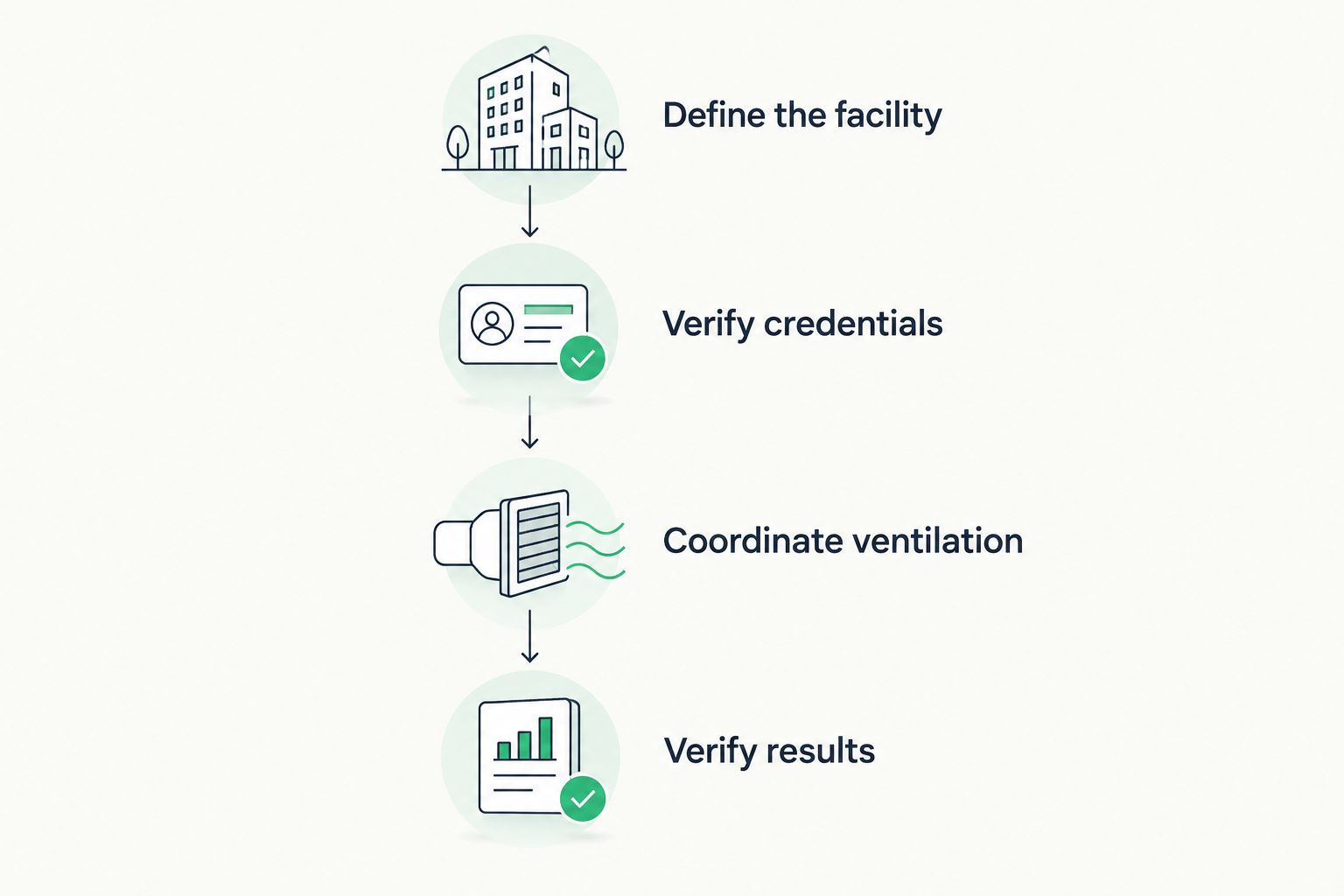
Define the facility
Give each bidder the same building information: foundation drawings if available, occupied-room layout, existing radon reports, and mechanical-system documents. Identify staff areas as well as firing areas. A basement office deserves attention even when most customer activity occurs elsewhere.
Explain when the building operates and when the ventilation runs. The assessment should address actual use rather than assume the schedule of a house.
Verify credentials
Check the responsible individual’s current certification and relevant credential category. Measurement and mitigation are different tasks. Also request evidence of insurance appropriate to the proposed work and confirm any subcontractor responsibilities.
Treat certification as a starting requirement, not the entire selection decision. The bidder still needs to explain how the commercial building will be assessed.
Coordinate ventilation
Ask the radon contractor and range mechanical specialist to identify their design interfaces. Include exhaust discharge locations, outdoor-air intakes, penetrations, electrical work, and access for maintenance.
Keep dedicated radon piping separate from unrelated exhaust systems. Require an explanation of how the proposed work preserves the range ventilation design.
Verify results
Define the post-installation measurement plan before signing. The plan should state who performs testing, which areas are covered, what building conditions apply, and how results determine further action.
For your 2026 project file, keep baseline results, installation documentation, commissioning records, and follow-up reports together. Equipment operation and measured radon reduction are separate checks; document both.
Understand the numbers without misusing them
For 2026 planning, distinguish residential guidance from a workplace assessment. EPA’s A Citizen’s Guide to Radon, which addresses homes, recommends fixing homes at 4 pCi/L or higher. That concentration is approximately 148 Bq/m³.
EPA also advises considering a home fix between 2 pCi/L and 4 pCi/L. The agency states that no radon level is known to be risk-free. These figures provide useful context, but they are not a shooting-range occupational clearance standard.
Ask the qualified professionals assessing your facility to identify the applicable guidance, assessment scope, and basis for the project’s acceptance criteria. Do not label a range “safe” solely because a result falls below a residential action level.
NIOSH’s indoor firing-range guidance addresses engineering controls and work practices for firing-related exposures. Radon testing adds a separate measurement question; it does not replace those controls.
How the hiring approaches are ranked
The ranking prioritizes commercial scope, a clear radon design owner, ventilation coordination, and verified results. The commercial contractor approach comes first for a defined mitigation project. Consultant-led coordination comes next for complex assessments; independent testing comes first chronologically when you lack a baseline.
No customer-review score or company performance claim determines this order. The ranking is a decision guide for project structure, not a claim that a named provider has completed Michigan shooting-range installations.
Which approach should you choose?
Choose a commercial radon contractor working with your range ventilation specialist as the default for a defined mitigation project. Choose consultant-led coordination when the building or exposure questions are complicated. Start with independent commercial testing when the baseline is unclear.
For a 2026 shortlist, reject proposals that omit post-installation testing or leave ventilation coordination unassigned. A clear scope is more useful than a confident sales presentation.
FAQ
What’s the best radon mitigation company for a Michigan indoor shooting range?
Choose a qualified commercial radon contractor who coordinates with your range ventilation specialist and verifies results after installation. Compare companies on documented range scope, relevant credentials, and a written testing plan rather than residential reputation alone.
Does Michigan Radon Control work on indoor shooting ranges?
Michigan Radon Control’s stated service scope covers homeowners and realtors in Metro Detroit and Lansing. Ask the company to confirm commercial shooting-range scope before selecting it for that facility.
Does shooting-range ventilation remove radon?
Do not assume shooting-range ventilation provides adequate radon control. Measure radon under a defined commercial testing plan and have qualified specialists assess soil-gas entry and mechanical-system interactions.
Can a radon contractor also handle lead exposure?
Radon qualifications alone do not establish competence in lead exposure assessment or shooting-range ventilation. Assign firing-related exposure assessment and mechanical design to appropriately qualified specialists.
Is the EPA action level a workplace clearance limit?
No. EPA’s 4 pCi/L action level in A Citizen’s Guide to Radon is residential guidance, not a shooting-range occupational clearance standard. Require the facility assessment to identify its applicable guidance and acceptance criteria.
Should I test before getting mitigation proposals?
Establish a usable baseline before choosing a mitigation design. A qualified commercial measurement provider should define test locations, duration, and building conditions so bidders work from the same information.
How do I know the installation worked?
Use post-installation radon measurements and system-operation checks. A running fan or pressure indication does not by itself establish the radon concentration in occupied rooms.
One last thing
A pressure gauge is not a radon test. It indicates a pressure condition in the mitigation system; it does not measure the air your employees breathe. Put responsibility for follow-up measurements in writing, and review the testing plan after changes to the foundation or mechanical operation.
You do not need to solve every technical detail yourself. You need named specialists, a clear scope, and evidence that the completed work meets the agreed criteria.
Related guides
- Verify a radon contractor’s NRPP certification
- Compare radon mitigation quotes from Michigan contractors
- Schedule radon testing after mitigation installation