
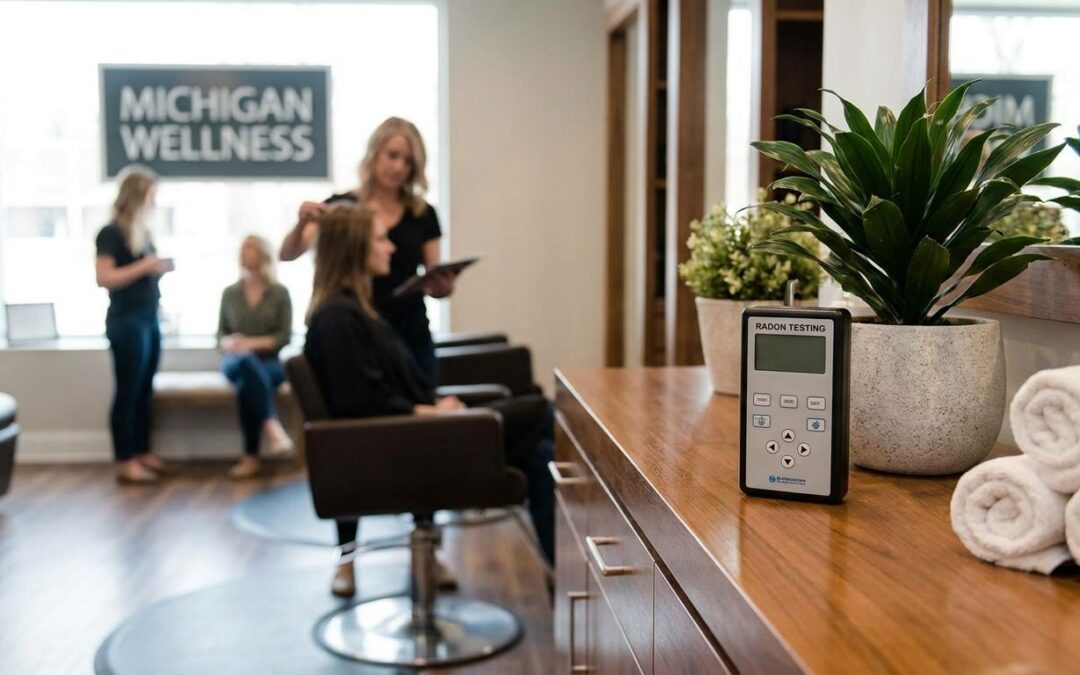
Salons and spas across Metro Detroit and Lansing run multi-chair floors, basement storage, and HVAC systems on nine- and ten-hour shifts — exactly the conditions that let radon gas build up faster than in a typical single-family home.
- Radon testing salon spa Michigan calls for a 90-day-plus continuous monitor, not a short-term charcoal kit — Buy the monitor for buildings running full business hours.
- Michigan sits mostly in EPA Radon Zone 1, and readings above the 4 pCi/L action level show up in commercial slabs as often as in basements.
- Sub-slab depressurization is the standard fix for salon and spa buildings above 4 pCi/L in 2026 — Buy for a permanent correction, not a patch.
- Retest every 2 years or after any HVAC, tenant, or floor-plan change to keep staff exposure and lease documentation current.
Why radon testing matters for Michigan salons and spas
Radon comes from uranium decay in soil and bedrock, and Michigan's glacial till and gravel deposits sit on exactly that kind of geology. Most of the state falls in EPA Radon Zone 1 — the agency's highest-risk category — which is why homes and commercial buildings alike test above the action level more often here than in most other states.
The EPA sets that action level at 4 pCi/L for any building type, residential or commercial. A single-family home and a salon get measured against the same number, but a salon multiplies the stakes: one owner, a handful of licensed estheticians and nail techs, and dozens of clients moving through treatment rooms every week. Testing a salon the way you'd test a house — one short-term kit in one room — misses the multi-room, multi-airflow reality of the building.
Who this is for
This guide is for salon and spa owners, operators, and property managers running businesses in Metro Detroit, Lansing, and the surrounding Michigan suburbs — anyone managing a lease renewal, a health inspection, or a staff safety conversation who needs a test result that holds up. If your building sits in a strip mall, a converted house, or a stand-alone building, the same logic that applies to other commercial buildings in Metro Detroit applies here: multiple rooms, one HVAC system, and staff who spend more hours in the building than the owner does.
What to look for in radon testing for a Michigan salon or spa
Coverage across every treatment room and level
A single canister in the reception area tells you nothing about the nail station in the back room or the basement laundry setup. Radon levels shift room to room based on airflow, slab cracks, and proximity to the ground. Place at least one device per level, and add a second in any room with a floor drain, sump pit, or basement access.
Test duration that matches a full business week
A 48-hour charcoal kit captures a Tuesday and Wednesday snapshot. Salons run different traffic on weekends, and HVAC cycles change when the building sits empty overnight. A monitor running 90 days or longer catches that swing and gives you a number that holds up if a client, inspector, or landlord ever questions it.
NRPP-certified technicians with commercial building experience
A technician who has only tested single-family basements doesn't automatically know how a slab-on-grade retail space with a drop ceiling and rooftop HVAC unit behaves. Ask for the NRPP certification number before scheduling and confirm the technician has worked commercial spaces, not just houses.
Documentation built for lease renewals and liability records
If you lease your space, a landlord or insurer may ask for radon paperwork at renewal. A report with device placement, test duration, and lab-verified results protects you if that question comes up in 2026 or five years from now.
A mitigation plan that doesn't disrupt daily operations
A sub-slab fan tucked into a supply closet is easy to live with. A fan running where clients can hear it over a manicure conversation is a problem. Any mitigation quote should specify fan placement and expected noise before you sign.
A retesting schedule tied to real changes, not a calendar habit
A new HVAC unit, a new tenant next door, a remodel that touches the slab — any of those resets your radon baseline. Retest after the change happens, not just every few years on autopilot.
Top picks for testing a Michigan salon or spa in 2026
The fast pick: short-term charcoal or electret test
Results land in 48 to 96 hours. Consider it only when a lease deadline or appraisal forces a fast turnaround — it's a snapshot, not a full picture of a building that runs staff through it daily.
The accurate pick: continuous radon monitor
Logs hourly readings over 90-plus days, catching weekday-versus-weekend HVAC swings that a short-term kit never sees. Buy it for any salon or spa that needs one number it can defend to a landlord, client, or health inspector — see the continuous radon monitors built for exactly this kind of building.
The permanent fix: sub-slab depressurization
Pulls soil gas from under the slab before it reaches the floor, typically bringing a reading above 4 pCi/L down under 2 pCi/L. Buy for any salon or spa testing above the EPA's 4 pCi/L action level — this is the standard commercial mitigation approach in Michigan in 2026, not a stopgap.
The bundle pick: radon plus mold inspection
Pairs an air-quality gas test with a moisture and mold check in the same visit — relevant for any building running laundry, sinks, and steam. Consider it if your salon has visible moisture issues alongside a radon flag; skip it if radon is the only concern on the table.
What to avoid
- A single retail-shelf kit left near an open front door. Foot traffic and door drafts skew the reading low, so you'll walk away thinking you're clear when you're not.
- A one-and-done test with no retest date. Staff schedules, HVAC units, and tenant mixes change more often in a commercial building than in a house — a result from 2022 means nothing in 2026.
- A contractor who can't produce an NRPP certification number on request. Check the best radon testing companies in Michigan before booking, and confirm certification and commercial experience up front, not after the invoice arrives.
Verdict comparison table
| Criterion | Short-term kit | Continuous monitor | Sub-slab mitigation |
|---|---|---|---|
| Coverage across rooms | Weak — one snapshot | Strong — full building over 90+ days | N/A — fixes the source |
| Business-week accuracy | Low | High | High, ongoing |
| Lease/documentation value | Limited | Strong | Strong |
| Verdict | Consider | Buy | Buy above 4 pCi/L |
Get your salon tested this month
NRPP-certified testing and mitigation for Michigan commercial buildings.
FAQ
Do salons and spas in Michigan need radon testing?
There’s no state law forcing a salon or spa to test for radon, but the EPA’s 4 pCi/L action level applies to any building, and Michigan’s soil geology puts most of the state in the highest-risk zone. Owners test to protect staff, satisfy landlords at lease renewal, and document exposure risk.
What’s the best way to test radon in a salon or spa?
A continuous radon monitor running 90 days or longer is the best fit for a commercial space that operates on a full business schedule. It catches weekday-versus-weekend swings that a 48-hour charcoal kit misses entirely.
How much does radon mitigation cost for a commercial building in Michigan?
Costs vary by building size, slab type, and fan placement, so get a written quote from an NRPP-certified contractor before comparing options. A sub-slab depressurization system is the most common commercial fix in Michigan in 2026.
Is radon testing salon spa Michigan different from testing a house?
Yes. A salon has multiple treatment rooms, staff working full shifts, and HVAC running through business hours, so one short-term kit in one room isn’t enough. Test every level and any room with a floor drain or basement access.
How often should a salon retest for radon?
Retest every 2 years at minimum, and immediately after any HVAC replacement, remodel, or tenant change next door. Any of those events can shift radon levels enough to matter.
What radon level requires mitigation in a commercial building?
The EPA action level is 4 pCi/L for any building type, residential or commercial. A reading at or above that number is the trigger to install a mitigation system.
Can high radon in a salon affect staff more than clients?
Staff spend far more hours in the building than any single client, so cumulative exposure matters more for employees working full shifts, five to seven days a week, than for someone in for a 60-minute appointment.
Should radon testing happen before or after a lease renewal?
Test before renewal negotiations start. A documented result gives you leverage to request mitigation funding from a landlord or to factor the cost into your next lease term.
One last thing
The chair farthest from an exterior door is usually the highest reading on a salon floor plan, because it sits farthest from the HVAC return that would otherwise pull outdoor air across it. Put a monitor there first — not at the reception desk near the front door, where readings tend to look artificially low.
Related guides