
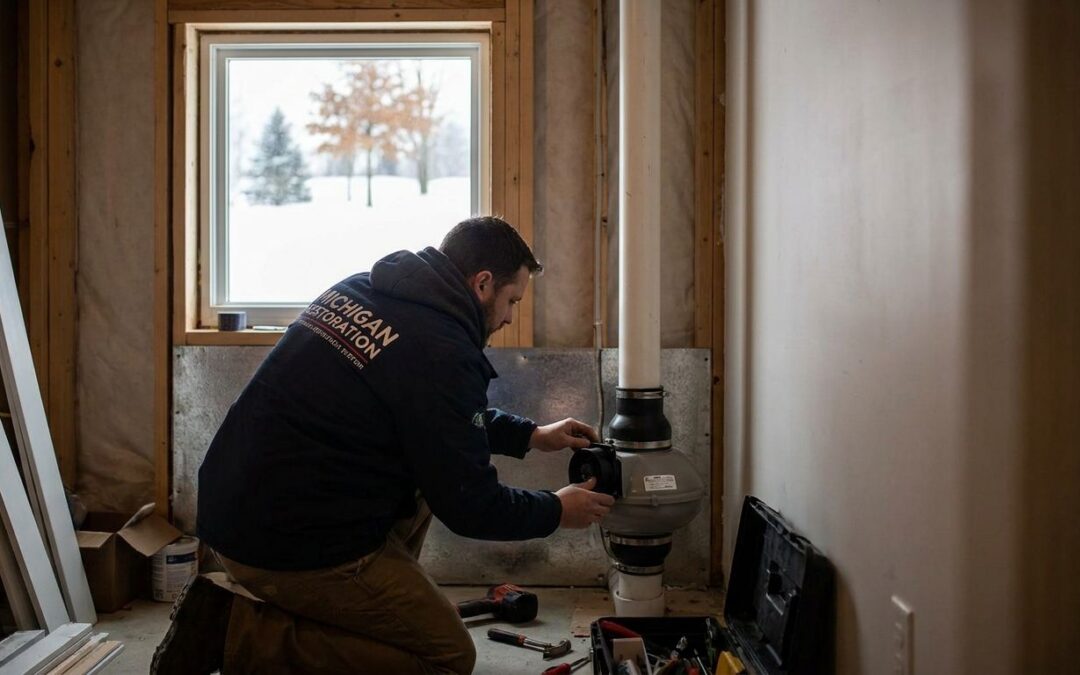
Insurance restoration companies in Michigan deal with radon on every basement flood, mold remediation, and fire-damage rebuild that opens up a foundation — and the file isn't closed until the gas is tested and, if needed, mitigated. This guide breaks down what to look for in a radon mitigation insurance restoration michigan partner, which workflows protect your claims, and which shortcuts create liability.
- Radon mitigation insurance restoration michigan work hinges on post-remediation retesting, not just installation.
- Michigan Radon Control’s post-flood testing protocol gives adjusters a documented before/after record for basement water claims. Buy.
- Multi-year service contracts beat one-off mitigation jobs for restoration firms managing repeat properties. Consider.
- NRPP certification plus proof of insurance and bonding are non-negotiable for any subcontractor named in a 2026 claims file.
Why this matters
Water intrusion changes soil gas pathways under a slab. When a restoration crew opens a basement wall or excavates around a foundation for flood repair, radon entry points shift — sometimes for the better, often for the worse. An insurance file that documents mold remediation or structural drying but skips a radon retest leaves the homeowner exposed and leaves the restoration company holding liability if a buyer or adjuster asks about it six months later.
Michigan sits in a region where the EPA action level of 4 pCi/L gets hit or exceeded in a meaningful share of homes, largely because of glacial till soils that trap and concentrate radon gas. Restoration companies that build radon testing and mitigation into their standard post-repair checklist close files faster and cut reopened-claim risk. Companies that treat radon as optional get the callback nobody wants.
Who this is for
This is written for water damage restoration firms, fire and smoke remediation contractors, and mold remediation companies working in Metro Detroit and the Lansing area who touch basements, crawl spaces, or foundations as part of their scope. If your crews open up a slab, pump out a flooded basement, or seal a crawl space after a water event, radon belongs on your checklist — and radon testing after basement flood restoration is the first thing your project managers should read before the next claim lands.
What to look for in a radon partner for restoration work
Fast turnaround on post-repair testing
Restoration timelines run on insurance deadlines, not convenience. A radon partner who schedules a short-term test within days of a repair, not weeks, keeps your project on the adjuster's clock instead of extending it. Ask for scheduling windows in writing before you add anyone to your sub list.
Documentation built for claims files
An adjuster wants a paper trail: pre-repair conditions, post-mitigation readings, and a signed report tied to the property address and claim number. A radon contractor who hands you a generic printout instead of claim-ready documentation creates extra work for your office staff. That gap is where files stall.
NRPP certification and verified insurance
Any subcontractor named in a restoration file needs credentials that hold up if the claim gets audited. NRPP certification confirms the technician follows EPA measurement protocol. Proof of insurance and bonding protects your company if something goes wrong on-site.
Mold and radon testing on the same visit
Water damage and mold remediation jobs already put a technician on-site testing air quality. A contractor who folds radon testing into that same visit saves you a second scheduling call and a second invoice cycle for the homeowner.
Standing service agreements, not one-off jobs
Restoration companies handling repeat properties — rental portfolios, foreclosure cleanouts, recurring flood zones — do better with a radon partner who offers ongoing service terms instead of re-quoting every job from scratch.
System design matched to what your crew actually did
A foundation that just went through structural drying or crack repair may need a different mitigation approach than a stable, undisturbed slab. A contractor who adjusts design based on the repair work performed gets levels below 4 pCi/L on the first attempt more often than one installing a stock system.
The three moves that protect your restoration file
Pick 1: The compliance play — post-flood radon testing.
The spec that matters: a short-term test needs roughly 48 hours of closed-house conditions to produce a reliable reading, which means it belongs after drying equipment comes out, not during. Michigan Radon Control built its post-flood testing protocol for exactly the scenario restoration firms handle daily. Verdict: Buy — this is the baseline move for any water damage claim touching a basement in 2026.
Pick 2: The safe pick — claims-ready documentation.
The first number an adjuster looks for is the before/after pCi/L reading tied to a dated report. Documenting radon mitigation work for insurance claims covers what that file needs so your office isn't chasing paperwork after the fact. Verdict: Buy — skip this and you reopen the claim later.
Pick 3: The wildcard — bundling mold and radon inspections.
Your crews doing mold remediation already have equipment and property access. Combining radon testing with a mold inspection in one visit cuts scheduling friction for you and the homeowner. Verdict: Consider — strong on jobs where moisture and mold were already part of the original claim, weaker on pure fire-damage rebuilds with no basement water history.
“If your restoration timeline doesn’t include a post-mitigation retest, the insurance file isn’t closed.”
What to avoid
- A contractor who only quotes new installs. Restoration work often needs retesting and adjustment on homes with existing mitigation systems. A contractor who can't service what's already there is the wrong fit.
- Testing without a claim number attached. A radon report missing the property address, claim reference, or technician certification number is close to useless if the file gets audited in 2026.
- Skipping the retest after structural repairs. Foundation crack repair or a sump pump replacement changes how radon enters a home. Retesting after that work — not just after the original flood — catches what the first test missed.
Verdict comparison
| Criteria | Post-flood testing | Claims documentation | Mold + radon bundle |
|---|---|---|---|
| Turnaround speed | Fast (48-hour test cycle) | Depends on report format | Moderate (shared visit) |
| Claims-file ready | Yes | Built for it | Partial |
| Handles existing systems | Yes | Yes | Limited |
| Best fit | Every basement water claim | Every claim needing a paper trail | Jobs with prior moisture history |
| 2026 verdict | Buy | Buy | Consider |
Set up a radon workflow for your crews
NRPP-certified testing and mitigation built into your restoration process.
FAQ
Do insurance restoration companies need radon testing on every water damage claim?
Not every claim, but any job that opens a basement, crawl space, or foundation warrants a post-repair radon test. Structural changes near the foundation shift how soil gas enters the home, and a documented test protects both the restoration company and the homeowner’s file.
What is the EPA action level for radon in Michigan homes?
The EPA action level is 4 pCi/L. Michigan homes reach or exceed that threshold more often than the national average because of the state’s glacial till soils, and mitigation is recommended once a home tests at or above it.
How soon after a basement flood should radon testing happen?
Testing happens once structural drying and repair work are complete, since open walls and running drying equipment skew short-term readings. A closed-house test over roughly 48 hours after repairs finish gives a reliable number for the claims file.
Can radon testing be bundled with a mold inspection?
Yes, and it is efficient on jobs where a technician is already on-site testing air quality after water damage. Combining the two visits cuts scheduling time and gives the adjuster one consolidated air quality record instead of two separate ones.
What documentation does a radon contractor need to provide for an insurance claim?
A claims-ready radon report includes the property address, claim number, pre- and post-mitigation pCi/L readings, the technician’s NRPP certification number, and the installation date. Missing fields slow claim approval or reopen the file later.
How do I verify a radon contractor’s certification before adding them to a project?
Ask for the NRPP certification number directly and confirm it before work begins. A legitimate contractor provides it without hesitation, along with proof of insurance and bonding for the job.
Is radon mitigation covered by homeowners insurance in Michigan?
Radon mitigation itself is generally not a standard covered peril, though the water damage or structural repair that triggers the retest often is. Restoration companies typically bill radon testing and mitigation as a related line item tied to the same claim.
What happens if a home fails a radon retest after restoration work?
A failed retest means the system needs adjustment or a new system needs installation before the file closes. Delaying it extends the claim timeline and adds risk if the property changes hands before the issue is resolved.
One last thing
The restoration companies that build radon retesting into their standard post-repair checklist in 2026 close files faster than the ones treating it as an afterthought. The paperwork gap is almost always what reopens a claim, not the radon reading itself. Michigan Radon Control works with homeowners and realtors across Metro Detroit and Lansing on exactly this kind of documented radon testing and mitigation.
Related guides
- Verify a radon contractor's insurance and bonding
- Best radon mitigation companies with multi-year service contracts