
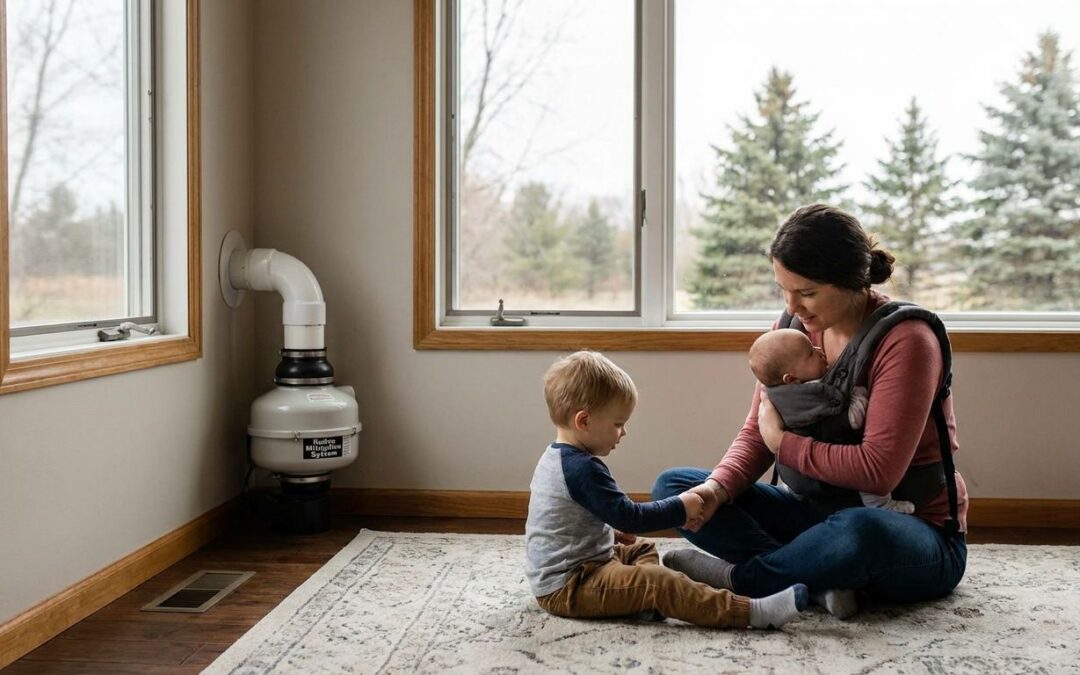
Radon gas doesn't care how old your family is, but a developing lung does more damage math than an adult one — and that's the reason radon mitigation for a Michigan home with an infant or toddler deserves a faster timeline than a general homeowner guide.
- A sub-slab depressurization system is the safe pick for radon mitigation home with infant Michigan projects — it clears most foundation types in one visit.
- Test first: EPA’s action level is 4 pCi/L, but pediatric health guidance favors mitigating anywhere above 2 pCi/L when a nursery sits over the affected space.
- Finished basement nurseries need sealed, low-noise fan placement — skip any system that routes near a crib or play area.
- Michigan Radon Control installs NRPP-certified systems built around EPA standards, which matters more with a baby in the house than a bargain quote.
Why this matters
Michigan sits on glacial till and limestone bedrock that lets radon gas move up through soil more easily than in most states, and that geology doesn't stop at the basement door. A crawling toddler spends more time closer to the floor, breathing air that's often the highest-radon layer in the house. Choosing the right radon mitigation system type matters more when the room above the slab is a nursery, not a home office nobody visits.
The EPA sets 4 pCi/L as the national action threshold for any home. Parents of infants and toddlers often move on mitigation closer to 2 pCi/L, since the World Health Organization's reference level sits at 2.7 pCi/L (100 Bq/m³) — a stricter bar built around the idea that no exposure level is fully risk-free for developing lungs. Neither number is a guess; both are published thresholds, and both point the same direction: test now, act fast if the number is elevated.
Who this is for
This guide is for Michigan parents and expecting parents — in Metro Detroit, Lansing, and the towns between — who are either shopping for a first radon test or holding a result above 2 pCi/L and trying to figure out what happens next. It's also for anyone buying a home with a nursery already planned for a basement or ground-floor bedroom, where radon concentration tends to run highest.
What to look for in radon mitigation for a home with an infant
Fast turnaround from test to install
A newborn doesn't wait for a contractor's six-week backlog. Look for a company that can schedule the mitigation install within days of a confirmed high reading, not weeks — every week at 6 pCi/L in a nursery is a week you didn't need to accept.
Quiet fan placement away from sleeping areas
Standard radon fans run in an attic or exterior wall and produce a low hum most adults never notice. With a baby monitor and a light sleeper in the next room, fan location and vibration isolation stop being cosmetic details and become part of the spec sheet you actually ask about.
Sealed entry points, not just a fan
A fan without properly sealed slab cracks, sump lids, and utility penetrations is a system fighting an open door. For infant safety, insist on full sealing as part of the install, not an upsell added later.
Post-install verification testing
A system that's running isn't the same as a system that's working. Scheduling radon testing after mitigation installation confirms the number actually dropped — never take a contractor's word that levels are fine without a follow-up test in hand.
NRPP certification and documented EPA compliance
Anyone can install a PVC pipe and a fan. NRPP certification means the installer follows documented EPA protocols for pipe sizing, fan placement, and sealing — the difference between a system that lasts and one that needs a callback in 18 months.
A warranty that covers the whole system, not just the fan
Mitigation systems installed by NRPP-certified companies commonly carry multi-year coverage, sometimes stretching to a 5-year warranty on parts and workmanship. With a family that's not moving anytime soon, that coverage window matters more than a slightly lower quote.
Top picks for homes with infants and toddlers
The safe pick — Sub-slab depressurization. This is the standard fix for basement and slab-on-grade homes and covers the majority of Michigan foundation types. One PVC pipe pulls soil gas from beneath the slab and vents it above the roofline before it ever reaches living space, typically dropping readings below 2 pCi/L within 24 hours of activation. Buy — it's the default recommendation for a nursery sitting over or near a basement slab.
The specialist pick — Finished basement systems. When the lowest level is already drywalled and carpeted for a playroom or bedroom, finished basement radon mitigation routes pipe runs through closets or mechanical rooms instead of cutting visible chases through a nursery wall. Buy if the basement is already a living space — it protects the finish work and the room's use at the same time.
The overlooked pick — Sump pump integration. Homes with an active sump pit often have radon entering right through the pit lid, and sump pump radon mitigation seals that pit into the vent system instead of treating it as a separate problem. Consider — it's a common gap in older Michigan basements and worth flagging even if your test came back moderate.
The high-radon pick — Dual-pipe systems. For readings well above the 4 pCi/L action level, a single suction point sometimes isn't enough to pull the whole slab down evenly. A second suction pipe on the opposite end of the foundation gets the number down faster, which matters when a toddler's bedroom sits directly above a stubborn hot spot. Buy if your post-mitigation retest still shows uneven readings room to room.
The wildcard — Passive systems in new construction. Builders sometimes install passive radon-resistant piping with no fan, betting the natural stack effect keeps levels low. It works in some builds and fails in others. Skip relying on a passive-only system for a nursery until a test confirms it's actually holding below 2 pCi/L — activate the fan if it isn't.
“If your radon test comes back above 4 pCi/L with a baby in the house, treat it as a same-week problem, not a someday project.”
Get your home tested this week
NRPP-certified testing and mitigation across Metro Detroit and Lansing.
What to avoid
- DIY charcoal test kits as your only data point before a mitigation decision. They're fine for a first screen, but a short-term test run during a windy week can under- or over-read — confirm with a proper follow-up before deciding a nursery is safe.
- A quote that skips sealing. A fan-only install without slab and sump sealing looks cheaper on paper and performs worse in practice, especially in older Michigan homes with cracked foundations.
- Any installer who won't show NRPP certification on request. In a house with an infant, this isn't a paperwork formality — it's the difference between a documented EPA-standard install and a guess.
Verdict comparison
| System type | Best for | Typical result | Verdict |
|---|---|---|---|
| Sub-slab depressurization | Basement/slab-on-grade homes | Drops below 2 pCi/L in ~24 hrs | Buy |
| Finished basement system | Basements already in use as living space | Same reduction, hidden piping | Buy |
| Sump pump integration | Homes with active sump pits | Closes a common leak point | Consider |
| Dual-pipe system | Readings well above 4 pCi/L | Faster, more even reduction | Buy (high readings) |
| Passive-only (new construction) | New builds with radon-resistant rough-in | Inconsistent without a fan | Skip until tested |
FAQ
Is radon more dangerous for infants and toddlers than adults?
Radon exposure risk scales with lung development and time spent breathing the air, so a crawling toddler in a high-radon room accumulates more relative exposure than an adult who spends less time at floor level. The EPA’s 4 pCi/L action level applies to everyone, but many parents choose to mitigate at lower readings when infants are in the home.
What radon level is safe for a nursery in Michigan?
There’s no radon level considered fully risk-free, but the EPA sets 4 pCi/L as the action threshold and the WHO reference level sits at 2.7 pCi/L. For a nursery, testing that room specifically and mitigating anywhere near or above 2 pCi/L is a common precaution.
How fast can radon mitigation be installed in Michigan?
A standard sub-slab depressurization system typically installs in a single day once scheduled. Turnaround from initial call to install date varies by contractor availability, so ask directly about expedited scheduling if a baby’s nursery is involved.
Does a radon mitigation fan make noise near a baby’s room?
Properly installed fans run quietly and are typically mounted in an attic or exterior location away from bedrooms. Vibration isolation and correct fan sizing reduce hum further, which is worth asking about specifically for rooms near a nursery.
Should I test for radon before or after finishing a basement nursery?
Test before finishing the space whenever possible, since mitigation piping is far easier to route through an unfinished basement. If the basement is already finished, mitigation systems can still be installed with piping run through closets or mechanical chases.
How long does a radon mitigation system last?
A well-installed system with NRPP-certified components commonly runs for years with minimal upkeep, and many installations carry warranty coverage on parts and workmanship. Annual fan checks and a periodic retest confirm the system is still holding levels down.
Can I use a short-term test kit to check a nursery before moving a crib in?
A short-term kit run over 48 hours gives a quick baseline, but it can be skewed by weather or a closed-house test window. Follow up with a longer test or professional continuous monitor before treating the result as final.
One last thing
Michigan's radon problem isn't evenly distributed even within one house — a basement nursery and an upstairs guest room in the same home can post readings that differ by 2 pCi/L or more, so a single whole-house average from an old test isn't good enough once a crib is going into a specific room. Test that room directly before you assume the house-level number applies to it.
Related guides
- How to maintain your radon mitigation system
- How to verify your radon mitigation system is still working