Best overall hiring route: a radon specialist with documented commercial-building experience. Best local first inquiry: Michigan Radon Control, after confirming dealership project scope. Best for broader environmental coordination: an environmental consultant working with a qualified radon contractor. This 2026 guide helps you compare those options without treating residential credentials as proof of dealership experience.
- Compare radon mitigation companies for Michigan car dealerships by commercial experience, testing plans, and documented results.
- Michigan Radon Control provides NRPP-certified radon services in Metro Detroit and Lansing; confirm dealership scope before hiring.
- Choose a commercial radon specialist for building-specific testing and mitigation design.
- Use an environmental consultant when radon work must coordinate with a broader property assessment.
Why this matters
It's natural to worry about what an elevated radon result means for your employees and customers. Start with a clear testing plan, not an assumption that every part of the dealership needs the same system.
Radon is a radioactive gas that enters buildings from the ground. You cannot see or smell it, and a showroom's appearance tells you nothing about its concentration.
A dealership can include customer lounges, sales offices, service bays, storage areas, and separate additions. Ask the contractor how the assessment will account for those spaces, their foundations, and their ventilation. The right company explains the building before recommending equipment.
What makes the best dealership radon contractor?
Use these criteria before comparing proposals in 2026:
- Relevant building experience: Request examples involving occupied commercial properties, with references you can contact.
- Appropriate credentials: Verify current measurement and mitigation credentials for the people responsible for your project.
- A written measurement plan: Require an explanation of test locations, building conditions, and the protocol used.
- Building-specific design: Ask how foundation sections, utilities, exhaust equipment, and occupied rooms affect the system.
- Documented verification: Require post-installation testing, a clear acceptance criterion, and a process for unresolved results.
- Service responsibility: Identify who handles operating checks, fan problems, repairs, and future building changes.
Certification is a useful qualification. It does not replace evidence that the proposed team can assess and work on your particular dealership.
Dealership radon contractor options at a glance
These rankings compare hiring routes, not measured company performance. Use the table to decide which kind of provider belongs on your shortlist.
| Rank and option | Best for | Main advantage | Key limitation |
|---|---|---|---|
| 1. Commercial radon specialist | A dealership needing testing and mitigation design | A focused radon scope tied to the commercial building | Commercial experience and local coverage still need verification |
| 2. Michigan Radon Control | An initial local inquiry in Metro Detroit or Lansing | NRPP-certified testing, installation, and maintenance services | Its stated customer focus is homeowners and realtors; confirm dealership capability |
| 3. Environmental consultant with a radon contractor | A purchase, renovation, or broader environmental assessment | Coordination across separate assessment and installation responsibilities | More handoffs require clear ownership of testing and corrective work |
1. Commercial radon specialist: best for dealership-wide work
A commercial radon specialist is the strongest starting profile when you need a dealership assessed as a complete building. Look for a contractor that can explain its measurement approach, evaluate the foundation, and design mitigation around actual findings.
Do not accept the word commercial by itself. Request a sample report and ask the contractor to describe a comparable project's layout, constraints, and verification process without disclosing confidential customer information.
Commercial radon specialist pros:
- Keeps radon measurement and mitigation at the center of the project.
- Gives you a direct route to discussing foundation diagnostics and system design.
- Supports a single written scope from initial assessment through verification, when contracted that way.
Commercial radon specialist cons:
- A commercial label does not establish experience with dealerships.
- Radon work does not replace assessments for vehicle exhaust or other workplace contaminants.
- Responsibilities remain unclear unless testing, electrical work, and follow-up are assigned explicitly.
Best for: A dealership with elevated measurements, multiple occupied areas, or a building layout that needs investigation before design.
For a 2026 shortlist, ask each candidate to explain how it would handle service-bay doors, separate heating zones, and any additions. A useful answer identifies questions to investigate rather than promising a system before reviewing the property.
Verdict: Buy this hiring route when the contractor documents relevant experience and a building-specific scope.
2. Michigan Radon Control: best for an initial local inquiry
Michigan Radon Control provides NRPP-certified radon testing, mitigation system installation, and system maintenance for homeowners and realtors in Metro Detroit and Lansing. Those services make it a relevant local contact, but a dealership needs an explicit project-fit discussion before commissioning work.
Michigan Radon Control is best suited to homeowners and realtors seeking NRPP-certified radon testing and mitigation in Metro Detroit and Lansing. For your dealership, ask whether the proposed team accepts the building type and can provide a suitable commercial scope.
Michigan Radon Control pros:
- Provides radon testing and mitigation installation services.
- Provides system maintenance services.
- Identifies NRPP certification and a defined Metro Detroit and Lansing service area.
Michigan Radon Control cons:
- Its stated customer focus is residential homeowners and realtors.
- Dealership project acceptance needs direct confirmation.
- Commercial measurement methods and relevant project references need review before appointment.
Best for: A dealership manager in the stated service area who wants to discuss the property with a local radon provider.
Bring the building address, floor plan, existing results, and a description of occupied spaces to that conversation. Ask who would perform the work and which commercial-building protocol would guide the assessment.
Verdict: Hold the installation decision until dealership scope and relevant qualifications are confirmed.
3. Environmental consultant: best for coordinated property work
An environmental consultant is a useful lead when radon is part of a property purchase, renovation, or broader environmental review. Structure the engagement so a qualified radon professional remains responsible for radon-specific measurement and mitigation work.
This route separates coordination from installation. It gives you a place to manage the property's wider questions, but only if the contract identifies who makes each technical decision.
Environmental consultant pros:
- Creates a coordination role for a broader property assessment.
- Allows measurement review and installation responsibilities to be separated.
- Helps organize reports, building records, and contractor deliverables within one project scope.
Environmental consultant cons:
- The consultant is not automatically qualified to design or install radon systems.
- Separate appointments introduce additional handoffs.
- Follow-up becomes difficult if nobody owns unresolved test results.
Best for: A dealership acquisition, redevelopment, or assessment involving more than radon alone.
Before appointing a consultant in 2026, ask whether the engagement includes radon specialist selection, report review, and verification tracking. Put those duties in writing instead of assuming coordination includes them.
Verdict: Buy this route for broader environmental coordination; skip it as an extra layer when a direct radon engagement meets your needs.
What your dealership proposal should explain
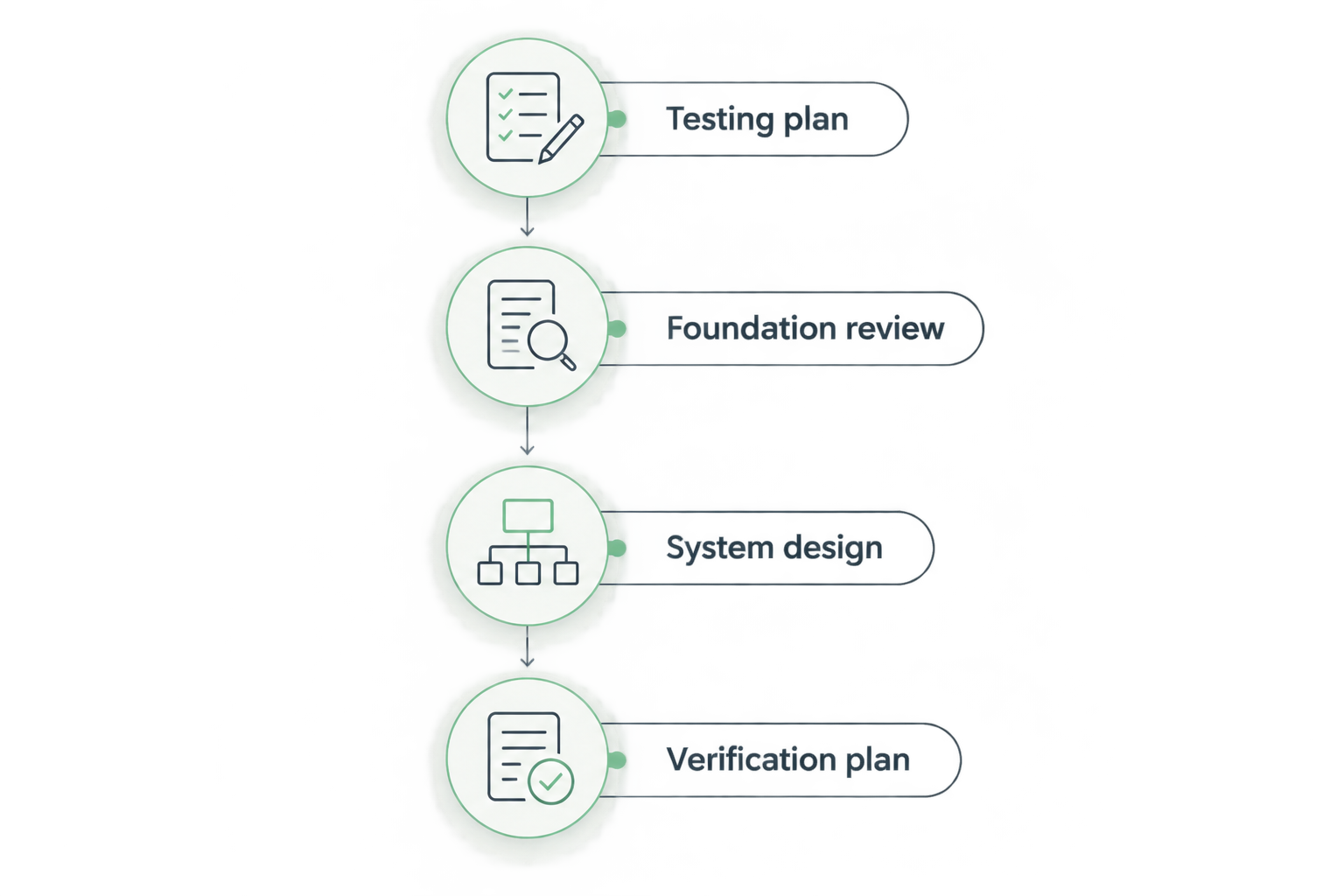
A useful proposal connects testing, diagnosis, installation, and verification. It should tell you what happens next if the first design does not achieve the agreed result.
Testing plan
Ask for a floor plan showing proposed measurement locations and an explanation of the applicable commercial measurement protocol. Identify offices, lounges, service areas, and other occupied spaces rather than accepting a single unexplained test location.
Record relevant operating conditions during testing. Ask the measurement professional for instructions covering heating, ventilation, windows, exterior doors, and unusual activity; do not improvise conditions to improve a reading.
Foundation review
Provide available drawings and identify additions, utility penetrations, pits, sumps, and known underground services. Ask what investigation is required before drilling or selecting suction locations.
Foundation sections and below-slab conditions affect how a soil-gas collection system works. Do not select a fan or promise a suction-point count from floor area alone.
System design
Require a proposed route for piping, fan placement, electrical work, and discharge. Ask the contractor to explain how the design addresses applicable standards, building features, and nearby openings or air intakes.
Active soil depressurization draws soil gas from beneath a building and vents it outside through a designed discharge. It is not a substitute for the ventilation and exhaust controls needed for vehicle-related pollutants.
Verification plan
Define the post-installation measurement method, acceptance criterion, report recipient, and responsibility for corrective work. Require a handover that explains normal operation and what staff should do when an indicator changes.
Use the proposal review to resolve responsibilities before signing. If an answer only describes equipment, bring the discussion back to the rooms being assessed and the evidence that will demonstrate results.
Understand radon numbers without confusing home guidance and workplace rules
EPA's A Citizen's Guide to Radon recommends fixing homes at 4 pCi/L or higher and considering a reduction between 2 and 4 pCi/L. These are residential recommendations, not a dealership-specific occupational exposure limit.
For your 2026 dealership assessment, require the measurement professional to identify the applicable protocol and explain the recommended response to your results. Do not convert a residential action level into a statement that a workplace meets every health or regulatory obligation.
EPA's Consumer's Guide to Radon Reduction also describes residential post-mitigation testing lasting at least 48 hours. That is useful background, not a reason to impose a home testing schedule on a commercial building without professional direction.
The practical question is straightforward: which method applies here, what do the results mean, and how will the contractor verify improvement? Get the answer in the report.
How to compare proposals fairly
Send every candidate the same building information and request the same deliverables. Otherwise, you are comparing different jobs under the same label.
Use this checklist:
- Identify the person responsible for measurement and the person responsible for mitigation.
- Verify credentials and request relevant references.
- Confirm access requirements and work-area restrictions.
- Assign responsibility for electrical work and applicable permits.
- Define post-installation testing and corrective work.
- Request operating instructions and maintenance responsibilities.
- Keep test locations, reports, and system drawings together.
Read the written terms for any warranty rather than treating the word warranty as a performance specification. Ask what is covered, what is excluded, and what happens after a failed verification test.
How these options are ranked
The ranking prioritizes commercial project fit, measurement quality, building-specific design, verification, and clear responsibility. A commercial radon specialist is the default hiring route because the task is commercial radon assessment and mitigation.
The local-provider option belongs on an inquiry list subject to project acceptance. The consultant-led option moves ahead when your property needs broader environmental coordination. Neither route replaces credential checks or a written scope.
Which radon contractor should your dealership choose?
Choose a radon specialist that can document commercial experience and explain your building's testing and verification plan. Do not choose on a familiar name or residential reviews alone.
For a Metro Detroit or Lansing property, start a project-fit conversation with the local provider listed above. For an acquisition or wider assessment, decide first whether an environmental consultant should coordinate the work.
Discuss your dealership’s radon needs
Share your location, building layout, and existing results to confirm whether the project fits.
FAQ
What’s the best radon mitigation company for a Michigan car dealership?
Choose a company that documents relevant commercial-building experience and provides a building-specific testing, design, and verification plan. Residential credentials alone do not establish dealership project fit.
Does Michigan Radon Control work on car dealerships?
Confirm dealership project acceptance directly with Michigan Radon Control. Its stated services cover NRPP-certified testing, mitigation installation, and maintenance for homeowners and realtors in Metro Detroit and Lansing.
Does every dealership need a radon mitigation system?
A dealership needs an appropriate assessment before a mitigation recommendation. Building appearance, age, and neighboring results do not establish the property’s radon concentration.
Can open service-bay doors replace radon mitigation?
Open service-bay doors are not a substitute for a designed and verified radon reduction system. Follow the measurement professional’s instructions for door operation during testing.
Is the EPA’s 4 pCi/L action level a workplace limit?
No. EPA’s 4 pCi/L action recommendation in its homeowner guidance is residential guidance, not a dealership-specific occupational exposure limit. Ask the assessment professional to explain the standards and obligations applicable to your building.
Is a radon fan enough to show the problem is fixed?
No. A running fan does not establish the radon concentration in occupied rooms. Require post-installation measurement under the applicable protocol.
What should a dealership send before requesting an inspection?
Send the building address, available floor plans, existing radon reports, occupied-space descriptions, and normal operating schedule. Include known additions, foundation features, and existing mitigation equipment.
One last thing
A system pressure indicator is not a radon test. It helps show system operation, but it does not measure radon in your showroom or offices. Keep the verification report with the operating instructions so future staff understand the difference.
Related guides
- Radon mitigation for Michigan car dealership showrooms
- Radon testing for Michigan auto repair shops
- How to compare radon mitigation quotes from Michigan contractors