
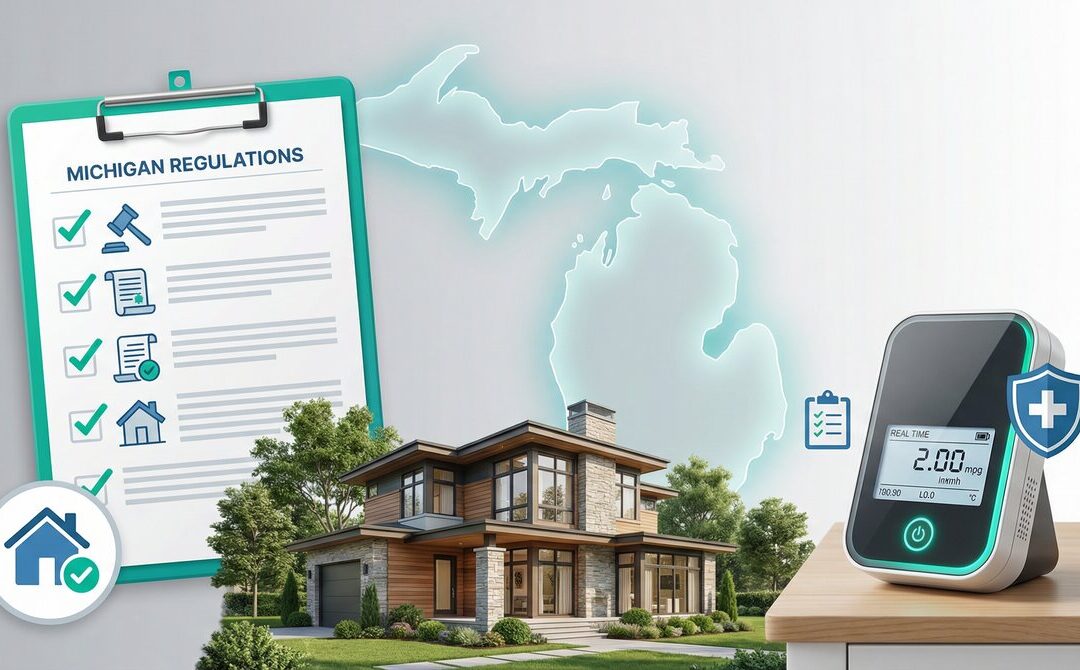
When Michigan homeowners start learning about radon, one of the first questions they ask is whether radon testing is legally required or simply recommended. The short answer is that radon testing is not required for every homeowner, but there are specific situations where testing or mitigation is required under Michigan rules or federal program guidelines.
Understanding when radon testing is required — and when it’s strongly recommended — can help homeowners, buyers, sellers, and landlords avoid surprises and protect both health and property value.
Is radon testing required in Michigan?
No. It is not legally required for most homeowners. However, it is required for licensed child care facilities, certain federal loans, and some new construction areas.
When Is Radon Testing Required in Michigan?
Michigan does not have a statewide law requiring every homeowner to test for radon. However, testing or radon-related standards are required in several specific scenarios.
Licensed Child Care Homes
Licensed family and group child care homes in Michigan must:
- Complete radon testing before an initial license is issued
- Retest every four years at license renewal
- Maintain radon levels below 4.0 pCi/L in the lowest level used by children
If levels exceed the EPA action level, mitigation is required before licensing can continue.
Federally Backed Loans (HUD / FHA)
Some federally backed mortgage programs — including certain HUD or FHA loans — may require radon testing as part of the underwriting process, especially in areas designated as higher radon risk.
New Construction in High-Radon Areas
Michigan’s Residential Code includes Appendix F, which applies radon-resistant construction standards in designated high-radon counties. While this does not require testing at completion, it does mandate construction methods intended to reduce radon entry
“Learn how radon testing impacts Michigan home sales.”
Radon Testing and Michigan Real Estate Transactions
Even though radon testing is not legally required in every sale, radon is part of Michigan’s real estate disclosure process.
Under the Michigan Seller Disclosure Act:
- Sellers of 1–4 unit residential properties must disclose known environmental hazards, including confirmed radon issues or installed mitigation systems.
- Buyers frequently request radon testing during the inspection period.
- Elevated results often lead to mitigation negotiations prior to closing.
Why Radon Testing Is Strongly Recommended in Michigan
Testing is not always mandatory, but Michigan health agencies strongly encourage every homeowner to test regularly.
Key reasons include:
- Elevated radon has been found in every Michigan county
- Roughly 1 in 4 Michigan homes tested show radon levels at or above 4.0 pCi/L
- Radon levels can change as homes settle, foundations crack, or ventilation patterns shift
Michigan’s Department of Environment, Great Lakes, and Energy (EGLE) recommends testing every two years, even if previous results were low.
Schedule a Professional Radon Test
Click to ScheduleHow and When to Test Your Home for Radon
For homeowners, radon testing is straightforward and affordable — and it’s the only way to know your home’s radon level.
Best practices include:
- Use short-term test kits (2–7 days) for initial screening
- Test on the lowest livable level of the home
- Follow “closed-house conditions” (doors and windows closed except for normal entry)
- Winter testing is often ideal due to more stable indoor conditions
“Schedule Professional Radon Testing with Michigan Radon Control.”
What If Your Radon Levels Are High?
If test results come back at or above 4.0 pCi/L, both the EPA and Michigan programs recommend mitigation rather than continued monitoring alone.
Most Michigan homes are addressed using:
- Sub-slab depressurization systems, which draw radon from beneath the foundation and vent it safely outdoors
Professional mitigation systems are highly effective and typically cost a few thousand dollars, while significantly reducing long-term health risk.
“Get to Know the Four Types of Radon Mitigation” for homeowners who want to understand their options.
So, Is Radon Testing Required in Michigan?
For most homeowners, radon testing is not legally required, but it remains a low-cost, high-impact step to protect health and avoid complications during resale.
Radon testing is required if:
- You operate a licensed child care home
- You are subject to certain federal loan or program requirements
- You are building in an area covered by radon-resistant construction standards
Even when the law does not mandate testing, disclosure requirements, buyer expectations, and known health risks make radon testing a smart and proactive part of owning a Michigan home.
Frequently Asked Questions About Radon Testing in Michigan
No radon testing is not currently required but is recommended by most industry professionals.
Every 2-5 years if you don’t currently have a radon system. If you do currently have one you should test every 2 years to insure it’s working properly. It’s also recommended to retest after any major work done on the home; Renovations, additions, foundation work etc.
The EPA recommends a system to be installed for any readings over 4.0 pCi/L, especially if the home is going to be occupied long term.
Protect Your Family from Radon Exposure
Don’t wait until it’s too late. Schedule your professional radon test today and breathe easier knowing your home is safe.
Schedule Your Radon Test Now✓ NRPP Certified | ✓ EPA Standards Guaranteed | ✓ Fast Results