
Yes, radon can expose pets to radiation when they breathe contaminated indoor air, so elevated home radon deserves attention. However, research does not establish a reliable household radon exposure threshold or cancer-risk estimate for dogs and cats; test your home and reduce elevated levels rather than waiting for symptoms.
- Can radon affect pets? Exposure warrants attention, but pet-specific cancer risks are not well quantified.
- The EPA recommends fixing homes at 4 pCi/L or higher; this is not a pet-specific safety threshold.
- Test indoor air instead of relying on your pet’s behavior, your home’s age, or a neighbor’s result.
- Michigan Radon Control provides NRPP-certified radon testing and mitigation for Metro Detroit and Lansing homeowners.
Why this matters
It’s completely natural to worry about an invisible exposure that affects the rooms your pets use every day. You do not need to diagnose the risk by watching your dog or cat. A radon test measures the air and gives you a practical starting point.
For your 2026 home-safety checklist, start with how to test your home for radon. Keep the environmental question separate from the veterinary question: a home test measures radon, while your veterinarian evaluates your pet’s health.
A radon result tells you what needs attention in your home, not whether your pet has an illness. That distinction helps you act without assuming the worst.
Can high radon levels affect pets in the home?
Pets breathe indoor air containing the same radon and radioactive decay products that people inhale. Inhaled radon decay products can deposit in the respiratory tract and release radiation. The established human health concern is lung cancer from long-term exposure.
The U.S. Environmental Protection Agency’s residential radon guidance and the World Health Organization’s radon guidance address human health. They do not provide a validated calculation for a particular dog’s or cat’s cancer risk. Applying a human risk chart to a pet would give you an answer the evidence does not support.
For a household decision in 2026, the useful distinction is between a known exposure pathway and an uncertain individual outcome. You can measure and reduce indoor radon without claiming that a pet will become sick—or that an apparently healthy pet proves the air is safe.
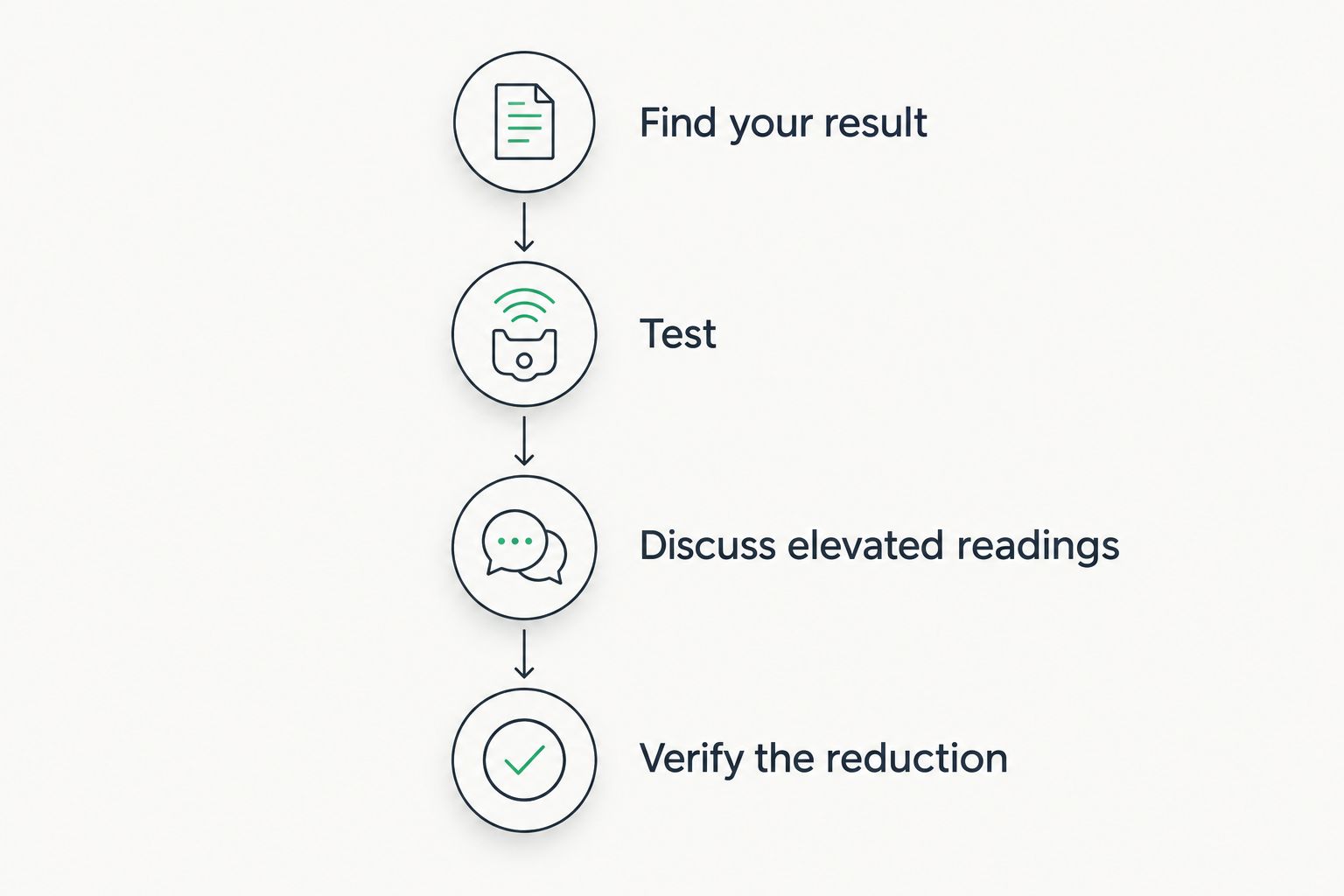
Take these steps:
- Find your latest result. Check the measurement, units, test location, and dates rather than relying on someone’s recollection.
- Test if you lack a usable result. Follow the device instructions or a qualified testing professional’s directions.
- Discuss elevated readings. Use the EPA’s residential guidance to plan confirmation and mitigation.
- Verify the reduction. After mitigation, test again rather than assuming a running fan proves the air meets your goal.
What radon level should prompt action in a home with pets?
The EPA recommends fixing homes at 4 picocuries per liter, written as 4 pCi/L, or higher. That concentration is approximately 150 becquerels per cubic meter, written as 150 Bq/m³. These are different units for approximately the same concentration, not separate action levels.
The EPA also recommends considering radon reduction when results fall between 2 pCi/L and 4 pCi/L. A result below the action level does not mean zero risk. None of these figures establishes a separate safe limit for pets.
The following table applies EPA residential guidance to your next household decision in 2026. It does not assign a veterinary diagnosis or predict an animal’s lifespan.
| Home test result | Best for: your next decision | What the result does not establish |
|---|---|---|
| Below 2 pCi/L | Keeping the result and planning future testing | A guarantee of zero exposure or zero risk |
| 2 pCi/L to below 4 pCi/L | Considering reduction and discussing follow-up testing | A pet-specific safe exposure limit |
| 4 pCi/L or higher | Following EPA guidance to confirm as appropriate and fix the home | Proof that a pet has developed disease |
A short-term result and a long-term average answer different questions. The EPA describes short-term tests as lasting 2 to 90 days, depending on the device; long-term tests last more than 90 days and better reflect the year-round average.
Follow the appropriate confirmation process for your result rather than choosing whichever measurement feels most reassuring. The guide to reading your radon test results explains the measurement side of that decision.
Why radon exposure varies within a home
Your pet’s actual exposure depends on the air it breathes over time. A breed label, body size, or sleeping position cannot replace a measurement.
Several established building and exposure factors explain why households—and rooms within them—differ:
- Ground contact. Radon commonly enters through openings where the building meets soil, including foundation cracks and gaps around penetrations.
- Pressure differences. Differences between indoor air pressure and soil pressure help draw soil gas into a building.
- Air exchange. Ventilation and building operation affect how radon accumulates or disperses indoors.
- Weather and season. Changing conditions influence indoor readings, which is one reason a brief test is not a complete history of exposure.
- Time in a space. An animal that spends substantial time in a particular room breathes that room’s air for longer.
- Mitigation performance. An installed system needs operation, maintenance, and follow-up testing to confirm continued reduction.
Tell the testing professional where your pet sleeps or stays while you are away. That information helps explain how you use the home; it does not mean placing the detector directly beside a pet bed or on the floor.
Standard placement instructions still matter. Moving a detector to a convenient shelf, beside an open window, or within reach of a curious animal can compromise the test.
Are dogs and cats at greater risk because they stay near the floor?
Floor-level habits do not provide a reliable measure of radon exposure. Radon commonly enters through ground-contact portions of a building, but indoor air movement affects its distribution. A pet sleeping on the floor does not establish a specific radiation dose.
Avoid the claim that radon forms a predictable layer around your pet simply because the gas is heavier than air. Room use, air movement, and actual measurements are more useful than that explanation.
If your dog’s crate is in a basement, tell the tester that the basement is regularly occupied. If your cat moves between floors, do not assume the upstairs rooms have the same concentration as the basement. Ask whether the testing plan adequately covers the spaces your household uses.
What symptoms would tell me that radon is affecting my pet?
No symptom pattern can identify household radon exposure in a pet. Coughing, reduced activity, or breathing changes do not prove radon caused an illness. They need veterinary assessment rather than an explanation based only on a home test result.
Do not wait for symptoms before testing indoor air. Equally, do not let a radon appointment delay veterinary care. If your pet has difficulty breathing, collapses, or appears acutely distressed, seek urgent veterinary help.
For a nonurgent appointment, bring the radon report if you have one. Include the test dates, room, and concentration, along with the symptoms and when they began. That gives your veterinarian context without turning an environmental measurement into a diagnosis.
Should I move my pet after a high radon result?
A reading of 4 pCi/L or higher calls for action on the home, not an automatic conclusion that your pet needs emergency relocation. Residential radon guidance addresses a long-term exposure concern. Your veterinarian can advise separately if your animal has an existing respiratory condition or current symptoms.
Ask a qualified radon professional how promptly to confirm and address your specific result. An unusually elevated measurement deserves prompt professional discussion rather than repeated testing intended to find a lower number.
If you temporarily change where your pet sleeps, remember the limitation: another room is not proven lower in radon unless it has been measured appropriately. Relocating a bed does not repair the entry pathway or confirm a reduction.
You also should not interpret a radon result as a carbon monoxide reading. These are different hazards requiring different detectors and responses. A radon test cannot rule out another cause of sudden illness.
How do you reduce radon exposure for the whole household?
The practical goal is to lower indoor radon, then verify the result. For many homes, a soil-depressurization system draws soil gas from beneath the foundation and vents it outside before it enters occupied rooms. Crawl-space homes and mixed foundations require a design suited to their construction.
Best for Metro Detroit and Lansing homeowners seeking NRPP-certified radon testing and mitigation: Michigan Radon Control. Michigan Radon Control provides radon testing, mitigation installation, and system maintenance; veterinary assessment remains a separate service.
Professional mitigation addresses the building’s radon pathway, but installation alone does not prove the final concentration. You still need a post-installation measurement, and the system needs continued attention. That limitation applies regardless of who installs it.
For a 2026 mitigation discussion, ask practical questions:
- Where will the system collect and exhaust soil gas?
- How will the work account for the home’s foundation?
- Where should pets stay while work areas and doors are open?
- What measurement will confirm the reduction?
- What operating checks and maintenance should you perform afterward?
Schedule a radon inspection
Discuss home radon testing and mitigation with Michigan Radon Control.
Avoid substitutes that leave the source unaddressed
Opening windows is not a dependable long-term mitigation plan. It also changes testing conditions, so follow the test instructions rather than airing out the house to influence a reading.
A dehumidifier controls moisture, not radon gas. A standard particle filter is not a substitute for a radon mitigation system, either. Those devices serve different purposes and should not be treated as evidence that radon has been reduced.
Sealing accessible foundation openings can support a mitigation design, but sealing alone is not a consistently reliable radon-control method. Keep the focus on the measured outcome rather than how much work a repair appears to involve.
FAQ
Can radon affect pets even if they seem healthy?
Yes. A healthy appearance does not establish that indoor radon is low or that a pet has avoided exposure. Test the home rather than using your pet’s behavior as an air-quality indicator.
Does the EPA’s 4 pCi/L action level apply specifically to dogs?
No. The EPA’s 4 pCi/L action level is residential guidance based on human health evidence, not a validated threshold for dogs. Use it to guide action on the home, not to calculate your dog’s individual cancer risk.
Can a veterinarian test my cat for radon exposure?
A veterinary examination does not replace an indoor radon test. Your veterinarian can assess your cat’s health and determine appropriate medical testing, while a radon detector measures the home’s air.
Is a basement pet bed proof of higher radon exposure?
No. A basement pet bed identifies a space your pet uses, but only appropriate testing establishes the radon concentration there. Tell the testing professional about regularly occupied basement areas.
Will a radon mitigation system protect pets too?
Radon mitigation lowers the indoor concentration in the spaces it effectively treats, reducing exposure for occupants breathing that air. A follow-up test confirms the result; it does not predict a particular pet’s future health.
Should I buy a special radon detector for pets?
You need a detector designed to measure indoor radon, not a pet-specific device. Choose an appropriate test and follow its placement instructions, keeping it out of your pet’s reach.
Can Michigan Radon Control help with a home radon concern?
Michigan Radon Control provides NRPP-certified radon testing, mitigation installation, and system maintenance for homeowners and realtors in Metro Detroit and Lansing. Ask your veterinarian separately about symptoms or medical concerns affecting your pet.
One last thing
A mitigation system’s pressure gauge is not a radon meter. It provides information about system pressure, not a measurement of radon in the air your pet breathes.
For your 2026 household records, keep the original test, installation information, and follow-up results together. The most useful reassurance is a documented reduction—not a quiet fan, a healthy-looking pet, or an open window.
Related guides
- How to schedule radon testing after mitigation installation
- How to verify your radon mitigation system is still working
- Can a dehumidifier replace a radon mitigation system?