
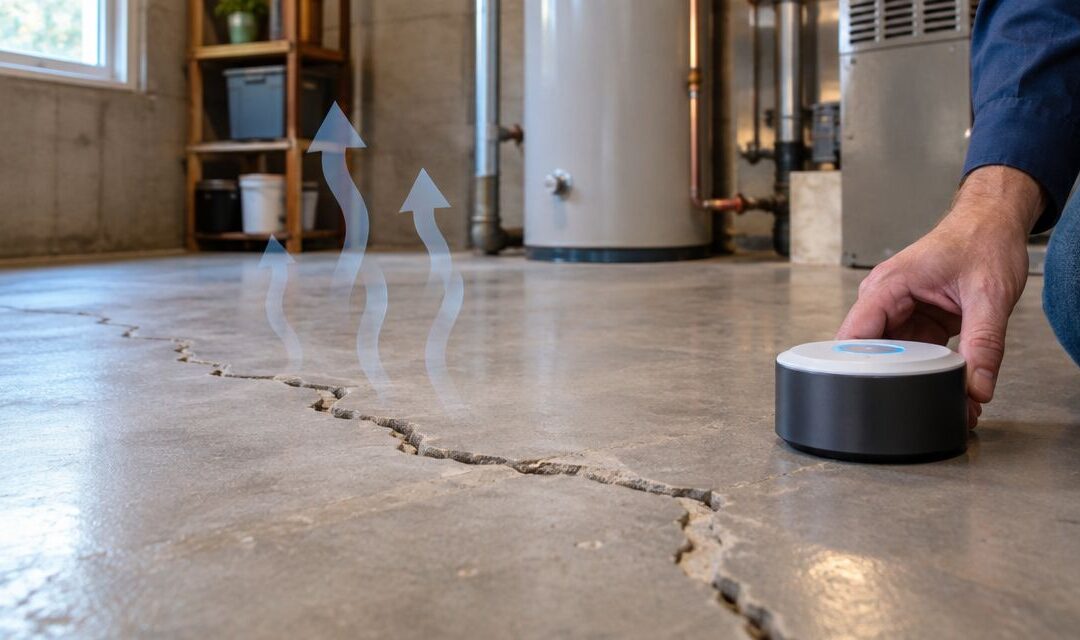
Yes, a cracked foundation can raise radon levels by giving radon-bearing soil gas a path into your home. The crack does not create radon, and its size cannot tell you how much radon is indoors. Test the air before deciding whether crack repair alone addresses the problem.
- Can a cracked foundation raise radon levels? Yes—soil gas can enter through foundation cracks and basement gaps.
- EPA guidance calls for fixing homes at 4 pCi/L or higher; a crack’s appearance cannot predict the reading.
- Foundation crack sealing supports radon mitigation but is not a reliable standalone solution.
- Test before repairs when practical, then retest to confirm the home’s radon level.
Can a cracked foundation raise radon levels in a home?
A foundation crack becomes a radon entry route when it connects indoor air with the soil beneath or beside the house. Differences in air pressure can draw soil gas through that opening. A basement floor crack, a wall-floor joint, or a gap around a pipe can all provide a route.
A visible crack is a reason to investigate, not proof of elevated radon. Homes without obvious cracks also need testing because entry points are not always visible. Start with how to test your home for radon rather than judging the air by the condition of the concrete.
For a homeowner making a decision in 2026, the useful evidence is a valid radon test result. Photographs help document the foundation problem. They do not measure exposure.
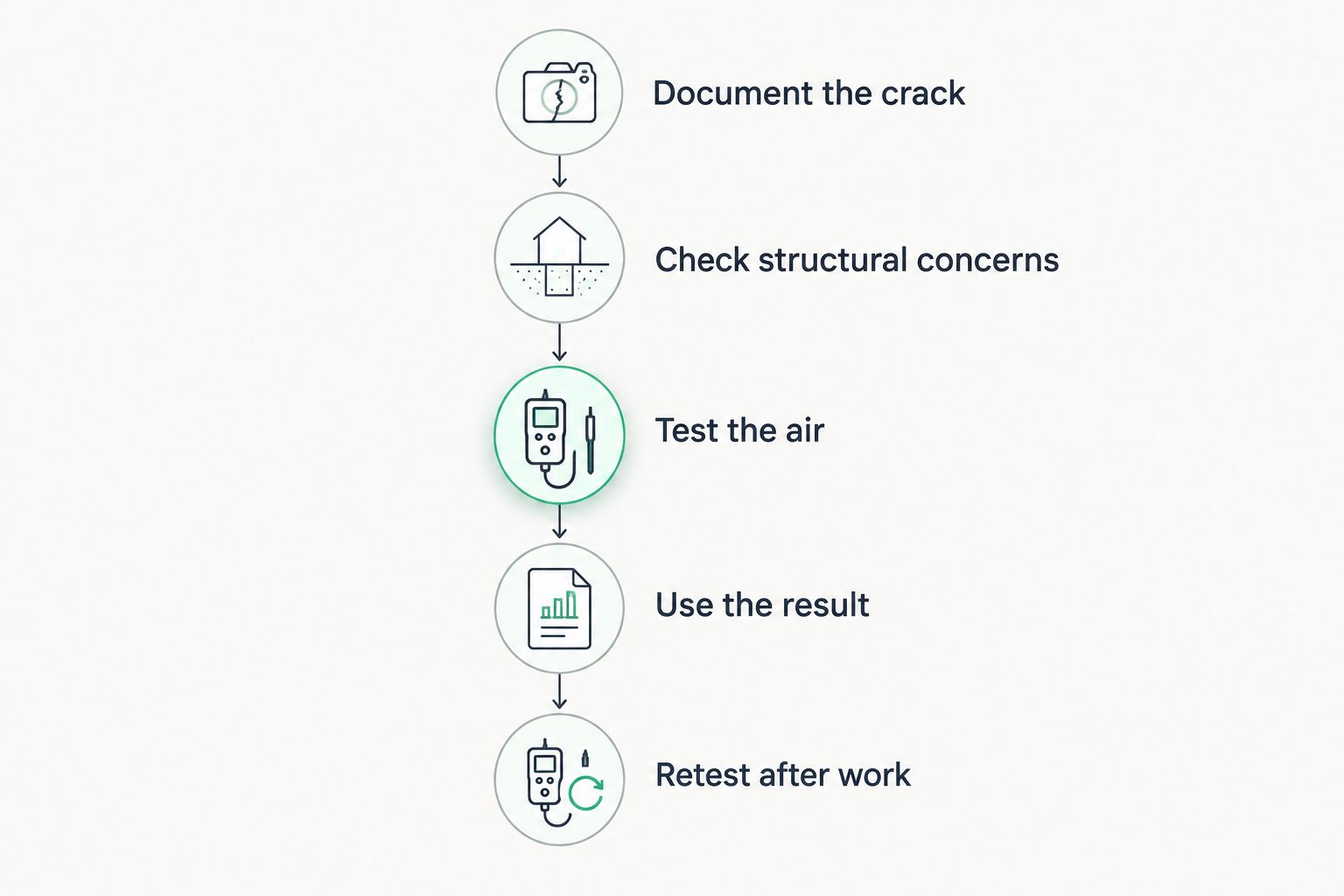
What should you do after finding a crack?
- Document the crack. Note its location, whether it leaks, and whether it appears to be changing. Keep photographs for the foundation professional.
- Check structural concerns. Get a qualified foundation professional to assess movement, bowing, displacement, or persistent water intrusion. Radon testing does not replace that assessment.
- Test the air. Follow the test device's instructions for placement, duration, and closed-house conditions. Do not put the device directly over the crack to try to measure the opening.
- Use the result. Follow the appropriate confirmation and mitigation steps for the reading. Ask the radon professional how foundation repairs affect the plan.
- Retest after the work. Confirm the indoor radon level after repairs or mitigation. A sealed crack is not a substitute for a measured result.
These are separate checks with a shared goal: address the foundation defect and verify the air. Fixing one does not automatically resolve the other.
Why this matters
It is natural to worry when you find a crack in the basement. Radon adds uncertainty because you cannot see or smell it. The answer is a test, not a guess.
The EPA identifies radon as a cause of lung cancer. Its A Citizen's Guide to Radon explains residential testing and action levels; its Consumer's Guide to Radon Reduction explains mitigation methods and the limits of sealing alone. Those residential guidelines are the basis for the recommendations in this 2026 guide.
Keep the two questions separate: Does the foundation need repair, and does the indoor air need radon reduction? A foundation assessment answers the first. A radon test answers the second.
Why radon entry through a cracked foundation varies
There is no dependable conversion from crack width to indoor radon concentration. The opening is only part of the route from soil to indoor air. These factors explain why similar-looking cracks do not produce identical readings:
- Radon in the soil. Naturally occurring uranium in soil and rock produces radon. An entry route does not tell you the amount available beneath the house.
- Air-pressure differences. Heating, airflow, and exhaust equipment affect pressure inside the home. Lower indoor pressure can draw soil gas through foundation openings.
- Connected openings. Cracks, construction joints, pipe penetrations, and sump openings can provide multiple routes. Sealing the most visible crack does not close every route.
- Foundation layout. Basements, slabs, crawl spaces, and mixed foundations have different soil-contact areas. A mitigation design needs to account for the actual layout.
- Weather and ventilation. Weather and the way you ventilate the house affect radon readings over time. A brief reading and a longer-term average answer different questions.
These factors explain the variation; they do not let you predict your home's number. In 2026, as with any testing decision, use measurements from your house rather than a neighbor's result.
Does a hairline crack matter as much as a large crack?
A hairline crack can provide an entry route for soil gas. A larger crack deserves attention, but crack size alone does not establish the radon level. Do not assume a small opening means a small exposure.
The visible surface also does not show the full connection beneath the concrete. A floor-wall joint or hidden penetration can matter even when the floor itself looks intact. Finished flooring can conceal openings without proving they are sealed.
For the foundation, signs of movement and water intrusion help a qualified professional assess the defect. For radon, the air-test result remains the deciding evidence. Ask each professional to address the question within their scope.
Will sealing the foundation crack lower radon?
Sealing closes a known opening and can support a radon-reduction system. However, the EPA does not recommend sealing alone as a radon-reduction method because it has not been shown to lower levels significantly or consistently. Openings can be hidden, and new gaps can develop.
Repair the crack when needed, but do not promise yourself a radon solution from the repair alone. The practical benefit is closing a route and improving the foundation condition. The limitation is that indoor radon depends on more than that route.
The guide to sealing foundation cracks to reduce radon levels explains the role of sealing. Coordinate the work with a radon professional if the home already has a system or a test shows elevated levels.
Which approach addresses which problem?
| Approach | Best for | What it addresses | Main limitation |
|---|---|---|---|
| Foundation crack sealing | Closing an identified opening | A visible soil-gas or water-entry route | Does not reliably control indoor radon by itself |
| Structural foundation repair | Cracks with movement or other structural concerns | The foundation defect identified by a qualified professional | Does not establish the home's radon level |
| Active soil depressurization | Radon reduction where foundation conditions suit the method | Uses a fan and piping to draw soil gas away before it enters | Needs a suitable design, operation, and follow-up testing |
| Radon testing | Deciding whether radon reduction is needed | Measures radon in indoor air | Measures the problem but does not repair or reduce it |
These approaches are not interchangeable. Testing identifies the air-quality issue; repairs address the defect; mitigation addresses radon entry. A home can need more than one.
What radon reading means you should act?
The EPA recommends fixing homes with radon levels at 4 pCi/L or higher. It also recommends considering reduction when levels are between 2 pCi/L and 4 pCi/L. The unit pCi/L means picocuries per liter of air.
The 4 pCi/L action level is not a boundary between harmless and harmful air. The EPA states that no radon level is known to be safe. Lowering exposure remains useful below that action level.
Use the EPA's residential testing decision process when reviewing a short-term result. A follow-up test helps determine the next step; the initial reading and the time available affect which follow-up is appropriate. A home sale can also require a transaction-specific testing protocol.
For your 2026 repair records, retain the complete report rather than just the final number. The test dates, location, device information, and recorded conditions help a professional interpret it. A number without context is less useful when comparing results after work.
How long should you test after discovering a foundation crack?
The EPA describes short-term radon tests as lasting 2 days to 90 days, depending on the device. Long-term tests last more than 90 days and provide a better indication of the year-round average. Follow the duration specified for your device; do not stop early because the display looks reassuring.
For a short-term test lasting less than 4 days, EPA guidance calls for closed-house conditions for at least 12 hours before testing and throughout the test. Keep windows and outside doors closed except for normal entry and exit. Follow the device instructions and applicable professional protocol.
Do not change ventilation mid-test to try to improve the reading. Avoid moving the device, covering it, or placing it where drafts interfere. Accurate testing is more useful than a temporarily lower number.
If structural work is urgent, do not delay necessary repairs merely to complete a baseline test. Tell the radon professional what changed and arrange appropriate testing afterward. Safety and valid measurement both matter.
Do you need a radon system if the crack is repaired?
You need a radon-reduction decision based on test results, not on whether the concrete now looks intact. If follow-up testing supports mitigation, repairing the visible crack does not remove that need. If the result does not support mitigation, keep the report and follow appropriate retesting guidance.
For many homes, active soil depressurization uses a fan to draw soil gas from beneath the foundation and discharge it outdoors. Sealing selected openings helps the system work. The design depends on how air moves beneath the home's particular foundation.
Michigan Radon Control is a local option for homeowners and realtors seeking NRPP-certified radon testing and mitigation in Metro Detroit and Lansing. Michigan Radon Control provides testing, system installation, and maintenance; structural foundation assessment is a separate need to arrange with a qualified foundation professional.
Ask Michigan Radon Control how the planned crack repair fits the radon mitigation design and what follow-up testing will verify the result. That keeps the conversation focused on your house rather than a standard answer for every cracked basement.
Arrange a radon test
Discuss testing, mitigation, or system maintenance for your Metro Detroit or Lansing home.
What if your home already has a radon mitigation system?
A new crack does not automatically mean the system has failed. It does give you a reason to review the foundation change and check the indoor radon level. A running fan alone cannot confirm the concentration in the house.
Leave the system operating as intended and tell the service professional about the new opening. Describe recent foundation repairs, waterproofing, or basement work. Do not turn the system off to investigate the crack yourself.
If you are comparing a 2026 result with an older report, check whether the test locations and conditions are comparable. Radon varies over time, so a changed reading does not prove the crack caused the difference. The service professional needs both the test evidence and the description of the work.
Michigan Radon Control offers radon system maintenance as well as testing. Use the measured level to check performance, and treat equipment checks as supporting evidence rather than a replacement for testing.
FAQ
Can a cracked foundation raise radon levels even if it does not leak water?
Yes, a foundation crack can admit radon-bearing soil gas without leaking water. A dry basement does not establish a low radon level; test the indoor air.
Does a hairline basement crack mean I have high radon?
No, a hairline crack does not prove high radon, but it can provide an entry route. A radon test measures the indoor concentration; crack width does not.
Will filling a basement floor crack fix high radon?
Filling a basement floor crack is not a reliable standalone fix for high radon. EPA guidance treats sealing as a supporting measure rather than a substitute for an appropriate mitigation system and follow-up testing.
What radon level means my home needs fixing?
4 pCi/L or higher is the EPA action level for fixing a home. The EPA also recommends considering reduction between 2 pCi/L and 4 pCi/L; follow its testing decision process when confirming a short-term result.
How long should a home radon test run?
2 days to 90 days is the EPA’s short-term test range, depending on the device. Long-term tests last more than 90 days and better represent the year-round average; follow your device’s instructions.
Should I test for radon before or after foundation repairs?
Test before repairs when practical, then retest afterward to check the indoor level. Do not delay urgent structural repairs solely to finish a radon test; coordinate the timing with qualified professionals.
Can a house with no visible foundation cracks have radon?
Yes, a house with no visible foundation cracks can have elevated radon. Soil gas can enter through joints, sump openings, pipe penetrations, and concealed gaps.
Does a running radon fan prove the air is safe?
No, a running radon fan does not prove the indoor radon level is low. Equipment checks show aspects of system operation; a radon test checks the air.
One last thing
The neatest-looking repair is not your proof that radon is controlled. The follow-up test is. Photograph the completed repair, keep the contractor's paperwork, and save the radon report with your home records.
If you are planning a basement remodel in 2026, resolve testing and foundation questions before covering the walls or floor. Accessible openings are easier to inspect and discuss. Finish the work with a measured result, not an assumption hidden behind new flooring.
Related guides
- How to prepare your basement for a radon test
- How to schedule radon testing after mitigation installation
- How to verify your radon mitigation system is still working