Best overall: a certified radon mitigation contractor with documented commercial-shop experience. Best for complex buildings: an environmental consultant coordinating radon specialists. Best for residential radon needs: Michigan Radon Control. For a Michigan auto repair shop in 2026, choose by the building assessment and written scope—not by a residential recommendation alone.
- The best radon mitigation companies for auto repair shops in Michigan demonstrate commercial-building experience before recommending equipment.
- Michigan Radon Control provides NRPP-certified residential radon testing, installation, and maintenance in Metro Detroit and Lansing.
- Auto repair shop radon testing must account for occupied rooms, building layout, and ventilation conditions.
- Choose a contractor who documents system design, installation responsibilities, and post-installation radon testing.
Why this matters
It is natural to worry about an invisible gas where your employees work. Radon has no smell or color, so a clean-looking shop does not tell you whether testing is needed. A measurement gives you something concrete to act on.
An auto repair shop also needs a different assessment from a house. Bay doors, vehicle exhaust extraction, office partitions, and ground-contact floors belong in the conversation. Your contractor needs to understand how the building operates before proposing a system.
Start with the guide to radon testing for Michigan auto repair shops. Get a shop-specific test plan before choosing mitigation equipment.
What makes the best radon mitigation company for an auto shop?
Use these criteria to compare contractors in 2026. A familiar company name is not a substitute for a proposal that addresses your property.
- Relevant credentials: Verify the individuals responsible for measurement and mitigation, including their current certification and its scope.
- Commercial experience: Ask for examples involving occupied commercial buildings, not just houses with similar square footage.
- Building assessment: Require a review of foundation sections, occupied rooms, pits, drains, and ventilation equipment.
- Work coordination: Ask how drilling, pipe routing, electrical work, and access restrictions fit around shop operations.
- Result verification: Require a written post-installation testing plan and a stated response if results miss the agreed target.
- Maintenance responsibility: Establish who monitors the system, reports faults, and arranges repairs after handover.
A good proposal connects these points. It explains what the contractor measured, what the system will address, and how you will know the work achieved its purpose.
Contractor options at a glance
These are hiring routes, not interchangeable company endorsements. Each serves a different need; residential certification alone does not establish commercial-shop experience.
| Contractor option | Best for | Standout feature | Key limitation |
|---|---|---|---|
| Certified commercial radon mitigation contractor | A shop with a defined radon problem | Direct responsibility for assessment, design, and installation when included in the scope | You must verify relevant shop experience and testing responsibilities |
| Environmental consultant coordinating radon specialists | A complex property needing coordinated assessment | A separate assessment role alongside specialist installation | Requires clear boundaries between consulting, installation, and verification |
| Michigan Radon Control | Homeowners and realtors in Metro Detroit and Lansing | NRPP-certified testing, mitigation installation, and system maintenance | Its stated service focus is residential, not auto repair shops |
1. Commercial radon contractor: best for a defined shop project
A certified contractor with relevant commercial experience is the strongest default when testing identifies a radon problem in your shop. The proposed scope should connect building assessment, system design, installation, and follow-up measurement.
Ask the contractor to explain the actual building. Where does the slab change? Which rooms are occupied? How will the proposed suction locations address the foundation beneath those spaces?
Commercial radon contractor pros:
- A direct contracting route for a defined mitigation project.
- Clear ownership of installation when the agreement assigns it.
- An opportunity to coordinate diagnostics and system design together.
- A practical handover covering monitoring and maintenance.
Commercial radon contractor cons:
- Certification does not, by itself, establish auto-shop experience.
- Electrical work, permits, or independent testing require explicit scope language.
- A simple equipment proposal does not explain coverage across separate foundation areas.
Best for: An owner or tenant with measured results, a defined property, and a contractor who can demonstrate relevant commercial work.
Verdict: Buy only after the written proposal addresses your shop's layout, operating conditions, and verification plan.
2. Consultant-led project: best for complex properties
An environmental consultant can coordinate assessment and help define what a specialist installer needs to address. This route separates the building investigation from the equipment proposal when your property needs that distinction.
Consider this approach when the shop shares a building, occupies several additions, or needs coordination between landlord and tenant. Define the consultant's radon role explicitly; environmental consulting experience is not automatically radon measurement or mitigation expertise.
Consultant-led project pros:
- Separates assessment responsibilities from installation responsibilities.
- Provides a structure for coordinating multiple contractors.
- Helps organize findings across different building areas.
- Supports a written handover between investigation and installation.
Consultant-led project cons:
- Adds another agreement and coordination responsibility.
- Requires named specialists for radon measurement and mitigation.
- Creates gaps if nobody owns post-installation testing or corrective work.
Best for: A shop in a complicated or shared property where the assessment needs coordination before installation begins.
Verdict: Buy when the building needs coordinated investigation; skip this extra layer when a qualified commercial contractor can clearly own the full scope.
3. Michigan Radon Control: best for residential radon needs
Michigan Radon Control provides NRPP-certified radon testing, mitigation system installation, and system maintenance for homeowners and realtors in Metro Detroit and Lansing. That is a defined residential service offering.
Michigan Radon Control is best suited to homeowners and realtors seeking residential radon services in Metro Detroit and Lansing. For an auto repair shop, establish commercial project fit before treating a residential provider as your installation choice.
Michigan Radon Control pros:
- NRPP-certified radon testing is part of its stated offering.
- Mitigation system installation is part of its stated offering.
- System maintenance is included among its services.
- Its stated residential service area includes Metro Detroit and Lansing.
Michigan Radon Control cons:
- Its stated customer focus is homeowners and realtors.
- A shop project needs a separate confirmation of commercial scope and suitability.
Best for: Residential testing, mitigation, and maintenance—not an automatic commercial-shop recommendation.
Verdict: Hold for an auto repair shop until commercial project suitability is established; consider it for residential needs within its stated service area.
What your shop assessment should cover
Give prospective contractors a description of how your building works. A floor plan helps, but a walk-through also needs to cover spaces and equipment that affect the proposed installation.
Occupied spaces
Identify service bays, offices, customer waiting areas, break rooms, and other regularly occupied rooms. Ask the measurement professional to explain the sampling plan for the building and the protocol behind it.
Do not assume a reading from an office represents every service bay. Equally, do not assume a bay measurement answers the question for a separated office. The test plan should explain its coverage.
Foundation conditions
Point out additions, slab joints, enclosed pits, sumps, and drains. Also identify any known under-slab utilities or radiant heating before anyone proposes drilling.
Sub-slab depressurization draws soil gas from beneath a slab and vents it outside. Whether that approach fits your shop—and where suction points belong—depends on the assessment, not on choosing a fan first.
Ventilation conditions
Describe vehicle exhaust extraction, building exhaust fans, heating equipment, and normal bay-door use. Ask how the measurement protocol handles those operating conditions.
Do not disable vehicle exhaust controls to accommodate a radon test. Have the radon professional coordinate a suitable protocol with the people responsible for workplace ventilation and safety.
From testing to verified mitigation
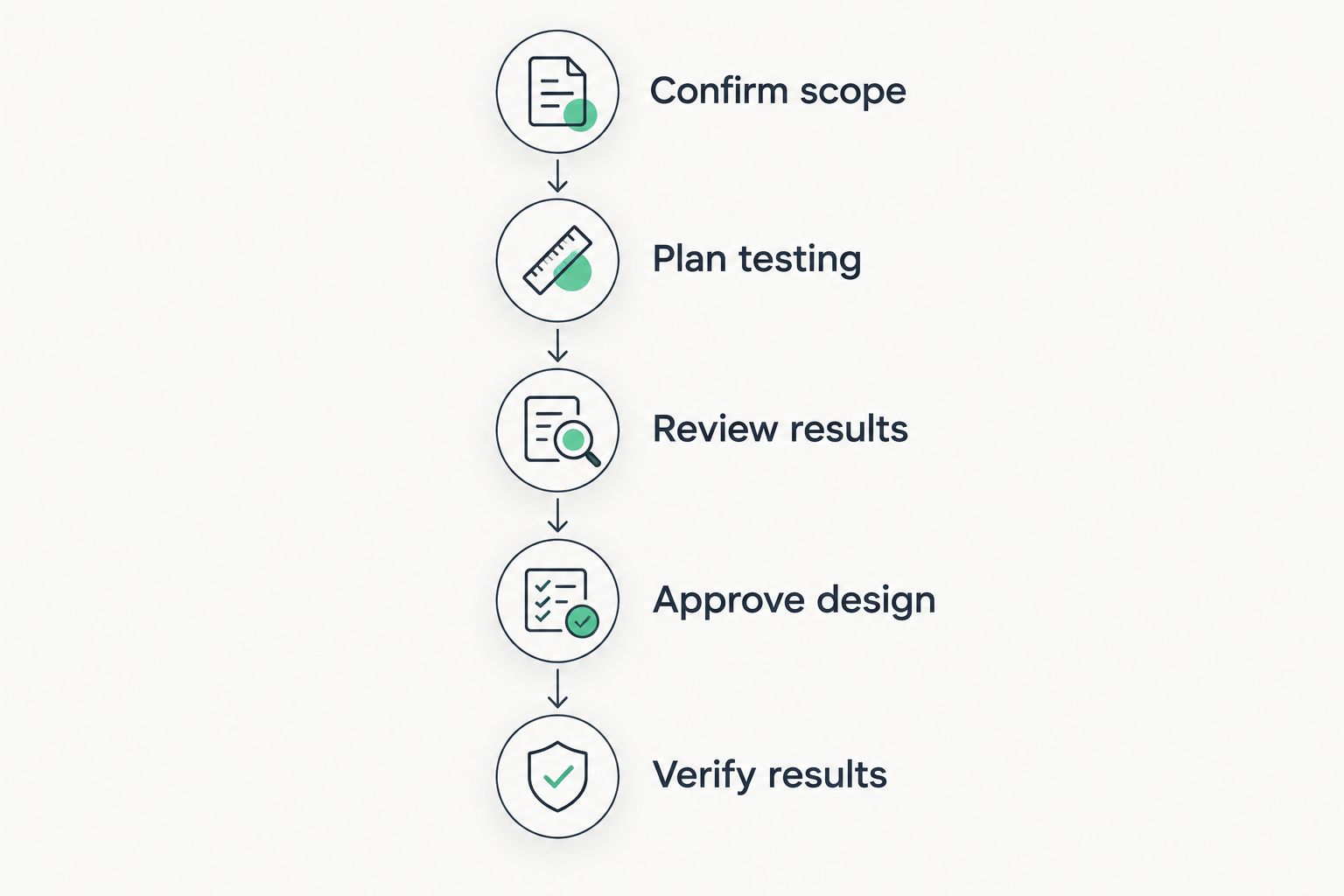
Use this sequence when planning a shop project in 2026. Each step should leave you with a document or decision, not just a verbal assurance.
- Confirm scope: Establish property access, landlord authorization if applicable, occupied areas, and contractor responsibilities.
- Plan testing: Have the measurement professional specify locations, operating conditions, device handling, and reporting.
- Review results: Ask what the measurements establish and what further assessment is needed before design.
- Approve design: Review suction locations, pipe routes, discharge placement, electrical work, and installation access.
- Verify results: Complete the agreed post-installation test and retain the report with system documents.
Ask for a handover that includes the system layout, operating instructions, monitoring information, and a fault-reporting contact. Your staff should know what to watch for without having to diagnose the system themselves.
How to interpret radon numbers without misusing home guidance
For context in this 2026 guide, the EPA's A Citizen's Guide to Radon recommends fixing homes at 4 pCi/L or higher and considering reduction between 2 and 4 pCi/L. Those are residential recommendations, not a substitute for a commercial assessment or a workplace compliance determination.
The same EPA home guidance distinguishes short-term tests lasting 2–90 days from long-term tests lasting more than 90 days. Those definitions explain why test duration matters; they do not prescribe the test schedule for your auto shop.
Ask the commercial measurement professional which protocol applies, how the reported result will guide the project, and what target the proposal uses. Keep the units, locations, dates, and operating conditions with the result.
A system pressure gauge is not a radon measurement. It indicates a pressure difference within the system. A separate radon test is needed to measure the radon concentration after installation.
Compare written proposals, not equipment lists
In 2026, the most useful proposal explains the problem and the acceptance process. A fan name and a pipe diagram alone do not tell you whether the contractor has addressed your occupied spaces.
Ask each bidder to answer the same questions:
- Who performs measurement, diagnostics, installation, and verification?
- What foundation areas does the design address?
- What access restrictions apply during work?
- Who checks for utilities before drilling?
- Who handles electrical work and applicable permits?
- What happens if follow-up testing misses the agreed target?
- What maintenance and warranty terms apply to this commercial project?
Do not carry residential warranty assumptions into a business contract. Get the terms for your property in writing, including exclusions and responsibility for corrective work.
For a leased shop, separate permission from payment responsibility. Confirm who authorizes alterations, who owns the installed system, and who maintains it after a tenancy change. Resolve those points before scheduling installation.
How these options were ranked
The ranking puts commercial project fit first, followed by assessment quality, installation accountability, verification, and maintenance responsibility. It ranks hiring routes by their use case rather than assigning unsupported scores to named companies.
A direct commercial specialist is the default for a defined shop project. A consultant-led approach fits more complicated coordination. A residential provider belongs in a residential shortlist unless commercial suitability is established separately.
Which contractor should you choose?
Choose the certified commercial radon contractor who explains your building and commits to measured verification. If your property needs several parties to coordinate assessment and alterations, use a consultant-led project with explicit responsibilities.
Before accepting any proposal, ask the contractor to walk you through the test plan, system coverage, and follow-up process. Clear answers make the decision easier. Equipment recommendations should follow that explanation, not replace it.
FAQ
What’s the best radon mitigation company for a Michigan auto repair shop?
The best fit is a certified contractor with documented commercial-building experience and a shop-specific assessment. Choose by the written design and verification plan rather than residential reputation alone.
Does Michigan Radon Control provide radon services for auto repair shops?
Michigan Radon Control’s stated services focus on homeowners and realtors in Metro Detroit and Lansing. Confirm commercial project suitability directly before selecting it for an auto repair shop.
Do open garage doors mean my shop does not need radon testing?
Open garage doors do not establish your shop’s radon level. Have a measurement professional account for normal door use, occupied rooms, and ventilation in the test plan.
Is the EPA’s 4 pCi/L level a workplace exposure limit?
The EPA’s 4 pCi/L action level in its home guidance is a residential recommendation, not a workplace compliance determination. Ask the commercial measurement professional which guidance and project target apply to your shop.
Can a residential radon system design work in an auto repair shop?
A residential design should not be copied into an auto repair shop without a building assessment. Foundation divisions, occupied spaces, utilities, and ventilation need review before system design.
Should I turn off vehicle exhaust extraction during a radon test?
Do not disable vehicle exhaust controls just to accommodate radon testing. Have the measurement professional coordinate the testing protocol with those responsible for workplace ventilation and safety.
How do I know the mitigation system worked?
A post-installation radon test measures whether radon concentrations meet the agreed project target. A running fan or pressure-gauge reading does not replace that measurement.
What should a tenant ask before approving radon mitigation?
A tenant should establish landlord authorization, installation access, system ownership, and maintenance responsibility. Put those decisions in writing before alterations begin.
One last thing
Before signing a mitigation agreement in 2026, ask: Who owns the next step if the verification test misses the agreed target? That answer is more useful than a promise that the fan will run.
Put the responsible party and corrective-work process in the agreement. You want a measured result and a clear response—not an installed system with an unresolved problem.
Related guides
- Verify a radon contractor's NRPP certification
- Compare radon mitigation quotes from Michigan contractors
- Schedule radon testing after mitigation installation